Main

May 23, 2006

The return of fear to world stock markets


>Published: May 20 2006 03:00 | Last updated: May 20 2006 03:00
>>

Like a sudden storm on a clear day, the tempest that swept through the world's stock markets over the course of the past 10 days caught many investors by surprise. That storm abated yesterday but left the markets battered in its wake. Since peaking in late April/early May the FTSE 100 index has fallen 7.5 per cent, the S&P 500 4.6 per cent, the Eurotop 7.1 per cent and the Nikkei 225 8 per cent. During the three-year-long bull market that began in March 2003, there have been other corrections, all of which were short-lived. But this one may turn out to be more significant.

Even after the recent declines, world stock markets remain far above their 2003 lows. The FTSE 100 index is up 73 per cent, the S&P 500 58 per cent, the Eurotop 91 per cent and the Nikkei 112 per cent. It is too soon to say the bull market is over. However, the latest sell-off reflects changes in global conditions that will make further equity gains much more challenging.

One dramatic change is the increase in volatility. The Chicago Board Options Exchange VIX index, which measures market expectations of volatility, jumped from 11.83 on May 1 to a year-high of 17.31 in trading yesterday. While volatility is important in its own right, this jump reflects deeperconcerns.

The market is gripped by two scares: an inflation scare and a dollar scare. One of the most widely used measures of US inflation expectations, the spread between nominal and inflation-protected government bonds, has risen from 2.34 per cent on January 1 to 2.66 per cent yesterday. Rightly or wrongly, the credibility of the Federal Reserve under its new chairman, Ben Bernanke, is being openly questioned.

Meanwhile, equity investors have taken fright at the fall in the dollar since early April. The dollar recovered some ground this week, on expectations that inflation concerns would force the Fed to raise US interest rates further. But it remains down 3 per cent on a trade-weighted basis since April 1.

Of the two scares, investors should worry less about US inflation and more about the dollar (though the two are obviously related). All new Fed chairmen are tested by the markets. Mr Bernanke is no inflation dove, core inflation on the Fed's preferred measure is still only 2 per cent and the US economy is slowing towards trend.

The dollar is a bigger concern. While a steady and broad-based decline of the kind seen in late April/early May is both necessary and desirable, it could give way to a dollar rout and higher US interest rates. Much depends on Asian central banks, whose intervention to support fixed exchange rates frustrated a decline in the dollar in the post-dotcom bubble period, and their counterparts in oil exporting countries.

In valuation terms, the case for equities also looks weaker than it did a year ago. The rise in long term interest rates (from 4.4 per cent at the start of the year to 5.2 per cent in the US) means shares no longer look as cheap as they did relative to bonds. The yen "carry trade" (borrowing in yen at low interest rates and investing in higher yielding assets), which helped boost all risky assets, is fading away as Japan's economy revives.

If there is no cause for panic, then, there is cause for caution. Investors should expect more volatility ahead. With risk premia still very low by historic standards, there is little scope for outperformance by high-risk assets. If either the inflation scare or the dollar scare prove correct, shares could have a long way further to fall.

May 22, 2006

More on the relative abundance of Gold and Silver


David Zurbuchen submits:

Silver is rarer than gold. Period. There is less silver in the world, above ground than there is gold. That is easy to document. Since I have been harping on this point, no one has been able to refute it.


Even though there are five ounces of gold in the world now for every one ounce of silver, this 5 to 1 ratio will expand as newly mined gold is added to above ground supplies… This should get your juices flowing. It should drive you to buy silver… Silver is more rare than gold, and rarer still is someone who knows this fact. You should act accordingly.

-Ted Butler

Where has Ted Butler so easily documented his claim that silver is more rare than gold? I don’t recall ever reading his proof text. If one does happen to exist, I would appreciate someone sending it to me.

As far as I know, Ted Butler is dead wrong in all of his above pronouncements. It was comments like those above that mislead me into writing my first ever Gold-Eagle essay entitled “Silver: A Rare Opportunity”, an essay which emphasized the very ‘facts’ that I’m now attempting to refute.

Now, I realize I’ll probably be making some enemies by calling Ted Butler a liar, but I believe this is an important issue to come to terms with. If our investment decisions are founded upon fictions, then we are prone to failure. That being said, I do truly enjoy Ted’s writings, after all, he was one of the few writers who really piqued my interest in silver over the years. But nevertheless, I don’t want the average person to be misled by the above claims he has frequently made.

So here are my opposing claims:

1.Silver is not rarer than Gold.

2.The gold to silver rarity ratio is about 1 to 5, not 5 to 1.

3.Finally, there is nothing factual about the statement that silver is rarer than gold, UNLESS you qualify it with the condition that you are only referring to market accessible silver in the form of bullion.

But this is an unfair comparison, because you are including all gold in jewelry form while excluding all silver in jewelry, sterlingware, and privately held bullion/coin forms. Granted, the market price of silver will need to rise a greater percentage than the market price of gold before either its jewelry, silverware, or privately hoarded coin forms become available to the market in large quantities, but the fact still remains that this form of silver is available at some price*.

(We’ll deal more with this ‘price’ in an upcoming essay. For now one would be advised to read “Hidden Silver About to Surface?” But a word of caution, at this time I believe Gene Arensberg’s estimate of how much silver is held in private hoards, if only dealing with silver in coin and bullion form, is too high.)

The Real Silver Deficit

Let us begin by reading a very telling quote from pg. 1046 of the 1954 Minerals Yearbook:

According to the Bureau of the Mint, the world output of silver from 1493 through 1954 was 20,039,4621 troy ounces, valued at $17,278,499,800. Of this total yield, North America produced 62 percent and South America 20 percent. Mexico contributed 35 percent of the total, the United States , Bolivia 9, Peru 9, and Canada 4. It has been estimated that about one-third of the total world production of silver is in circulation as coinage or held by governments for monetary purposes; one-third, including that hoarded, is privately owned; and one-third has been misplaced or dissipated.

Since silver mine production from 3000BC to-1492AD was equal to about 7.6B ounces (Part 1), we must add to this the 20.0B ounces mined from 1492-1954 to arrive at a total of 27.6B ounces of worldwide silver production from 3000BC to 1954AD.

If only two-thirds of those 27.6B ounces remained, then in 1954 there were roughly 18.4B ounces of silver in existence, mostly in the form of coinage, government bullion, private bullion, jewelry, and silverware/sterlingware.

From the following information we can begin to determine the world’s silver supply/demand deficit for the period 1955-2005:

- Worldwide mine production from 1955-2005 was about 19.5B ounces.
- Free-World industrial demand (I.D.) from 1955-2005 was 19.4B ounces.
- I.D. from transitional economies from 1955-2005 is estimated at 3.7B ounces.

(Transitional Economies supplied roughly 16% of the mine supply during this period, so I will also assume that they contributed 16% of the overall industrial demand.)

- I.D from ‘other countries’ from 1977-2005 is estimated at 0.378B ounces.

(Assumes that of the total industrial and arts demand of 630.2M ounces, 60% was used in industrial applications. Data for the period 1955-1976 is missing, but this is relatively insignificant.)

From the above, we discover that the aggregate world demand for the period 1955-2005 was 23.48B ounces (19.4B + 3.7B + .378B = 23.48B ounces)/

If we subtract this number from the cumulative mine supply during this same period (19.5B ounces), we are left with a massive deficit of 3.98B ounces.

(Interestingly enough, in 1941 the total world monetary stocks of silver were about 4.5B ounces (see: Minerals Yearbook 1941 pp. 55-56). When considering that the above deficit of 3.98B ounces does not account for the period of 1942-1954, it becomes crystal clear that there is very little cheap silver remaining.)

But we have yet to factor in old scrap supply, which CPM Group, in their 2003 Silver Survey, defines as:

Scrapped fabricated objects, old coins, old jewelry, decorative objects, household objects, a host of industrial waste, spent ethylene oxide catalysts, old electronic scrap, old sterlingware, old silverware and finally, photographic chemicals, films, and papers [emphasis mine].

Since the vast majority of old scrap supply has come from spent photographic materials (est. 80% in 2000) and catalysts (est. 10% in 2000) [see: http://pubs.usgs.gov/circ/c1196n/], we will assume that 90% of the old scrap that comes to market had its origin in industry as opposed to the arts (i.e. jewelry, sterlingware, decorative objects, etc.). We will then subtract this additional supply from the deficit to arrive at an accurate estimate of how much silver remains.

- Estimated scrap supply from 1955-2005 was 5.45B ounces though due to a deficiency of old scrap supply data for the years 1955-1959, some approximations had to be made based upon known ratios of industrial demand vs. old scrap supply in the neighboring years.

Since we are assuming that 90% of the old scrap came from industrial sources we have:

(-3.98B ounce deficit) + (5.45B ounce scrap supply x 0.90) = 1.47B ounce surplus for the period 1955-2005.

One other factor to consider is a loss of silver content in coinage due to abrasion. For the years 1955-2005, coinage demand was 2.73B ounces. Since the vast majority of this demand was realized between 1955 and 1970 (1.83B ounces worth), I will assume that the loss due to abrasion was 15% of the total in the ensuing 35 years.

- 1.83B x 0.15 = 0.27B ounces lost to abrasion of the coinage.

I’m confident this estimate is conservative for the following reasons:

1. Obviously these newly minted coins were not the only coins in existence during this period, and if we were to include all the coinage that was undergoing abrasion, the above 15% figure would shrink relative to the context of what it described (e.g. 15% loss due to abrasion of 1B ounces worth of coinage is only 7.5% loss due to abrasion of 2B ounces worth of coinage).

2. Large amounts of coins were melted down in the late 1970s, contributing considerably to the surge in old scrap supply during those years. Therefore, my previous assumption that 90% of old scrap had its origin in industrial recycling is probably over-estimated by at least 10-30% during the period 1975-1981, since all of those coins that were melted down would have in effect undergone a 100% loss due to abrasion while simultaneously contributing to the overall old scrap supply.

3. I’m assuming that the other 900M ounces of silver coinage minted between 1971 and 2005 underwent no abrasion at all.

For reasons that I will expound upon in a future essay dealing with the topic of abrasion prior to the 20th century, I feel that the above estimate of silver lost to abrasion should be several orders of magnitude higher. But for the sake of conservatism, I will work with the above number of 0.27B ounces.

•1.47B ounce surplus - 0.27B ounces lost due to abrasion = 1.2B ounce surplus for the years 1955-2005.

Thus, at year-end 1954 we begin with 18.4B ounces of silver existing in all forms, and through the period 1955-2005 which witnessed the rise of the electronic age, it appears we only increased the overall supply of silver by 1.2B ounces, even though we mined almost 20B ounces from the ground! This leaves us with a total of just 19.6B ounces of silver left in existence!

Now, there will likely be some misgivings about the weight I have attributed to the statement from the 1954 Minerals Yearbook, which said, “one-third [of total silver production] has been misplaced or dissipated.”

One might well wonder what exactly is meant by ‘misplaced’?

In order to error towards overstating the amount of silver that remains, so as to avoid as much skepticism as possible, let us assume that 20% of the misplaced silver referred to in the Minerals Yearbook dated 1954 has since been found. This would then leave us with 7.36B ounces of ‘lost’ silver during the period 3000BC-1954AD, instead of the previously stated 9.2 billion ounce loss. All in all, this has the effect of raising the amount of silver left in existence by 1.84B ounces. Thus, our conservative total now stands at 19.6B+1.84B = 21.44B ounces.

Now to compare our findings with those of the CRA Report published in 1992.

From the CRA Report
(Year-end 1991)

CRA estimates that from 1921 through 1990, 10 billion ounces were irrecoverably lost in North America alone, and 12.6 billion ounces for the entire world.

Note: The above estimate is fairly close to the one made in the 1954 Minerals Yearbook.

Before evaluating the CRA Report’s findings, let’s make use of the above statement to make one more estimate of how much silver remains.

1. According to my data, the world produced a total of 45.38B ounces of silver from 3000BC-2005AD.

45.38B -12.6B (silver “irrecoverably lost in North America”) = 32.78B ounces of silver left in existence when accounting for silver lost during the period 1921-1990.

2. From 3000BC to 1920 the world produced about 22.17B ounces, and of this total I estimate that 25% was lost to abrasion (vast majority), shipwreck, or even buried as treasure (including silver buried in tombs).

32.78B – (22.17B x 0.25) = 27.24B ounces of silver left in existence when accounting for silver lost during the period 3000BC –1990AD.

3. From 1991-2005, the world’s industrial demand for silver was 8.63B ounces.
During this same period the world supplied only 2.5B ounces of old scrap.
Assuming that 90% of the old scrap had its origin in recycled industrial materials as before, we are left with:

27.24B ounces – (8.63B – (2.5B x 0.90)) = 20.86B ounces of silver left in existence when accounting for all the silver lost from 3000BC – 2005AD.

This number varies by less than 3% of our previous 21.44B ounce estimate.

Back to the CRA Report and what it had to say about how much silver remained in 1992:

- Total Silver that remains above-ground (all forms): 19.06 billion ounces
- Total Silver contained in silverware and art forms: 16.48 billion ounces
- Total Silver contained in bullion form: 1.40 billion ounces
- Total Silver contained in coin and medallion form: 1.18 billion ounces

Updating the CRA Numbers

During the period 1992-1994: World mine production of silver totaled 1.373 billion ounces (Minerals Yearbooks).

During the period 1995-2004: World mine production of silver totaled 5.639 billion ounces (The Silver Institute).

During 2005 (Partial): World mine production of silver in 2005 totaled 527.3 million ounces (CPM Group – Silver Survey 2005).

Total World Mine Production from 1992 to 2005 = 7.54 billion ounces

Combining this number with the CRA Report’s estimated total above-ground supply of 19.06 billion ounces, we arrive at 26.6 billion ounces of silver remaining above ground.

Since 1992, the world has used nearly 8.1B ounces of silver industrially, but has only returned 2.4B ounces as old scrap. Assuming that 90% of the old scrap had its origin in recycled industrial materials, this leaves us with a total of just 20.66B ounces [26.6 – (8.1B – (2.4 x 0.90)] remaining above ground.

This number is strikingly similar to our 2 other separate findings of 21.44B ounces and 20.86B ounces.

By taking the average of all three, we arrive at 20.99B ounces of silver remaining in the world in all forms (mostly jewelry and silverware).

But in order to temper our enthusiasm in discovering what would actually be a relative rarity ratio between gold and silver of less than 1 to 5 based upon the above numbers, let us further assume that a maximum of 4 billion ounces of silver could be recycled from existing industrial (not including jewelry or sterlingware) materials if the price were right (say $50-$100/ounce). Including this additional potential supply, 24.99B ounces of silver would remain in all forms.

Here then is our new gold to silver ratio based solely upon relative rarity, buffered for the sake of being conservative with that extra 4 billion ounces. Again, I hope the inclusion of this additional 4 billion ounces will be a more than sufficient compromise to account for my inevitable bias towards silver.

The new gold to silver ratio is 24.99 billion ounces Ag/ 4.25 billion ounces Au (see Part 1)/ = 1 to 5.88 (Gold vs. Silver)

This means that based solely upon relative abundance, silver should be trading at about $110.50/ounce (using a gold price of $650.0).

Patience, it seems, is destined to pay some incredible dividends.

Conclusion

Clearly, silver is not more rare than gold, but a 1 to 5.78 rarity ratio is indicative of the incredible leverage to be found in all silver related investments since the current ratio stands at roughly 1 to 54. Will it ever reach the ‘magical’ 1 to 5 ratio insisted upon by Bunker Hunt over 30 years ago? That remains to be seen. But at least now we know for certain that such an idea isn’t nearly as far-fetched as it might have otherwise seemed.

Sources, Updates, and Validation

Sources for calculations in this article:

1. CPM Group’s Silver Survey 2003 & 2005 (www.cpmgroup.com)
2. US Geological Survey (USGS)
3. http://minerals.usgs.gov/ds/2005/140/
4. http://pubs.usgs.gov/of/2004/1251/2004-1251.pdf
5. http://minerals.usgs.gov/minerals/pubs/commodity/silver/
6. Minerals Yearbooks 1932-2004
7. The Silver Institute (www.silverinstitute.org)
8. Stocks of Silver Around the World (Charles River Associates, 1992)

Further Validation of the 60+ Year Structural Silver Deficit

Since 1946 the industrialized nations [i.e. the free-world] of the world have consumed more silver than they have mined, to meet growing demand…

-Sarnoff, Paul. Silver Bulls: The Great Silver Boom and Bust. Connecticut: Arlington House Publishers, 1980 (p.3).

A New Data Point for “The World’s Cumulative Silver Production”

Total Silver mined from 4000 B.C. through 1991: 37.5 billion ounces.

Source: Blanchard, James. Silver Bonanza: How to Profit from the Coming Bull Market in Silver. New York: Simon and Schuster, 1993.

Since mine production from 1992 to 2004 was about 7.0 billion ounces (Part 1), the new total is 37.5 billion ounces + 7.0 billion ounces = 44.5 billion ounces

Previously, the average cumulative silver production based upon 5 sources was 45.55 billion ounces.

With this additional data point, the world’s cumulative silver production is now the even more certain figure of 45.38 billion ounces.

This post is part of a multiple essay series

May 21, 2006

Stagflationary Recession underway in US

The 2005 to 2007 inflationary recession has moved well beyond stagflation. Circumstances deteriorated markedly in the last month, and market perceptions of same have begun to surface, as exhibited by strong gold and a weak dollar. Moreover, the trouble is not confined to a weak economy and higher inflation. It also includes a foundering administration and increasing odds of a shift of power coming out of November's election.

"Signs that the economy is not doing too well abound. Housing starts appear ready to signal recession, and the housing sector has been one of very few bright spots in economic activity over the last six years or so. Aside from politically-gimmicked GDP reporting, most numbers, net of inflation, have been soft to down over the last month, including retail sales, purchasing managers new orders, help wanted advertising, narrow money growth, real earnings, consumer sentiment and even the employment report. Exceptions have included strong industrial production, volatile new orders for durable goods and an improved but still staggering trade deficit.

"Although purposely suppressed in the 'official' data (PPI and CPI), there is an inflation problem. It is driven by oil, and increasingly, it also is being driven by dollar woes. These are factors separate from strong economic activity that commonly is viewed as the source of inflation.

"In like manner, Fed tightening -- designed in theory to slow the economy in order to slow inflation -- will do little to cool the current problem, shy of Volckerish rate hikes aimed at triggering such a severe downturn that prices are pulled down along with business activity into a depression. Quite to the contrary, current Fed activity has been the reverse of the jawboned inflation fighting, aimed at stimulating liquidity, not killing it. While short-term interest rates have been increased, broad money growth also has been soaring, at least prior to its reporting cut-off. Excessive money growth tends to be an inflation stimulant, not a retardant.

"In general, the broad economic outlook has not changed. The 2005 to 2007 inflationary recession continues to deepen. Recession, inflation and risks of heavy dollar selling are upon us, gaining greater market credence, and they continue to offer a nightmarish environment for somewhat less Pollyannaish financial markets than were in place last month.

"The Shadow Government Statistics' Early Warning System (EWS) was activated in May 2005 and signaled the onset of a formal recession in July 2005. The EWS looks at historical growth patterns of key leading economic indicators in advance of major economic booms and busts and sets growth trigger points that generate warnings of major upturns or downturns when predetermined growth limits are breached. Since the beginning of 2005 a number of key indicators have been nearing or at their fail-safe points, with four indicators moving beyond those levels, signaling a recession. Once beyond their fail-safe points, these indicators have never sent out false alarms, either for an economic boom or bust. Housing starts appears ready to generate such a signal in the next month or so.

"With a resumed economic boom massaged into first-quarter GDP reporting, negative GDP growth is not likely to surface in regular government reporting until after the November 2006 election, given the rampant political manipulation of most key numbers. The National Bureau of Economic Research (NBER) should time the downturn to mid-2005 and announce same also sometime after the election, so as not to be deemed politically motivated in its timing.

"Whether or not there is a recession will be a hot topic in the popular financial media, with politics helping to fuel the debate as the election nears. Those Wall Street economists who act as shills for the market will keep up their 'strong growth is just around the corner' hype regardless of any and all evidence to the contrary."

May 20, 2006

Unusual wave of derivatives activity...

May 19 – Financial Times (Gillian Tett ):  “The recent sharp falls in stock markets appear to have been exacerbated by an unusual wave of derivatives activity on the part of hedge funds and big banks, traders yesterday indicated. In particular, some banks and big investors appear to have been forced into selling large amounts of equity futures because they have been acting as counter-parties to large, leveraged bets on the direction of stock market volatility in recent months - and these bets are now unravelling because volatility has increased sharply.  This forced selling has hurt equity futures index prices on markets such as the London International Futures Exchange - and depressed the value of cash equities as well, some observers suggest.  ‘This is an incredibly sensitive topic but it looks as if some big investors are being forced into big moves because they need to hedge these [derivatives] positions,’ one senior trader said yesterday.  It is impossible to track this type of derivatives trading with accuracy, since the investors and banks engaged in these markets are extremely anxious to keep their positions private.”

May 18, 2006

Longer Bull Run = Bigger bubble: Marc Faber


Moneycontrol.com | May 10, 2006


Born in Zurich, Switzerland Mark Faber got his PhD in Economics by age 25. He has worked in all the major money centres of the world from New York to Hong Kong. CNBC-TV18 caught up with investing guru Marc Faber. Excerpts from an interview:

When you were growing up, you were a surgeon's son -- what propelled you to study economics?

Actually at that time I was skiing for the Swiss national team and I did not really know what to study, but I knew that Economics was a relatively easy thing to do. It took only four years.

What did they teach you - what was the world like in the 1960's - and how has your worldview changed through the lenses as an economist?

I think in the 1960s the world had far fewer opportunities; we still had the cold war, the Vietnam War was on and as an investor one couldn't invest in countries like China or India or Taiwan or Indonesia. So the world was much more limited in terms of investment opportunities and even the total credit take -- 3:32 was much lower as a per cent of the economy than it is today.

In other words, that time people had relatively high incomes but the asset values were relatively low. Today in real terms, in the western world, people have relatively low incomes and asset values are high measured by the Dow Jones or by housing prices.

How was the first impact of Asia on you? Being a disciplined Swiss -- was it chaotic, disorganised?

No, not really. I arrived in Hong Kong in the 1970 and Hong Kong Chinese were very hardworking but of course what strikes me today is, how poor Asia was in 1973; if one went to Taiwan, Korea or Singapore, these were very poor societies and if one looks back at the last 30 years -- the progress that has been achieved is just mind boggling.

All I can say is that history is accelerating in terms of speed of change. If one looks at how Bangalore has developed in the last 10 years or how Shanghai has developed in 10-20 years time, there will be changes in the world and in Asia that nobody can really comprehend today.

At that time steel and shipyards were the talk of Asia?

Yes, shipping was a big thing in the 70s. Everybody was building steel plants and cement but in the 1970s, very few people were interested in investing in Asia. Some American institutions had few investments in Japanese stocks (like the Templetons of the world) but aside form British institutions that bought some shares in Malaysia, Hong Kong and Singapore, there were practically no funds of flows out of America and Europe into Asia.

All the flow that time was from Asia into US stocks and also into gold, silver and other precious metals. Then in the late '80s the flow began into Asia from the western world.

There are great myths built about the market and you spent the better part of your life adding to the truths and destroying the myths - one of the great myths is that stock market always goes up in the long run?

That is very difficult to tell. One could argue that in the long run most things will appreciate in value, but the problem is that most companies live only 30 years and then they die. In other words, they go bankrupt.

So when people talk about stocks going up in the long run, one would have to constantly re-balance one's portfolio. One could also argue that stocks go up sometimes but they fall as a result of inflation adjusted or in other words against another currency or gold.

In the long run, it is also said that it is never different -- there is a myth that every bull market will say it is different this time -- is it right?

I think in every asset mania what then happens is that if asset price or a stock or real estate have gone up for a long time, one will find university professors who write books and say why real estate goes up or why stocks always appreciate and so on. The fact is simply that, markets move up and down and that will never change.

The myth that a bull market contains the seed of destruction to the next bear market.

I suppose the longer a bull market lasts, the more likely it is that it will end in a colossal bubble because if you consider that there are in this room several asset classes: real estate, stocks, bonds, commodities, etc.

And say stocks always go up more than commodities, then obviously all the money will move into stocks because they will outperform other assets and so once all the money moves into stocks, then obviously you will end with the whole room only owning stocks and thus the bubble.

And frightfully expensive P/E ratios?

Yes exactly, but the beauty of the bubble is because it attracts so much money, it will leave other asset prices depressed compared to the bubble sector. So if one looks at the 2000 bubble, we had the bubble in the TMT sector but we did not have a bubble in the steel stocks or commodity related shares such as oil companies and that is where the value was at that time.

So the great truth is that every crisis creates an opportunity?

Yes, that is for sure, but not necessarily where the crisis occurs. Every bubble also creates an opportunity because rise in one sector creates an undervaluation somewhere else. Since the year 2002 and since Mr Alan Greenspan embarked on this highly expansionary monetary policy; all asset prices have gone up, bond prices have rallied, commodity prices are up, stock prices are up and real estate is up and this is across the world.

Today it is difficult to find something that is distressed; I think there is only relative value at the present time.

You say in your books -- "don't listen to analysts; listen to markets" -- could you explain that?

I think analysts are frequently not very objective because they work for large investment banks and have a vested interest. It is very seldom in life to find someone who is in real estate who is negative about real estate or an art dealer who will tell you art prices will go down or a stock broker who will tell you stocks will go down.

I am sceptical about analysts that specialise in one sector because they have vested interest that that sector remains popular and actually attracts a lot of money. It is the same as a fund manager -- he cannot turn and tell his investor I don't think you should invest in India if he is an Indian fund because if his investors leave his fund, then he has no business left.

So these types of people with self-interest have a tendency, whether they are at heart optimistic or not, but at least to tell the public that they are optimistic.

You wrote a paper on life cycle of emerging markets. How relevant is that today and over the years what has been your experience of how the emerging markets behave?

I think all markets go through stages whether they are in a phase Zero which would be defined as a phase, where there is really no interest whatsoever in that asset class. It could be Latin American shares in the late 1980s after Latin America had gone through very high inflation rates, or it could have been Japanese shares, recently in 2003 after 14 years of bear market, there was very little interest in Japanese shares.

In India, we had several cycles and until three years ago, foreign investors have shown very little interest in Indian shares. Then there is usually a catalyst, which leads to some improvement in the economic conditions and financial conditions of that country, and then you have a bull market, which usually ends in a bubble.

Nobody knows whether in India, the bull market is ending now with this new high, or whether we will go to 15,000.

How would you judge the top?

I would say that frequently it is easier to identify a major low. When lows occur, you have very often have a lengthy base-building period during which a commodity, or a stock trades sideways for many years, and then there is a breakout on the upside.

With the market tops, a bubble is a bubble and you hardly know at what point it will break. If you take Nasdaq, it could have been broken at 4000 a year earlier, or at 5000 in March 2000, or at 7000, who knows, it was exaggerated any way. To identify tops is easier once the top has already occurred, than ahead of time.

A lot of people say that you get the trend right, but the timing wrong. Is it important to get both of them right?

I don't think I always have been pessimistic. I have been involved in fund management as a chairman of a variety of funds. I have written a lot about emerging markets and promoted emerging markets over the last 25 years.

Concerning the timing, I am the first one to admit that to press a button and say this is the low and press it again and say this is the peak, is very difficult. I am not sure if anyone has successfully managed to do that. I always look at what is the risk and what is the reward of an investment.

If you can find an asset class or stock market that is inexpensive I am prepared to wait until it moves. People criticized me in 1999, when I said buy gold now because it has gone down for 20 years, it may be an opportunity to buy it and it started to move in 2001. For two years you are sitting without any reward but then it went up significantly since then.

How important is it to understand the role of the Federal Reserve to understand the world economy?

I think it is very important to understand the fact that we have a central banking system where the central banks can indicate, theoretically drop dollar bills from Helicopters. You won't be able to do that because all American helicopters are in Iraq. But they can print money, that is a fact and they can flood the system with liquidity.

Then you have to find a measurement of inflation. We measure inflation by rise in money supply. It would be wrong to think that the inflation is just consumer price increases. Inflation is a loss of purchasing power of your currency, dollar or Rupee.

It can manifest itself by rise in consumer price but it can also manifest itself by a loss of purchasing power of money against real estate, or against stocks and real estate.

Americans have fewer passports than their mortgages, so clearly they don't care about dollar depreciating?

The difference between America and an emerging economy is that, the emerging economy usually borrows in a hard currency. They have difficulties in borrowing in local currencies. So they borrow in dollars or in yen.

So when the current account deficit balloons, it comes to a currency crisis and depreciation of currency and then an adjustment in the economy takes place with consumption slumping and then the current account balance will be retraced.

In the case of the US, they can print money as much as they like and keep current account deficit ballooning and also have a very negative net asset position and it doesn't hurt them because their borrowings are in dollars.

How long will the foreign governments, the Chinese, the Japanese continue to subsidies these huge deficits. What are the implications when they pull from the T-bill auctions?

It is conceivable that we have a dollar stand and dollar depreciates in value. Since the year 2000, the stock market has deprecated against the price of gold and dollar has depreciated against the price of gold.

The gold price has gone up in dollar terms and that could continue for quite some time. I think eventually the world will be very apprehensive to hold dollars and will rush into assets.

What is the public enemy No 1 in your book, would it be inflation, or deflation?

In my book public enemy No 1 are the central banks. I think the world will be much better off under a gold standard. Other than that, I think the asset inflation is much more dangerous than consumer price inflation because asset inflation is driven by a huge credit bubble. Then asset prices become very expensive and when asset prices go down it leads to recession.

So the Central Banks will support asset prices and see to it that they keep on going up. So they will inflate more and more and eventually you will come to an economic collapse.

Can the dollar fall alone, or would it be the dominos effect, which would take down other markets?

In my opinion, the dollar will depreciate mostly against the gold. In the long run, what you will see is the standard of living in America will decline very significantly compared to the standard of living in Asia.

And the stock market capitalization of US, which is now 52% of the world's stock market capitalization, which will decline to somewhere between 20% and 30% and the Asian stock market capitalization will rise to between 20% and 30%, possibly 50% of the world.

What are your thoughts on the kind of meltdown that has happened in the commodity space and what has brought it about?

Basically not much has changed but the markets became over-extended in the last ten days with some industrial commodities going up vertically. So the market was terribly overbought and now we have a setback but that is for the time being.

Most asset markets have kind of reached the peak and I would stay aside from the market because one never knows if this is just a correction in the last ten days or is it the beginning of something more serious.

I'm not sure but looking at the shape of the market we could have most markets including India headed for something like a 30% correction.

When would you like to take that call on commodity markets? When would you decide that it is not just a technical correction that we saw yesterday but also something more serious? What signals you would be looking for?

In principle, the commodity complex is still from a longer-term perspective, attractive because we had a bear market from 1980 to 2000 and then the bull market started in 2001 and now we are in 2006.

So the bull market is five years old and the upward or the downward phase in commodity prices lasted for about 22 to 30 years. In other words, from peak to peak or soft to soft, the commodity cycle lasts for 45 to 60 years. So I think we still have some room to run.

Having said that, if one looks at the last bull market in commodities from 1970-1980; then in 1973, sugar, wheat and corn peaked and thereafter they never hit a new high.

So one can have in commodity markets, like in stock markets, different groups peaking out at different times. And it would not surprise me if some industrial commodities have not made a major high and may not make a new high in the near future or ever again in this cycle.

Across assets classes though it's been a secular run whether it is equity, commodities or even real estate. Do you think it is going to be a case of who blinks first or will weakness in one asset class lead to weakness across the others?

That is a good point because in every asset class, we have genuine buyers. If someone says I want to own India and I am prepared to ride out the fluctuations in the Indian market if it goes down 30%, then I would be prepared to buy more because I believe in the fundamental story of India.

But at the same time we have hedge funds, a trillion dollar in the world that are leveraged. So if we are conservative, we are talking about a leverage of 2:1 or 3:1, so it is $2:3 trillion that's splashing around the world.

In addition to that, we have hedge funds similarly hazier because whether it is a Goldman Sachs or a Morgan Stanley, they are essentially paid on performance of traders.

So they behave like hedge funds; they go long in markets that have strong upward momentum and then they go short when the markets turn down. We can have big fluctuations on a given day and what we had in the last two years is unusually low volatility, which usually gives way to much higher volatility.

You said you see a 30% correction in markets including India. Is that across classes or is it only the equity markets that you see this correction in?

This correction is expected mostly in equities and commodities and I have to say 30% correction is nothing in a lifetime. If someone cannot take a 30% correction, he should not touch anything at all, 30% is a norm of movement in individual stocks in market trend.

When you say 30%, what period of time do you see this correction coming in?

In the Middle-East the markets were very overbought and the Middle-East is an interesting example because oil prices are still near a record, so one cannot say that liquidity has contracted and yet most Middle-Eastern stock markets are down between 30-50% from their peak.

May 15, 2006

Trouble, Trouble, Debt, and Bubble

William K. Tabb 

The questions regarding U.S. macroeconomic policy these days come down to whether the country can keep borrowing. Can consumers keep spending by increasing their debt level? Can the federal government keep running a large budget deficit without serious problems developing? Can the U.S. current account deficit keep growing? Will foreigners keep buying government bonds to cover this growing debt? If the answer is no to such questions, we can expect serious trouble and not just for the United States but for the rest of the world, which has grown used to the United States as the consumer of last resort. The United States buys 50 percent more than it sells overseas, enough to sink any other economy. In another economy, such a deficit would lead to a severe devaluation of the currency, sharply inflating the price of imports and forcing the monetary authorities to push interest rates up considerably.

The United States started to run annual trade deficits in 1976 and has done so every year since. In 1985, this country became a net debtor nation, owing more to the rest of the world than is owed to it. By 1987, it became the world’s largest net debtor nation. The debt has grown and grown since, to the point where economists Nouriel Roubini and Brad Setser suggest that “The current account deficit will continue to grow on the back of higher and higher payments of U.S. foreign debt even if the trade deficit stabilizes. That is why sustained trade deficits will set off the kind of explosive debt dynamics that will lead to financial crises.”

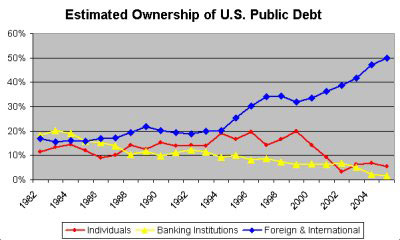
However it also seems to be in everybody’s interest to keep the game going. Asian countries, especially China, want to continue exporting to the United States and keep their currencies from strengthening, preferring to export to Americans and then to loan the money back to them so that they can buy more. Much of the foreign savings go into U.S. government bonds, keeping U.S. interest rates down (currently half of U.S. Treasury bonds are owned by foreigners). The cost of this debt seems manageable, in part because there is slower growth in most of the world’s countries, and so there is plenty of finance capital looking for a safe place to get positive returns. And the low interest rates allow American households to borrow more cheaply, using home equity loans on the seemingly ever-rising value of their homes.

The problem is, as Herbert Stein, Nixon’s economic adviser, famously said, “Things that can’t go on forever, don’t.” Surely a reckoning is coming. U.S. household debt has reached $11.5 billion, an amount equal to an unprecedented 127 percent of annual disposable income. The most recent figures by the Federal Reserve show the cost of debt servicing nearing a record high of 14 percent of disposable income—and interest rates are going up. How long will Asians and others hold U.S. debt when the dollar finally starts to fall and they take losses on their holdings?

Ah, but we have the equally famous retort from Mr. Nixon’s Treasury Secretary, John Connally, “It’s our currency, but it’s your problem.” America’s creditors can’t let the dollar fall too far without serious costs to themselves (their dollar holdings will buy less the lower the exchange value of the dollar). They will be drawn to keep lending. And sure enough, recently the dollar has defied expectations and strengthened, not weakened.

The bubbles and all the debt are serious economic problems and will have political consequences. However, people have been waiting for the dollar to collapse for a while; if it does, will all the unsustainable debt really be unsustainable? Will the dollar fall this year or next? Maybe. But it is possible to argue, and many do, that in an era of financial globalization, in which productivity growth in the United States continues to outpace that in other advanced economies, the United States will continue to be the destination for investment capital. As foreigners diversify out of their own economies, the United States continues to look good. Why shouldn’t foreign investment exceed 100 percent of the U.S. GDP? Why would this be a problem? Why would anyone want their money back if returns are competitive? Why then should the dollar fall? In any case, the big buyers of U.S. treasuries are foreign governments. They are not motivated simply by financial returns. Political pressure can be exerted by Washington should their view of their own self interest change. But why should it change? As for the federal deficit, why shouldn’t the Republicans keep enlarging the national debt? This “starves the beast.” It prevents public spending they don’t want on other grounds.

Is there support for such a Panglossian perspective? The “know-how” that U.S. transnationals export when they invest abroad is a major and uncounted (in the U.S. international financial accounts) export which seems to be responsible for the higher return on foreign investment enjoyed by U.S. investors compared to the return on foreign investment made in the United States. Michael Mandel, Business Week’s economics editor, argues that the United States is really doing far better than the trade and capital flow accounts indicate because of what is going on in the knowledge economy. Intangibles such as research and development (R&D) and the export of knowledge are poorly tracked by the federal government’s outmoded statistical gatherers, who still use industrial era categories. According to Business Week calculations, the ten biggest U.S. companies that report their R&D spending—firms such as ExxonMobil, General Electric, Microsoft, and Intel—have boosted R&D spending by 42 percent from 2000 to 2005, while over these years their capital spending only increased by 2 percent. What looks like less investment is really less investment in plant and equipment but not in intangible investments calculated to improve profits. America’s “knowledge-adjusted” GDP is moving right along, and that is why profits stay high. The decline in nominal investment also reflects the fact that capital goods are becoming less expensive because of productivity growth in the capital goods sector, capital deepening, and the enhanced efficiency due to improved information technology.

Even conceding that investment in the United States may be somewhat higher than official data show, it is not doing much to help the United States become more competitive. The nation’s problems are more severe, upsetting not only to its working people but to some unexpected establishment ideologues who have long celebrated globalization. Thomas Friedman, the New York Times columnist, argues that Bush is not good for America. He writes that the country “faces a huge set of challenges if it is going to retain its competitive edge. As a nation, we have a mounting educational deficit, energy deficit, budget deficit, health care deficit and ambition deficit. The administration is in denial on this, and Congress is off on Mars.” Friedman asks where are the American corporate leaders who would benefit from a serious effort to address these deficits. He can point to G.M.’s interest in health care since its benefit costs have made it noncompetitive and asks if there is any corporation in America that should not be protesting Bush’s cuts in federally sponsored basic research, a key source of innovation. But he also answers with a different voice noting that many key U.S.-based industries get most of their profits and increasingly their best talent from abroad. They are less motivated than in the past to deal with a Congress “catering to people who think ‘intelligent design’ is something done by God and not by Intel.”

There is, however, another way of looking at this. Consider that part of the higher return enjoyed by American investors results from the power of the U.S. imperial state, power that insures against bad treatment. U.S. power sets the rules on debt repayment, intellectual property rights, investor security, market access, and so on, things that no other state can insure for its investors, at least not to the same degree. The difference in the rate of return exists because foreigners are interested in a safe return and the security of their principal, while Americans investing in risky assets have some assurance that the global state economic governance institutions such as the World Bank and the International Monetary Fund, or if needed the U.S. Marines or threats by the State Department, will enforce debt collection so that their debts will be collected. U.S.-based firms charge exorbitantly for intellectual property and collect intellectual property rents, enforced by the World Trade Organization and the U.S. government, but these go to the bottom line of the companies in question. This is surely good news for those who own those U.S. assets abroad.

Sadly, working-class Americans, who are experiencing stagnant or falling real wages, do not share this satisfaction. For them, wages, shrinking benefits, and deteriorating job quality matter more than the external balance position of the United States. In the United States in which they live, income inequality grows dramatically, health care costs rise beyond the means of families, and secure retirement is a vanishing prospect. These are the real deficits for most Americans, serious shortfalls from what they have been led to expect. They are now told that to be competitive, their country must sacrifice its working people’s legitimate hopes.

In the United States where the president talks of creating an ownership society in which workers would “own” their own health care and retirement through privatized individual accounts, defined-benefit pensions, which guarantee a fixed amount of money after retirement, are replaced by defined-contribution plans, in which benefits depend upon what a worker can put in and the uncertainty of the equity market. The basic idea of social insurance, where all contribute and receive based on need, is canceled as those who can afford more not only get more but receive favored tax treatment for each dollar they set aside for their own welfare.

As part of the program, there are reductions in income tax (paid disproportionately by the rich), in taxation of corporations, and in capital gains and inheritance taxation that overwhelmingly benefit the rich. Government deficits created by these regressive tax cuts are partially offset by increases in payroll taxes, and proposals pour forth in support of consumption and flat-tax ideas—all new tax burdens for workers, with capital exempt.

Instead of unemployment benefits, there are to be personal reemployment and training accounts of limited size. Instead of well-funded public education, there are unfunded mandated testing and school vouchers. Consumers hurt by defective products and such are limited in their right to sue, and people who are bankrupted by personal tragedy can no longer seek bankruptcy relief as they have in the past. Government regulations to protect consumers are seen as inefficient because they increase the costs of doing business and are repealed or go unenforced, or are enforced by former industry partisans. Devolution of responsibilities from federal to state government undermines promised benefit levels, since states cannot afford such burdens and federal help is reduced.

This is the Ownership Society as envisioned by George W. Bush and those around him. It is a package of policies attacking the idea of citizenship rights and follows Margaret Thatcher’s principle that there is no such thing as society, only individuals. It stands in contrast to the principle unifying working-class movements everywhere—and at all times—solidarity. The deficits the Bush administration have created are undermining American society as we have known it. They are, however, in the narrow interests of the capitalist class.

While experts debate how long things can go on without a serious crisis, there is a structural issue of great importance to consider, namely the lack of significant domestic investment by U.S.-based transnationals and the continued expansion of their investment elsewhere. While U.S.-based corporations are earning record profits, they are investing little in the United States. For 2005, the Standard and Poor’s 500 U.S. corporations set new records, spending half a trillion dollars both to buy back their own stock and to pay dividends. Even the fund managers who profit in the short run worry that companies are underinvesting in their businesses. While profits were in many cases setting records, firms were not increasing investment; instead they were retrenching. Their profits were in fact coming from cost-cutting. This is not to say consumption was not rising. It did increase. But the majority of the increased spending was funded through debt creation, most of this due to the wealth effect of the increased value of real estate. Between 2000 and 2005, U.S. house prices increased by more than 60 percent. The market value of real estate in 2006 is about 200 percent of personal disposable income, and mortgage related assets are equal to over 60 percent of bank lending compared to 25 percent in 1970. As one investment analyst has written, “George W. Bush was re-elected president during 2004 because he presided over more housing inflation than any other American president.” That, and by scaring voters. The single-minded war on terrorism obscures stagnant and falling living standards for most of the U.S. working class.

Investment in residential construction is not the sort of investment that provides a surplus to repay foreign debt. The sectors which are growing in the United States, like health care, produce for the most part nontraded goods and services. It is only the growth of financial services, some specialized high-tech exports, and foreign investment that are showing high returns, and the firms controlling these are moving more activity offshore, following manufacturing’s lead and leaving the domestic service economy to create jobs—many low paying, temporary, and without benefits.

U.S. foreign borrowing is not significantly being used for investment to increase the productive capacity necessary to pay back the debt but for consumption, tax cuts, and military spending. From a ruling-class perspective (or at least some fraction of it), it could be argued, military spending is investment in the capacity of the U.S. state to intimidate others into accepting U.S. rules and to obtain control over valuable resources such as oil. From such a perspective, this is money well spent. However, the cost of imperialist adventure is going up and is not matched by success, so the cost/benefit ratio as seen by most ordinary Americans is not looking very good. The Persian Gulf War under the first Bush cost about $61 billion. Eighty percent of the total was paid for by American allies—Saudi Arabia, Kuwait, the United Arab Emirates, Germany, Japan, and South Korea, leaving the dollar cost of that war at only $7 billion for the United States (Japan alone contributed $13 billion). The Iraq invasion and occupation is a very different story. The United States is paying in lives and treasure, and it will continue to pay. The inflationary impact of such spending is hidden by low interest costs and the willingness of lenders to finance American profligacy.

What about the countries that are lending the United States all this money? Much of the so-called savings glut is coming from Asia. It is not the result of increased saving by households or private corporations. Rather it is fed by public sector saving as governments have cut back and increased their surpluses. Since the 1997 Asian financial crisis, which the Asian governments understand to have been a liquidity crisis, they have taken precautionary steps to dramatically increase their reserves to prevent a replay. Between 1996 and 2003, developing countries as a whole moved from a collective deficit of $88 billion to a surplus of $205 billion, a net change of $293 billion, a vast increase in global savings. The Federal Reserve estimates that this surplus increased by $60 billion in 2004. Figures for 2005 will show further increase. It is also the case that since the crisis, investment rates have fallen in the region (except for China) by more than 10 percent from the mid-1990s peak, as excess capacity is still being worked off and adjusted to the China impact. Because all of this saving is not being absorbed in productive investment, interest rates have fallen. Low interest rates have fueled the real estate bubble in the United States and some other places and allowed the cashing-out of the home equity loans that have fueled U.S. consumer spending.

Government-generated liquidity is also the engine of the other great motor of the contemporary global economy, China. China’s incredible investment rate, about 45 percent of its GDP, is also being driven by liquidity and not necessarily by expected profitability, raising the potential that China is growing too fast for its own good. State-owned banks are lending money to state-owned companies. In the case of enterprises owned by provincial authorities, borrowing and investment often seem to be uncorrelated with profitability, but rather are politically driven. Saving rates in China remain high in part because of an aging population worried about life in a free-market economy in which the provision of pensions, housing, education, and health care are not provided as a right by the state. At the same time, the significance of the U.S. current account deficit with China is complicated by a number of factors. First, most of China’s exports are controlled by foreign companies. These companies receive the profit when, say, a Barbie doll made for thirty-five cents in China sells for twenty dollars in a rich country’s market. Second, many of the products exported from China are not made there but assembled there from high-value components produced elsewhere. China’s value added is a fraction of the value of exports.

In 2005, China was the dominant Asian exporter, while exports from Asia as a whole were 36 percent of all world exports. In 1990, when Japan was the dominant exporter and we worried about Korea, Taiwan, Singapore, and Hong Kong, total exports from Asia were 38 percent of world exports. Much of what comes from China used to come from someplace else in Asia. Today Sony, Toshiba, and Panasonic, among others, send their products to the United States from China. Korea’s Samsung has twenty-three factories in China employing 50,000 workers. Taiwan may still control the market for computer components, but they are assembled in China by low-wage workers. Locals get only a small part of the profits generated. So while it is true that the U.S. deficit with China rose by 25 percent (to over $200 billion in 2005, and this is the largest debt the United States has ever run with any country), it is also the case that China’s deficit with the rest of Asia was more than two-thirds the size of its surplus with the United States. All together, the U.S. deficit with Asia has changed very little in recent years. It is the total value of oil and other energy sources that has been rising dramatically, thanks to the demand of a United States which refuses to conserve energy, causing it to run an increasingly large deficit when oil prices rise.

Importantly, on a global scale, saving and investment rates have both gone down, trends mainly reflecting developments in the industrial countries where both saving and investment have been trending downward since the 1970s even as saving has been increasing in the oil-producing countries and in Asia. The industrial countries still account for 70 percent of world saving, but this is down from 85 percent in 1970. Together, global savings and investment are near historic lows, having fallen markedly since the late 1990s. The even more telling figure is for the rate of growth of the global economy, which has been falling since the 1960s, when it was 5.4 percent to 4.1 percent in the 1970s, to 3.0 percent in the 1980s, to 2.3 percent in the 1990s. While mainstream economists dismiss any idea of a race to the bottom, there is an unquestionable slowing of growth and an emergent underconsumptionist, or rather overaccumulationist, trend. While global growth has slowed, the reach of transnational capital has dramatically increased, and its power to seek out lower costs and play workers in one place against workers elsewhere has grown. What we are seeing is a process of redistributional growth, in which over the ups and downs of the business cycle, capital’s share of the social product is increasing and labor’s share is diminishing.

There is a clear thread that connects domestic developments in the U.S. income distribution, debt-funded growth, the increased dominance of the rentier capitalists who profit from these developments, and global ambitions and the projection of imperial dominance. A century ago John A. Hobson argued that as the power of rentiers grows and taxation becomes more dramatically regressive, a hegemonic power (then Great Britain) is tempted to engage in imperialism. Hobson urged higher taxation of incomes generated as a result of financial speculation and government favoritism to produce a more equal distribution of income and higher working-class and middle-income spending, which would encourage domestic investment and make imperialism less attractive. He wrote,
The issue in a word, is between external expansion of markets and of territory on the one hand, and internal social and industrial reforms upon the other; between a militant imperialism animated by the lust for quantitative growth as a means by which the governing and possessing classes may retain their monopoly of political power and industrial supremacy, and a peaceful democracy engaged upon the development of its national resources in order to secure for all members the conditions of improved comfort, security, and leisure essential for a worthy national life. (John A. Hobson, “Free Trade and Foreign Policy,” Contemporary Review 64 [1898]: 179, quoted in Leonard Seabrooke, “The Economic Taproot of US Imperialism: The Bush Rentier Shift,” International Politics 41, no. 3 (September 2004): 293–318.

Today the “rentier shift” produces the very conditions Hobson warned of in the context of Great Britain a century ago. The growth of the rentier economy and the drive for external expansion long evident in U.S. history (and surely under both Clinton and Bush, albeit with a different policy mix) has been fed by an investor politics that has favored the very rich disproportionately in both taxation and government spending priorities. The dramatic increases in the upward redistribution of income have contributed to driving the investor class to look for opportunities abroad as the slower growth, and indeed saturation, of domestic markets pushes them to do. And this is taking place even as their increased class dominance—with trade unions and working-class power weakening, and real wages stagnating—allows them to push for a greater degree of regressive taxation and less progressive redistributive state spending.

Along Hobsonian lines, Arjay Kapur, a Citigroup strategist, argues that the rich are responsible for the low saving rate in Anglo-Saxon economies, which he describes as “plutonomies”—economies driven primarily by the wealthy as compared to the more egalitarian Japanese and European economies. In the plutonomies, above all the United States, it makes little sense to speak of the average consumer, since the top one percent of all households has 20 percent of the income, about the same as the bottom 60 percent.

Spending in the United States is driven by the asset inflation of the equity and real estate holdings of the top 10 percent of the income distribution. The wealth effect of such holdings allows debt- financed spending and results in the negative saving rate. Kapur finds that throughout our history there has been a strong negative correlation between the share of U.S. income going to the top 1 percent and the overall saving rate—the higher the share, the lower the saving rate. Economies with low saving rates tend to show current account deficits and the need for foreign borrowing.

To this analysis one might add that the power of the United States to command foreign credit depends in some measure on the power of the U.S. state, the continued use of the dollar as the reserve currency, and other factors which ultimately rest on U.S. imperial power. This relation is two-way. Harvard’s Linda Bilmes and Columbia’s Joseph Stiglitz estimate that the eventual cost of the war in Iraq will be more than a trillion dollars and possibly closer to two trillion dollars. So far the Bush administration has borrowed the money and underestimated the cost, but its policies raise the specter of imperial overstretch and the need for further coercion to keep the American economy afloat.

Past empires have followed the path that the United States seems to be going down, a movement from manufacturing production as the core activity to financialization and rentier income, and then finally bankruptcy from a loss of competitiveness and the cost of maintaining empire. For the elite there seems no better alternative, even if this is finally a negative-sum result. Any more positive strategy from the perspective of a democratic majority would require policies that would weaken the power of the ruling elite. It appears to this elite that it is better to continue to get rich and maintain power through the period of national decline. To the extent that this class can obtain rents from the familiar sources of state handouts, corrupt dealings, and tax policies, it stands to gain.

In conclusion, the concern over debt levels and bubbles is certainly appropriate. What is essentially a regional and sectoral disproportionality crisis leading to imbalance in capital flows and the high debt position of the United States is deserving of the attention it is receiving from all points on the ideological compass. What must be central to such discussions, however, is the class dimension of the accompanying redistribution of wealth and power and the resultant impact on members of the world’s working classes. Disproportionalities are more than matters of technical economics. They are manifestations of class struggle. Understood in this way, analysis enables more clear-sighted mobilization addressed at real enemies and demands for real solutions. Imperialist adventurism today serves the U.S. ruling class. It comes at the expense of working people everywhere.

May 12, 2006

Gold Bugs


By Peter McKay

The Wall Street Journal

Thursday, May 11, 2006

Investing pros have begun pondering the possibility that gold will

hit a record over $800 a troy ounce soon. This means that the gold

bugs -- that patchwork of sometimes offbeat investors who love the

shiny stuff -- are happier, and louder, than ever.

Gold futures for May delivery have risen this week 3.2%, or $21.50,

to a 25-year high of $703.70 per troy ounce. In the past two years,

prices have soared 86%.

"We all said what was going to happen and why," says Bill Murphy, an

ex-professional football player and trader who heads up a group that

goes by the name Gold Anti-Trust Action Committee, or GATA.

There are lots of reasons behind the move: For one, the dollar has

weakened, and seems headed lower. When people lose confidence in

paper currency some turn to gold, which is still seen in some parts

of the world as an alternative store of value, despite many years in

disfavor. This reputation as a store of financial value means it is

also seen as a hedge against inflation, which shows signs of picking

up, and against political turmoil, like say, turmoil in Venezuela,

Iran and Iraq.

For some gold bugs, though, it's rarely that simple. Back in 1999,

when gold was at multiyear lows around $250, GATA argued the metal's

price was being artificially suppressed by a cartel of large private

banks selling borrowed gold, much of it on loan from powerful

central banks. The latest stage of the rally, Mr. Murphy says, is

because Russia has become a heavy buyer, helping to squeeze the

alleged cartel.

"They're a little conspiratorial, for me even," says money manager

Peter Schiff, an outspoken gold bug himself. "I don't know if there

was any real orchestrated event."

Whatever the case, the gold bugs aren't alone anymore. The

investment audience for the precious metal is broadening as hedge

funds and others seek alternatives to stocks and bonds. Because the

gold market is relatively small, in terms of physical metal

available and the number of investors who have traditionally

participated, even a small increase in mass appetite for the metal

can result in more price increases.

Pick your reason. Gold seems headed higher still.

May 11, 2006

Copper Commision Report bullish

Copper nominal price reached on Friday a new historical high of 354,256 ¢/lb., growing by 8% with
respect to last Friday. Stocks registered with metal exchanges closed at 159,630 MT, falling by
2.6% (-4.3 thousand MT), showing current market shortage.

Copper price increase was due to the influence of different factors such as the present stocks
decreasing trend, optimistic reports regarding copper market future issued by some important
market agents such as BHP Billiton, and the US dollar weakness encouraging investors’ entrance
to the market. All occurred during a week in which holidays in China and Japan have moderated
market activity.

News of this week related to supply show the appointment of an arbitrator in the negotiations
between workers and Lomas Bayas (property of Falconbridge), which if no agreement is reached, it
could mean that strike would come into effect next Monday. On the other hand, paralyzation at La
Caridad mine in Mexico –it started last 24 March– continues. Besides, comments of BHP-Billiton’s
marketing director regarding prices will remain high until stocks increase from their current low
levels, strongly impacted as the current market bullish view was reaffirmed by one of the world’s
main copper producers.

Regarding demand information, different economic indicators show good future outlooks. In the US,
the leader indicators of industrial activity, ISM, and the factory orders surpassed market
expectations. On the other hand, the European leading industrial indicator grew with respect to last
month. There exists an historical positive correlation between both indexes and copper demand,
thus allowing anticipating that it would continue as dynamic as scheduled.

Demand dynamism, within a low copper availability context, explains part of spot premiums growth
in Europe, currently averaging US$ 165 per MT, with respect to US$ 135 per MT in April. It must be
considered that premiums correspond to the paid value on copper price and reflect physical market
trends. Besides, concentrates market information is confirming the expected lower availability. The
Germany refinery Norddeutsche Affinerie informed that raw material shortage would last until next
year, thus allowing anticipating strong mid-year negotiations between mining companies and
smelters in defining supply treatment charges. These have already established a strong downtrend
placed in values near 100/10 (and even lower) from 140/14 previously registered in the spot market.

The American currency fell by 0.5% until Thursday with respect to the previous Friday, and
surpassing 1.27 US$/€, at similar values as those of May 2005. A weak dollar has a positive effect
on commodities, which is reflected in the LME metals price index, which as of yesterday grew by
6.9% with respect to the previous Friday, due to strong rises of zinc and copper. Precious metals
were also influenced by the US dollar weakness, closing gold today at 682 US$/ounce (London
Initial) and silver at 14.070 US$/ounce (London Spot), growing by 6.9% and 12.1%, respectively.

Copper price, whose bullish trend has not changed, will continue to be determined by the evolution of the
pending labor issues (Grupo México, Lomas Bayas), as well as by any other new information mainly related
to supply. Besides, the US dollar evolution could continue influencing on commodities’ price.

May 10, 2006

Someone big wants in to the Gold Market

Gold has surged to $700 an ounce for the first time in 26 years after Chinese economists suggested the country should quadruple its bullion reserves to protect against a falling dollar.Speculators have been alert to any sign that Beijing may be planning to switch a portion of its massive $875bn reserves into gold, a move that would electrify the market.

They seized on comments yesterday by Liu Shanen, an official at the Beijing Gold Economy Development Research Centre, who said China should raise the portion of gold in its reserves from 1.3 percent today to between 3 and 5 percent. Such a move would entail the purchase of 1,900 tonnes of gold, equivalent to gobbling up nine months of global mine production.

Washington's cold response to Iran's move to defuse nuclear tension also helped fuel yesterday's rally. "No one is buying Iran's overtures," said Frank McGhee, a metals trader at Integrated Brokerage Services. "This is a purely geo-political move for gold. We've been here before. The difference is that this time, there are nukes involved."

June gold futures jumped $20.10 an ounce in New York, briefly touching the $700 line before falling back slightly.Tan Yaling, an economist at the Bank of China, backed the call for higher gold reserves to "help the government prevent risks and handle emergencies in case of future possible turbulence in the

international political and economic situation".John Reade, a UBS analyst, said neither economist had any official role but hints were enough to drive prices in the current climate. "This is an investor frenzy, and China has become the
biggest rumour in the gold world right now," he said.Mr Reade said gold had changed stride since the middle of last year, the key moment when it broke out against all major currencies and began to attract investment from the big money brigade.
"Speculative and investment interest has replaced jewellery demand. The last time that happened was in 1979 to 1980," he said.He said it was likely that Middle Eastern investors were switching
petrodollars into gold after burning their fingers in local stock markets.

Ross Norman, director of the BullionDesk.com, said China may already be a silent buyer on the open market.Central banks are supposed to record their gold purchases with the IMF promptly, but they have been known to move stealthily for months before declaring.

"This market has been bouncing back so quickly after each bout of profit-taking that it looks as if somebody big is trying to get in. It's too darn hot for my liking," Norman said.Mr Norman said there was a fair chance that gold mining equities would start to play "catch-up."

Special report from The Privateer - A newsletter I recommend.

As you will know by now, spot future Gold rose $US 21.60 to hit $US 701.50 at the close on Tuesday, May 9. This event was reported on CNNMoney.com under the headline: $700 Gold: Want in? Think Twice. On the surface, this is the normal type of stuff that the US mainstream financial media comes up with. They have to report it because it's news, but they structure the story in a way that they hope will dissuade most people from diving into the Gold market.

As we said, "normal", at least on the surface. But check out this story from exactly the same source, posted just under a month ago on April 11: $600 Gold: Want in? Think Twice. We strongly suggest that you print both these stories out and compare them. You will find that practically nothing but the numbers ($600 vs $700 as a Gold price) has changed. Clearly, the author of the two reports simply used the $600 Gold report as "boiler plate", substituted $700 for $600 in the $700 Gold report, and left the rest completely unchanged.

Please note that our Gold This Week commentary for April 14 - "Gold's Great - But Not For "Individuals" was based on this $600 Gold report from CNNMoney. What we said in that report goes double or triple for this new report, published less than a month later and with Gold $US 100 or 16.7% higher. This is very sloppy work indeed from the mainstream media. It will be interesting to see if they do it again at $US 800 Gold.

May 08, 2006

Mirages of Western Gold Bugs:


I think that this piece reflects my position to a significant degree... 

The Islamic Gold Dinar, the Iranian Oil Bourse and the Gold Standard

Dr. Eckart Woertz
Dubai, UAE
May 8, 3006

For many Western gold bugs, the precious metal is not an investment but a religion. Not surprisingly, the styles of their writings often resemble apocalyptic judgment sermons rather than sober investment analysis. The ideological importance they attribute to gold is rivaled only by the one the Communist Manifesto used to have for a different tribe. If gold is salvation, there needs to be a devil taking the other side. For die-hard gold bugs, this is the paper dollar and its various sinister manifestations reaching from big government to Wall Street, and the freemasons. Everything that is supposedly against such evil mongers has to be blown out of proportion and the farther away the country of origin the more outlandish the exaggerations become. Two perfect examples are the Islamic gold dinar and the Iranian euro-denominated oil bourse. Living in the Middle East, I have repeatedly been astonished by the huge gap that exists between web-based gold bug perceptions on the one hand and actual reality on the other hand.

The Islamic gold dinar was supposed to be used to settle bilateral trade between Muslim countries. By randomly surfing the Internet during the height of Islamic Dinar advertisements in 2002 and 2003, one could have gained the impression that the Islamic world was on the verge of skipping any payments in dollars or other paper money and switching to a gold standard like that of the good old 19th century. Unfortunately, off the web, in Middle Eastern reality the gold dinar was a non-issue. Yes, the initiator, Malaysia, had talks with Iran, Saudi-Arabia, and some other countries, but that was pretty much it. Even specialized central bankers in the region who were supposed to make the gold dinar a reality didn't have a clue about the idea. Thus, nothing has happened, Iran has not engaged in a settlement of bilateral trade with Malaysia using gold dinars, and the Gulf countries, which offered some polite interest, have quietly withdrawn, and are more inclined to discuss diversification into the Euro. A possible explanation for this failure is the trade surplus of Malaysia, which would have sucked the tiny gold reserves of the Gulf countries dry in no time, as an adjustment mechanism between the gold dinar as a trade currency and the money supply of the participating countries was not intended. Even more importantly, this hints to the simple fact that Islamic governments also love some expansionary monetary policies every once in a while. With the retirement of the main gold dinar proponent, former Malaysian Prime Minister Mahathir, the insight has dawned on many that the idea is dead. Even hard core gold bugs who are reporting from the "occupied South" or roaming the forests of Montana with their militia buddies should have grasped this in the meantime. But that's no problem as there is a new kid on the block: the planned Iranian oil bourse, which will offer euro-dominated oil contracts and will thus bring about the fall of the dollar.

The oil bourse as well has not really been a topic in Iranian newspapers. The Iranians do not seem to attribute the historical 'dollar-killer role' to the idea like gold bugs do. On May 6, Mohammad Javad Asemipour, advisor to Iran's oil minister and head of the bourse project, dismissed such notions as "propaganda." The project was not intended to rival marketplaces in New York, London, and Dubai, he said. Its goal was simply to increase liquidity in local energy markets, and in the beginning there was not to be any trading in crude oil, only in petrochemical products. The real bombshell for gold bugs, however, was that he said that pricing in euros was not intended! Anyway, after some postponements, the Iranian oil bourse is supposed to be set up this month on Kish, a small island free trade zone in the Arabian Gulf. The island is sleepy, and in the middle of nowhere. Along an empty road outside the city center there is a concrete desert of run-down hotels where workers from Dubai dwell. When their UAE visas are up for renewal, their employers send them to Kish for a visa roundtrip. But sometimes the paperwork does not arrive for weeks due to red tape and deliberate delays and they get stuck - cost-efficiently 'stored' without pay.

If you told one of these desperate souls that the lost island they are on will be the center stage of the coming dollar collapse, they would probably think you are crazy. It is not really a place where a highly paid oil trader from London, New York, or Singapore would like to relocate. It is as far from a functioning financial infrastructure as Pyongyang or the Antarctic. Back office facilities, settlement procedures, trading infrastructures, legal frameworks, debt markets, you name it. Need some credit to finance a major transaction? No problem, fill out a form and send it to one of the government-owned banks in Teheran, and in the meantime relax and enjoy the sunny climate. Pricing oil in euros would certainly be a nightmare for the dollar, but it will not happen to any meaningful extent because of the Iranian oil bourse. Like the Islamic gold dinar, it is a mirage of Western gold bugs - they see it from far away, on the web, but if they took the pain to apply for a passport and travel a bit, they would see it disappear.

I guess the political correctness squads of the gold bug community are already on their way to flood my mailbox. But wait a minute - I like gold, I am heavily invested because I think it will go much further, especially in dollar terms. Yes, the US twin deficit has gone out of control, and yes, Helicopter Ben is likely to choose inflation over deflation as a 'solution' to the debt problem. But at the same time, this debt is the only thing that keeps the world economy running, as every gold bug accurately observes. The US housing and consumer markets that goes without saying, but the Japanese love it as well, as the yen carry trade has enabled them to stabilize their shaky financial system with a zero interest rate policy and without inflation. China and Southeast Asia still have no alternatives developed for their export-oriented industrialization, and the Europeans have not exactly invented balanced budgets - they are content to sail in the geopolitical and economic wake of the US as well.

Of course, there will be continued diversification out of the dollar via the currency markets, and the euro and gold are obvious candidates. Norwegian plans to set up a euro-denominated oil bourse are much more likely to be a success than Iranian ones, and bilateral trade agreements like the $70 billion gas deal between China and Iran are already taking away liquidity from dollar-denominated open markets. Such deals might even use the euro as a pricing unit some day. But that will not change the nature of the game; the virtual reality of financial growth has become paramount. It seems like capitalism cannot expand in the real world anymore because geographically, it colonized all the non-commodified virgin lands a long time ago, and the inward expansion of new products and new markets got stuck in a stillborn microelectronic Kondratieff cycle. New products and markets still emerge, but do not absorb enough labor anymore because of the huge rationalization potentials the microelectronic revolution has set free. That leaves as the last frontier of growth the deceivingly limitless realm of numbers and financial engineering. If you think that's bad, be sure the deflationary shock of a gold standard would be worse.

What leads us to the ultimate mirage of Western gold bugs: the reintroduction of the gold standard. This is neither feasible nor desirable. Forget that the much-hailed age of the gold standard was not as cosy and peaceful as gold bugs perceive. After all, child labor was rampant and Western governments divided their time between policing the poor at home and killing and colonizing natives on foreign shores. Once they had consolidated their nation-states, imperialist competition between them got really ugly and finally ushered in World War I. Hardly a proof that a simple metal makes better societies; but there was low inflation, and gold bugs celebrate the period as 'freedom.' However, the main flaw in the gold bugs' view of history is that the homo oeconomicus who has expressed all his needs, relationships, and wishes in monetary quanta from time immemorial is a fiction. So is the conviction that in capitalism money is used to fulfill needs, instead of being an end in itself. These are axiomatic beliefs invented by neoclassical economists, Austrians, and other flat earthers of economic history.

Capitalist societies in the 19th century were still in a nascent stadium of development, and hardly comparable to the completely commodified ones we face nowadays. They comprised various forms of non-capitalist production (e.g. household work, agriculture), and the cold logic of accumulating abstract wealth in the "disembedded" spheres of market and state (Karl Polyani) was not yet generalized. It is hardly conceivable that capitalist societies could fit again into the tight golden corset in which they once flourished for a while when they were little babies. Thus, the gold bug's state of mind - affirming capitalism by evoking a harmonious picture of peaceful market communities and the whole 'honest money for honest work' charade - alludes to a past that never was and a future that will never be. The only thing that saved capitalism after 1929 was state intervention and monetary expansion, and the only thing that saved it after 1971 was even more monetary expansion and the advent of a brave new world of financial engineering. So let's hope that the music will continue to play for a while, because it will be difficult to grab a chair once it stops. And be careful what you wish for - or which gold bug is ready to tell the last GM worker to go home without knowing how to feed his family?

Best regards from Dubai, Eckart

-Dr. Eckart Woertz
Program Manager Economics
Gulf Research Center
P.O.Box 80758
187 Oud Metha Tower, 11th Floor
303 Sheikh Rashid Road
Dubai, UAE

Faber -Dollar is doomed!

Gold price to kick into full gear: Faber

Date : 07/05/2006

Reporter: Alan Kohler

ALAN KOHLER: Well, the death of the Greenback, gold at $US6,000 an ounce with commodity and energy prices rising vertically, spurred on by growing international tensions and war - no, that's not the background to the latest sci-fi pot boiler, but the tentative vision of one of the world's most respected contrarian economic forecasters, Marc Faber. Dr Faber must be taken seriously though because of his record in predicting, among other things, the global stock market crash of 87, Japan's collapse in 1990 and the Asian meltdown of 1997 - forecasts that earned him the moniker Dr Doom. He's also the editor and publisher of the influential The Gloom, Boom and Doom Report. And, as you'll hear, he has some very interesting views on the relative merits of the Australian and US central banks. I spoke to Marc Faber from New York this week.

Marc Faber, just to put this week's interest rate increase in Australia into a global perspective, do you think the developed world in general is in a process of increasing interest rates and reducing liquidity that has a way to run yet?

MARC FABER, 'THE GLOOM, BOOM AND DOOM REPORT': Yes, I think so because we have a global boom and interest rate increases have been very slow. In other words, in the US, we went from 1 per cent on the Fed fund rate in June 2004 to 4.75 per cent, but I think that inflation is higher than 4.75 per cent. And if you look at long growth in the US and credit market growth, then we haven't had tight money yet because if money was tight, then asset markets wouldn't rally as they do at the present time.

ALAN KOHLER: There is a lot of debate in the financial markets about whether the US will have a pause in its interest rate tightening cycle. What do you think?

MARC FABER: Well, I basically think that Mr Bernanke is a money printer and it's interesting to see that since he was appointed Fed chairman, the price of gold has risen by 42 per cent so the market is not very happy with his bias towards money printing.

ALAN KOHLER: Do you think that Mr Bernanke is losing control of the situation, in fact? I mean, I notice the markets are testing him now.

MARC FABER: I think that on his recent comments that the Fed might pause, immediately the US dollar became very weak, the bond market sold off and gold prices shot up another $20, $30, so that is a lesson for him that the market begins to see through his inflationary monetary policies.

ALAN KOHLER: What do you think of the Australian central bank and its decision this week to increase interest rates?

MARC FABER: I think actually that the Australian central bank is probably relatively better than others in the sense that they have further tightened monetary policies and so we have in Australia an interesting situation. The economy is kind of weakening, but there are some inflationary pressures and the Australian Reserve Bank has increased interest rates so I find it is actually quite courageous.

ALAN KOHLER: What do you think it means for the Australian dollar?

MARC FABER: Actually what has happened, the Australian dollar along with the New Zealand dollar was weakening recently but in the last, say, two weeks the Australian dollar has again strengthened from 70 cents to 76 cents, so I would say the Australian dollar is supported by relatively high interest rates.

ALAN KOHLER: What do you think about the length of the current commodities boom? You've written recently about firstly how the long wave of commodities could last for another 15 to 20 years and you've also talked about the impact of India on commodities, so where do you see prices of commodities going from here?

MARC FABER: Basically we had a bear market in commodities between 1980 and 2001, or 1998 and 2001, so we had more than 20 years bear market in commodities. By the late 1990s in real terms, in other words inflation-adjusted, commodity prices were at the lowest level in the history of capitalism in the last 200 years and now they have risen substantially - the price of copper from around 60 cents to over $3 a pound, the price of gold has more than doubled. But in real terms, commodities are still relatively low compared to equities and therefore, also given the length of the cycle - the cycle for commodities lasts usually 45 to 60 years peak to peak or trough to trough - in other words the upward wave in commodities lasts around 22 to 30 years and we are now in year 2006. The bull market started in 2001 so we are five years into the bull market. I do concede that the markets are overbought and there is a lot of speculation and I expect a correction but I think longer term from here onwards commodities will outperform the Dow Jones and financial assets.

ALAN KOHLER: You've been reported as predicting that the price of gold will rise to $US6,000 per ounce. Is that correct - is that what you said?

MARC FABER: What I said is that if Mr Bernanke prints money, it is entirely conceivable that the Dow Jones goes to 33,000 or 40,000 or 100,000 or 1 million. All I am saying is if the Dow Jones here goes up three times because of money printing by Mr Bernanke and we have examples in financial history where a central bank printed money and everything went up, but in this instance I think that gold would significantly outperform the Dow Jones. So if someone says to me the Dow will go to 33,000, I say yes, it's possible but it will decline against the price of gold which will go up to $US5,000, $US6,000 an ounce.

ALAN KOHLER: Did you notice that Steven Roach, the chief economist of Morgan Stanley, who has been a bear for a very long time, seems to have changed his tune now, saying he's feeling better about the world than for a long time. Do you think that the fact that Steve Roach has kind of thrown in the towel is a sell signal or do you think he's onto something?

MARC FABER: Well, Steve is a good friend of mine and he gave already a sell signal two years ago. He suddenly turned bullish about bonds and since then the bond market has been weak. And I agree with him that we are in a global boom but it doesn't change the fact that it is an imbalanced boom and it's driven largely by credit creation in the US, leading to overconsumption, leading to a growing trade deficit, current account deficit, the accumulation of reserves in Asia and a global boom. But it is nevertheless an imbalanced boom and one day there will be a problem, certainly with the US dollar. The US dollar is a doomed currency. Doomed? Doomed. Will be worthless. Actually each one of your listeners should buy one US Treasury bond and frame it - put it on the wall so they can show their grandchildren how the US dollar and how US dollar bonds became worthless as a result of monetary inflation.

ALAN KOHLER: You made at least three great calls - you warned of the 87 crash just before it happened, you warned investors to get out of Japan in 1990 and out of Asia in general in 1997. So what specifically is your call right now?

MARC FABER: I think we are in a bear market for financial assets. There's a bear market where the Dow Jones, say, would go from here - 11,000 to 33,000. It would go up in dollar terms but the dollar would collapse against, say gold or foreign currencies. That's what I think will happen with Mr Bernanke at the Fed because he has written papers and he has pronounced speeches in which he clearly says that the danger for the economy would be to have not deflation in the price of a fax machine or PC, but deflation in asset prices. And so I believe that he is a money printer. If I had been a university professor, I would not have let him pass his exams to become an economist. I would have said, "Learn an apprenticeship as a money printer."

ALAN KOHLER: (Laughs) So, a big mistake putting him in charge of the Fed then?

MARC FABER: I think it's very dangerous, very dangerous.

ALAN KOHLER: You've talked in the past about the links between the commodity price cycles and political tensions in the world and you've pointed out that when the Soviet Union collapsed, commodity prices were weak and you've said that rising commodity prices leads to the conditions for war. Now that we're in a commodities boom - which you now say is going to go for a long time - do you think that we're in for a period of rising political tension as well?

MARC FABER: Basically the way we economists have business cycles theories, the historians have war cycles theories and I don't want to go into all of them, but when commodity prices decline, countries are not concerned about getting supplies of vital commodities, whereas when commodity prices go up, it's a symptom of shortages. America needs oil for consumption and China and increasingly India need oil for their economic growth. If you are growing your industries at a production of 15 per cent per annum, as China, you need increasing quantities of oil and China was self-sufficient until 1994 and today they are the largest consumer of oil and import most of it from the Middle East. So the tensions of course arise and I can see that some people have become very powerful whereas the balance of power in the 80s and 90s shifted to the industrialised countries of the West that consume a lot of oil, now the balance of power has shifted to people like Evo Morales, Hugo Chavez in Venezuela, Mr Putin - Mr Putin is the most powerful man in the world, it's not Mr Bush because Mr Putin controls a production of oil of 10 million barrels, plus he controls all the pipelines going to Europe. And it has also shifted to Mr Ahmadinejad. Mr Ahmadinejad of Iran would be very quiet, as well as Mr Chavez, if oil prices were at $12. But at $70 they have a lot of leverage and so the tensions have also increased. It doesn't mean that it comes to war but the conditions for war have improved and I think that eventually this commodity cycle will last so long until there is a major war and during war times, the best hedge is to be low in commodities, then commodities really go up vertically.

ALAN KOHLER: Bit of a grim way to make money, I suppose?

MARC FABER: Hedge funds make money anyway. It doesn't - morals are not the most important issue.

ALAN KOHLER: Well, on that note we'll have to leave it there. Thanks very much, Marc Faber.

MARC FABER: It is my pleasure

Watch Faber

May 03, 2006

Commodity Prices High? Don't make me laugh!

((In 2001, adjusted for inflation, commodites sold for less than they did in the depts of the Great Depression. All the excitement over the high price of commodities is nothing compared to whats coming. The industrialisation and urbanisation of India and China will mean a massive increase in demand and prices will no doubt reach new highs in real terms...we have a little ways to go there....as this missive from an old geezer in Canada demonstrates))

 We all keep hearing about new highs that the commodities are making. Lets take a look at some of them to see where the prices have been and where they are going.

What does one use as a measurement as the purchasing power of the dollar keeps dropping, how can you measure something when the yardstick keeps changing? The government numbers on inflation are taken from Alice in Wonderland or maybe from Disney World, I am not sure but they are not of the real world which most of us have to live in.

In 1973 a gallon of gas cost about 60 – 65 cents, today in Canada it is over $5.00. I bought a new pick-up for $4000.00 in 1973. My truck last year was $52,000.00 MSRP.

In 1973 I was selling starter homes for $18,000.00, today they sell for just about $200,000.00.

To keep things simple lets multiply 1973 prices for commodities by ten as most things have gone up by a factor of ten. Also remember there is a lot less of these commodities available today as compared to 1973, as we consume them [especially silver].

Link to commodity prices http://minerals.usgs.gov/ds/2005/140/

Aluminum in 1973 was $582.00 per m/t or $.26 per pound
  
Aluminum in 2006 is about  $1.24 per pound
 Needs to double
 
A new high for Aluminum would be about $2.70 per pound   


Cobalt in 1973 was $6480.00 per m/t or $2.95 per pound.
 
 
Cobalt in 2006 is about $16.00 per pound.   
 Needs to double
 
A new high for cobalt would be about $30.00 per pound   


Copper in 1973 was $1312.00 per m/t or about 59 cents a pound
 
 
Copper in 2006 hit $3.25 per pound. 
 Needs to double
 
A new high for copper would have to be over $6.00 per pound.


Gold in 1973 was $3,150,000.00 per m/t or $98.00 per ounce
 
 
Gold in 2006 was up to $640.00 per ounce
 
 
A new high for gold would be about $990.00 per ounce.   
 Will be there shortly


Lead in 1973 was $359.00 per m/t or about 16 cents a pound
 
 
Lead in 2006 is about 55 cents a pound.
 Needs to triple
 
A new high for lead would have to be over $1.60 per pound.


Moly in 1973 was $3985.00 per m/t or about $1.81 per pound.
 
 
Moly in 2006 is about $24.00 per pound
 
 
Moly has made a new high by exceeding $18.00 per pound.


Nickel in 1973 was $3370.00 per m/t or about $1.54 per pound.
 
 
Nickel in 2006 is about $8.75 per pound.
 Needs to double
 
A new high for nickel would have to be over $16.00 per pound.


Silver in 1973 was $82,310.00 per m/t or about $2.55 per ounce.
 
 
Silver in 2006 was about $14.79 per ounce.
 Needs to double
 
A new high for silver would have to be over $26.00 per ounce.


Tin in 1973 was $5018.00 per m/t or about $2.28 per pound.
 
 
Tin in 2006 is about $9320.00 per m/t or about $4.23 per pound.
 A long way to go
 
A new high for Tin would have to be over $23.00 per pound.


Zinc in 1973 was $456.00 per m/t or about $.21 per pound.
 
 
Zinc in 2006 is about $3360.00 per m/t or about $1.52 per pound.
 
 
A new high for Zinc would have to be over $2.15 per pound.


Most commodities are a long way off from making new highs; I would say all that is happening is they are playing catch up. Or maybe they are losing control and the commodities are not as manipulated as they once were. When one sector of society can create money at will, while others have to trade their labor for it, how can we have free markets?

My main focus is silver, where is the price of silver heading? Higher way higher or as Bill at www.LeMetropoleCafe.com says TO THE MOON.

The reason silver is heading higher is supply and demand. Read Ted Butlers work at www.butlerresearch.com/archive_free.html  or Jason’s at www.silverstockreport.com/

Silver is precious, not for the price but for what it is.

The next big thing in medical research will be silver; they will rediscover all the things silver was capable of doing before the big drug companies came along.

Silver one day will be priced as high or higher than gold, because we consume silver and we store gold, so silver will become rare in the future [50 years?]. There is only so much silver in the earth’s crust.  By keeping the price low they have discouraged doing research to look for alternatives for silver.

Draw a yearly silver chart of the prices for the last 35 years with inflation factored in and the price has not moved.  All that has happened is that the purchasing power of the dollar has dropped.

If one cut a little off a yard stick each year the same as what the dollar has lost in purchasing power  we would have about a 2 inch yardstick.  Would anyone use it?  Would anyone draw a chart using a yard as a standard of measurement? No. Then why compare past dollars to today’s dollar. It is useless information.

New high’s or new lows. Where are all the new highs in the commodities??????

In 1964 one could buy a gallon of gas for 50 cents, I can still buy a gallon of gas for the same 50 cents.

The reason is that the 50 cents was silver, which in our funny money today is worth about $5.00, the cost of a gallon of gas today. Real money maintains its purchasing power.

Wm. J. [Bill] Murray
President
Silver Phoenix Resources Inc.

www.minersmanual.com

May 02, 2006

Embry Sees Trouble for Paper Money;

Embry Sees Trouble for Paper Money;
Gold Headed for US$1,000, Sprott Strategist Says

By Levi Folk 
National Post, Toronto
Monday, May 1, 2006

We are "in the early throes of paper money getting seriously
debased," warns John Embry of Sprott Asset Management, and the price
of gold is headed to US$700 this year and US$1,000
conceivably "within two to three years -- maybe quicker."

This story is finally gaining traction because of the remarkable
deterioration in the financial position of the United States, he
says. Confidence in U.S. paper money is starting to ebb, "and, boy,
when it really starts to move, you'll be shocked, I think, at how
fast the prices will move."

"I think what you've got here is a perfect storm," he concludes. The
United States has shown "very little interest in any fiscal
responsibility," and has created, in the face of declining
savings, "an enormous debt pyramid" that can be sustained only by
ever-greater credit expansion, he explains.

The supply of money is ever expanding, whereas the supply of gold is
relatively scarce, hence the "perfect storm." Insufficient
exploration for at least the last five years suggests "at best a
flat production profile" for gold, says Embry -- this in a situation
where demand already outstrips supply by roughly 1,500 tons/year.

Behind this "perfect storm" is a conspiracy theory advanced by Embry
that points to the U.S. Federal Reserve Bank doing whatever it can
to hide the truth about its debased currency. To give one subtle
example, the Fed recently stopped publishing a broad measure of the
money supply (M3) because it suggests that the money supply remains
accommodative despite the rate hikes in the United States. To take
another, central banks have been selling gold over the past decade
to make their currencies appear stronger.

The problem with conspiracy theories is that they can be used to
dismiss any evidence that does not corroborate one's view of the
markets.

For example, inflation is the smoking gun that Embry cannot find. In
fact, expected inflation, which can be calculated as the difference
between current yields on real-return bonds (Treasury Inflation-
Protected Securities in the United States) and nominal bonds,
remains muted. Embry explains this conflicting evidence by
suggesting that the bond market is also being manipulated, this time
by the U.S. Treasury.

Conspiracies aside, the fundamentals for gold and silver are strong.

"The fund has been managed on the premise that gold and silver were
going materially higher in price, and that they're going to go far
beyond what most people think is possible." Investors simply do not
understand the "upside magnitude" implied by the supply-and-demand
gap.

Other factors are kicking in to bolster gold stocks, otherwise a
high-beta play on the actual commodity. For instance, the gold
sector is witnessing a spurt in merger and acquisition activity as
the majors are snapping up juniors with proven finds.

In addition to hedge funds and futures markets fuelling speculation
in precious metals, there are also now mainstream investment
vehicles like exchange-traded funds (ETFs) that are whetting the
appetite of investors. ETFs are providing a much easier mechanism
for people to invest in precious metals, he says, potentially "a
huge positive."

Barclays Global Investors iShares Silver Trust ETF (SLV on the
American Stock Exchange) came to market Friday. Silver had been
climbing for months in anticipation of the fund's launch.

Silver, in Embry's view, is the much more interesting story. True,
there is no central-bank silver reserve, but the supply-and-demand
equation is also working in favour of silver, as the enormous above-
ground inventory has been largely depleted and new sources of demand
mushroom (e.g., in the health sciences).

For these reasons, Embry thinks we'll see silver at US$20 in the not-
too-distant future. Accordingly, the fund has a 10% allocation to
silver bullion, and a relatively high exposure to pure silver plays
such as Silver Wheaton, Western Silver and Bear Creek Mining.
Meridian Gold should be included here too, he adds, because of the
high silver content in their ore.

Beyond the above-average exposure to silver, the fund is also
characterized by an emphasis on juniors over seniors.

"The way I've made my money through the years has been to put
considerable emphasis on juniors: emerging companies, exploration
vehicles." The juniors have "much more leverage to the upside," he
explains. "They're still relatively well-priced as per ounce in the
ground" -- but that will change, he adds.

Embry also sees value in gold producers in strong-currency countries
like Canada.

"I like small producers who have really struggled to survive:
They're lean and mean to the extent they can be; and now they're in
a position to benefit, and their stock prices don't reflect it,
because they're still not making much money." This has become a
secondary theme in his stock selection.

The emphasis on juniors, however, translates into higher risk,
especially in light of today's price volatility. Embry manages this
risk by maintaining a diversified portfolio of 70 names with an
emphasis on careful selection of juniors. Among his juniors,
Southwestern Resources and Greystar Resources have consistently
played a prominent role.

Oxiana Still Favoured


 - May 02 2006

Opinion at Tolhurst Noall may be that investors should look
elsewhere for exposure to surging copper and gold prices, but
the general market view seems to be that it is stillokay to
hold a few shares of Oxiana Resources (OXR) in one's
investment portfolio.
Oxiana's shares fell dramatically on Friday, when the market
experienced a good old fright following the surprise Chinese
interest rate hike, but they bounced back swiftly on Monday.
Moreover, if UBS's latest assessments are anything to go by,
Oxiana shareholders should be in for ongoing rock'n'roll in
the medium term.
UBS raised its commodities prices forecasts substantially on
Monday and among the results of that exercise is a target
increase for Oxiana to $4.20 from $3.00. As the shares were
only rated Neutral, they obviously went up to Buy.
As the average target price ha snow climbed to $3.29
(including UBS's contribution) the obvious question that comes
to mind is: is the rest of the market going to catch up?
Oxiana shares have been trading persistently above the
experts' target price for many weeks, closing at $3.64
yesterday.
The UBS upgrade lifts the stock's reading on FN Arena's Market
Sentiment Indicator to 0.4. Apart from UBS, GSJB Were,
Macquarie, Credit Suisse, ABN Amro and Deutsche Bank all rate
it a Buy.
Citigroup, Merrill Lynch and JP Morgan don't want to go
further than a Neutral. Aspect Huntley has a negative rating
for many resources stocks at the moment, and Oxiana is no
exception.

April 30, 2006

What was the price of gold then

Whether as the basis for the monetary unit of a country, or in its role in comparison to the currency price of silver, the price of gold has long been a subject of great interest to both the scholar and the general public. Below are five series for determining the value of gold historically:

  • British Official Price for the years 1257 to 1945
  • U.S. Official Price for the years 1786 to 2001
  • New York Market Price for the years 1791 to 1998
  • Gold/Silver Price Ratio for the years 1687 to 1998
  • London Market Price for the years 1718 to 2001
  • April 28, 2006

    Stay Long Commodities

    Will there be commodity class corrections ahead? Sure, and some may be quite violent. But at least for now, we'd continue to view these as buying opportunities as we believe the Fed and the central bankers are trapped. They are trapped in a set of circumstances they themselves spawned. Unwilling to allow prior period misallocations of capital (stock and housing bubble) to reconcile themselves, they have implicitly committed to facilitating ever larger amounts of liquidity support to the financial markets and theoretically real economy. But it seems to us that they have worked themselves into a corner now being that the harder they push on the liquidity accelerator, the harder they will have to yet push in the future to offset the real world inflationary costs of commodity prices their hedge, prop desk and momentum trading former friends are now supporting with the very liquidity the Fed creates in the first place. The veritable Catch-22? As the data above tell us, this liquidity is now squarely finding its way into the commodity complex and that process is accelerating. Can it continue on forever? Of course not. We continue to believe that US consumers will slow ahead, especially given our viewpoint that US household financial well being is negatively correlated to commodity prices, but anticipate that the Fed will ultimately panic and up the liquidity creation ante even further as they have in the past out of fear as consumer slow, again, playing right into the expectant hands of the financial sector who has been conditioned time and again to expect this very response from the FOMC. Who is the best friend of the current commodity bull, who is for now the longer term supporter of this trend, and who in public refuses to acknowledge what is plain for the entire planet to see in terms of forward inflationary pressures? The Fed and the US credit markets. Who else? Until this changes, stay long assets that benefit from inflationary trends, particularly those assets that have not already been significantly levered. Some day the Fed will change tactics. Some day they will realize the speculative financial community has played them for the fool. But we're not their yet. For now, the hedge, prop desk and momentum trading crowd are betraying their liquidity benefactors out of natural self interest as they pile into hard assets and hard asset related investments. We can only believe the Fed and their global central banking brethren are watching this in horror. Paralyzed and reverting to the only trick left in their bag - liquidity facilitation. But after all, the hedge, prop desk and momentum traders are only doing what the Fed has taught them to do for literally years now - put the Fed into a box of being forced to create and facilitate ever larger amounts of liquidity and credit. The financial sector servant of old has now assumed the role of master. You better believe it's different this time.

    April 27, 2006

    Has Peak Gold Arrived? Lessons From The Peak Oil Debate


    Roland Watson (The New Era Investor) submits: As someone who has kept track of the “Peak Oil” movement for a few years now, it comes as no surprise that oil prices have risen nearly six fold since they hit rock bottom in the late 1990s. Does this mean Peak Oil has already arrived? Not necessarily, but we note that a final peak in global oil production needs to be preceded by a continual decrease in excess crude oil production capacity. When capacity reaches zero, then Peak Oil arrives. That capacity has been dropping now for several years.

    But what can that current debate about oil teach us about gold? Gold, like oil, has been continuously rising in price for five years. Admittedly, its performance has been poor compared to oil, but does this price mechanism also indicate the mining equivalent of reducing “excess spare capacity” and is it also a prelude to “Peak Gold”? My conclusions led me to believe that these two commodities are similar in terms of a Hubbert’s Peak analysis and in terms of the effects of a peak in global production.

    Firstly, Peak Oil based on Hubbert’s theory of oil production versus reserves states that production goes into decline at about the halfway point of remaining reserves. How does this play out for gold? Based on the United States Geological Survey’s 2006 summary for gold, about 152,000 tonnes of gold has been mined out of the ground since man first dug out those shiny yellow nuggets.

    Furthermore, the USGS estimates a remaining reserve base of 90,000 tonnes. So, from the point of view of peak being the halfway point of reserves, gold should have peaked at a remaining reserve base of 121,000 tonnes (152,000 plus 90,000 divided by 2). When was this the case? Backtracking 31,000 tonnes of global mining output gives us the year of 1993.

    However, a look at the graph below of global mining production shows that gold output merely dipped in 1993 as recession hit the Western nations and then resumed a climb to a new high in the year 2000 (which has not been exceeded since). Now, despite climbing gold demand, mine output has been in decline since then.


    Does this imply 2000 was the global peak in gold production? That would mean that out of a 4000-year time range of gold production, we have a seven-year error in estimating the peak, which doesn’t look so bad after all!

    But we have to understand that just like oil reserve figures, figuring out how much gold has ever been mined and how much remains under the ground in an inexact science. What we can be sure of is that the numbers we are using have never been more accurate as man’s knowledge of the earth has increased.

    Another evidence of a commodity production peak is falling supply in the face of rising prices and demand. In a free market, supply should increase to fulfill demand or demand has to fall. For some years now, the difference between new mine output and demand has been filled by scrap recycling and above ground stockpiles. However, this is where the peak argument gets contentious as the 1990s cutback in exploration is given as the explanation for the recent decline in production.

    A similar argument is given to partly explain the tightness in oil supplies today. Oil plummeted from $25 to $10 a barrel between 1996 and 1998. Exploration budgets were cut and we are apparently suffering the consequences today. Okay, perhaps, but that argument is beginning to wear a bit thin after seven years and prices still at all time highs. Likewise with the production of gold, how long does it take to re-open uneconomic mines and get new ones up and running? Seven years and counting and once again prices are still at multi-decade highs.

    But perhaps the most important warning sign of a commodity peak are major producing countries individually peaking before the overall global peak. In the case of oil, the USA, China, Britain, Norway and Mexico amongst a host of others are at or past their national peak of oil production. We only await the Middle East countries and Russia to join them and complete the picture.

    In the world of gold producing countries the picture is interesting if we examine a chart produced by the World Gold Council. If the reader clicks to that page and scrolls halfway down they will observe the multi-colored graphics for each major country and region.

    In summary, South Africa peaked in the 1970s at 1000 tonnes (yet is still the main producer). The USA peaked in 1998 at 366 tonnes while Australia peaked in 1997 at 314 tonnes. Canada peaked in 1991 at 177 tonnes and Brazil in 1982 at 200 tonnes and so on. These example regions when combined currently produce 40% of the world’s gold. If this 40% declines at 5% per annum then the other 60% has to increase production by 3% just to keep production flat. This is not a pretty picture - unless you hold gold.

    Just like oil, the relatively few “giants” of gold production are being replaced by a host of smaller “minnows”. Just like oil, gold explorers are finding less gold in lower grades of quality. In terms of oil, the gold Ghawars and Cantarells have long been discovered and exploited. It is now basically a mopping up operation at the edges of exploration.

    It seems to me that Peak Gold may well have arrived. When Peak Oil arrives as well, then Peak Gold will be confirmed because increasingly higher energy costs will make many mines uneconomic and gold above ground will become far more expensive than gold shut in underground. Unless, of course, gold vaults into the thousands of dollars to offset energy costs!

    This is what we call the “New Era” of investment. It is an era when hard assets will no longer be taken for granted and seen as cheap and easily accessible. They will become rarer and harder to extract and will remain so for decades to come.

    April 26, 2006

    A Long Time Coming


    By: Theodore Butler


    It has been almost eight months since I’ve been able to write about a dealer short-covering clean out in silver. It seemed like it took forever. No matter how long it has taken, the good news to the blasting to the downside we have just witnessed is that the dealers (including Mr. Big) have used the sell-off as an opportunity to buy back a large number of their shorts. Actually, it’s a little more involved than that; the dealers created the sell-off by collusively pulling their bids on the decline. (If you’re not clear on that, please read some of my previous articles.)

    Now the question becomes, is it done? Have we reached a low risk buy point? I think so, but with the tremendous volatility I can’t say it’s only dimes to the downside, the way I could at 4 or 5 or 6 dollar mark (although it may be). But I can say that there are many, many dollars to the upside, courtesy of a host of reasons not contemplated a few years ago, including the growing potential awareness of the real silver story and the prospective ETF.

    I also get the feeling, whether we have seen the bottom of this silver sell-off or not, that the dealers will be very reluctant to sell the next rally, when it comes, which I think is soon. This should free the price dramatically. I say this because I think the dealers have been taught a lesson they will not soon forget. Most of you know that the lessons you have learned in life the hard way, through adversity, are those that are most obeyed. The dealers, likewise, have suffered heavy losses as a result of the 8 month silver rally and are, in fact, covering at substantial loss for the very first time in decades. I think they are more concerned with closing out their shorts and eliminating continued exposure to the upside, than they are with the losses they have booked. I think they will be reluctant to put their heads back into the lion’s mouth by going short again.

    There are a number of good things related to the dealer silver short covering. In particular, the very recent decline in silver relative to gold, may have created a special opportunity for real gold investors who hold little or no real silver. As regular readers are aware, I have long suggested that gold only investors switch some of their gold holdings to silver (assuming no fresh funds were available for silver purchases). This is no way implied that I thought gold’s price was surely headed lower, but rather that silver would outperform gold, handily, in the future. I still feel that way and the recent gold catch-up to the silver price should give such gold only investors another good switch point.

    Although it may appear that I am suggesting doing a gold/silver ratio trade on a leveraged basis, that is not the case. I am still suggesting a cash only, fully paid for position in real silver, only with the suggestion that if one does not have cash, that the gold be the source for raising the cash. The rational for my suggestion lies in the fact that the strong rise in the price of gold over the past few years allows gold only investors the chance to buy silver at, effectively, single digit prices, compliments of the gold price rise. What matters most is what will prevail in the future and, clearly, I am of a mind that sees much higher silver prices relative to gold. After all, we are running out of silver, not gold.

    Now I would like to present an article by my friend Israel Friedman. Even though I have known him for almost 30 years, and we discuss silver every single day, I have always been able to learn something new from Izzy. I hope you have the same experience. I will offer some comments following his article.


    Crazy Izzy

    By Israel Friedman

    Before I concentrate and write about physical silver, I ‘d like to congratulate Ted Butler on the extremely good achievement he has accomplished with the articles he has written on silver. Even though he says he considers me his mentor and teacher, I must confess I think I have learned more from him. I can’t think of one important issue in silver that he hasn’t introduced and it bothers me that others steal from him.

    We can say that today many investors are very happy that they bought silver and in my private opinion those that buy today at current prices will be rewarded also. Many people have asked me where we are in the silver baseball game. I say to them that we are in the middle of the first inning and the first inning is going to end when silver prices will be at 23 to 25.

    Before you invest in silver you have to do research and decide by yourself is Crazy Izzy right, or the rational Ted Butler or the naked shorts.

    I can give you only my opinion and tell you that silver was never priced at its real value. The price is determined on the COMEX exchange and for them they trade numbers, and at any number or price they sell you a contract, and in the last 20 years they sold naked hundreds of millions of ounces and have made billion of dollars.

    You have to ask a legitimate question why the price on the COMEX doesn’t reflect true value? It is very simple – 90% of the mining companies are public and for them silver is just another product and they sell it only to survive and to make enough money to have good salaries, benefits, and to be reelected as directors.

    If these mining companies were in private hands with the knowledge of rarity and deficit of silver, today prices would be not less than $ 250. No real owner sells merchandise for less than fair value without a motivation.

    Crazy Izzy thinks that they minimum value of silver today is $600. Why $600? The answer is very simple – if the market can pay $600 for an ounce of gold when world stocks are close to 5 billion ounces, why the value of silver should be less with world stocks of half a billion ounces?

    I can give you more and more examples, but the most important thing is don’t invest in silver if you don’t think big like me. You can only make big, if you think big.

    If you decide to invest in silver or you have invested already, you have different ways to invest. In my opinion, it will not take long that we will start to have shortages in silver and slowly, slowly the price will rise to the real value. Remember today’s real value is $600; tomorrow can be only higher, never lower. Why? Every day we have less stockpile on earth and less reserves in the ground.

    You are going to ask a legitimate question – who is going to pay $600 for one ounce of silver? The answer is that the industrial user and new demand will come by the world jewelry stores who are going to start to sell silver as the main article because of big public demand.


    We have in the world hundreds of thousands of jewelry stores, who will need store inventory of at least 500 ounces per store to satisfy the coming public demand. In addition, we must have sufficient silver in the pipeline for wholesale distribution and inventory turnover by the jewelry stores and the manufacturers. All told we are talking about hundreds of millions of ounces annually in new demand.

    So you will come to the same conclusion like me that physical silver is the place to be. Some people will say it’s better on the COMEX where you have leverage. Maybe today, but in a shortage situation they can change the rules and you will have a paper contract that is worth zero instead of real silver.

    My father taught me that it is better to have one bird in hand than ten on the tree, and what is in your hand is the safest.

    We are coming to a new era when materials and commodities will do well and other assets will do less well. Lately, we are experiencing a rise in all commodity prices and in my opinion we are only in the beginning of rising prices. The only simple answer is that there is not enough materials in the world to satisfy demand for higher living standards by billions of Indians and Chinese.

    In the beginning, you will not feel too much the rising prices of commodities in finished goods. Why? The cost of a product is changing. In the past the cost of raw materials in a finished product was 20% and 80% was labor, profit, etc. In the future we are going to witness a change in the composition of costs in finished goods – 80% will be for raw materials and only 20% for the rest. Why? The labor in China costs only 5% of what labor costs in the US and Europe.

    Taking everything into consideration I can see silver as a commodity in short supply for years to come and prices higher and higher.

    I’m a crazy thinker and don’t copy me – only after you have made your homework.

    Congratulations, Mr. Butler on a fantastic job.


    Izzy Scores Again

    I thank Izzy for his kind words and especially for introducing a completely new concept, the potential coming jewelry demand for silver. While many are waiting for a replay of 1979-80, namely the dumping by households of unwanted silver objects in response to higher prices, Izzy (and I) see it different. Instead of dumping because of higher prices, we see the public actually wanting to acquire silver because of the higher prices. Please allow me to explain.

    First of all, this is not a new idea from Izzy, as I have heard him talk about it for almost 25 years. It’s just that I have never written about it before, although it always made sense to me.

    Let’s face it, the dumping scenario certainly hasn’t begun playing out yet, at all. Silver has more than tripled from its lows, and I have yet to see any evidence that even one teapot or fork has been melted because of the higher prices. You must remember that many commentators were predicting not that long ago that people would be running out of their houses clutching silver trays at 7, 8, or 9 dollars. Or that our ports would be backed up with boatloads of scrap silver from India. How much evidence do you see of that?

    If great numbers of people were selling silver household objects at current prices, I would tend to dismiss what Izzy predicts. (For the record, while he is the smartest man I have ever known, he is not perfect, and has been wrong on occasions. I say this primarily to keep his ego in check.) But I don’t see many selling silver objects, so what Izzy says is more credible.

    The key is human nature. Most of the time, people love to buy bargains in their daily lives, preferring to shop for what they need by price. But when it comes to investments and status items, price considerations often go out the window. At times, higher prices alone actually encourage more buying, witness stock and real estate bubbles, along with minor phenomenon like Beanie Babies or trading cards. This explains the mass mania that develops into bubbles, where people are sucked in only because of the continued expectation of higher prices.

    When silver prices truly explode, people will be drawn into investing in it because of the higher prices. But not just in an investment sense. What Izzy is saying is that there will be new status created about silver as a luxury item in jewelry and household objects. In my opinion, he’s right. Many people love to show off and impress others. There are many who wear a 5 or 10 thousand dollar watch because they want you to know that they can afford it. I’m not passing judgment, mind you, I’m just observing basic human nature.

    With higher silver prices, silver will take on a new respectability. It will no longer be the poor man’s gold. People will desire and wear silver jewelry with pride precisely because silver costs more. People will buy and use sterling silver flatware and display silver objects of art because it is made from an expensive material that is in the news.

    And it’s not just that people will buy silver jewelry and art objects because of higher prices, but that industry must gear up to manufacture and distribute and inventory in order to satisfy demand from the public for a new status symbol. This, as Izzy writes, could involve hundreds of millions of ounces of new silver demand at higher prices.

    As a silver analyst or an investor, the potential of new significant demand at higher prices is something to be considered and monitored. It’s something I know I will be studying. For that I thank Izzy, who’s as crazy as a fox.


    -- Posted 25 April, 2006

    Gold gains weak vis a vis Copper, Zinc and Lead.

    That gold has been so weak relative to cyclical metals tells us three important things. First, that gold's monetary premium has actually SHRUNK over the past year and is now as low as it was in Q4 2000. Second, that most people believe the commodity rally to have almost everything to do with real economic expansion (the China/India growth story in particular) and almost nothing to do with inflation. Third, that the best part of gold's bull market lies in the future because right now hardly anyone perceives a serious inflation problem.

    Silver and Gold Prices in the German Wiemar Republic

    Hyperinflation: Wiemar, Germany January 1919 to November 1923
    [Expressed in German Marks needed to buy an oz. of ag. or au.]

    Jan. 1919 Silver 12 Gold 170
    May. 1919 Silver 17 Gold 267
    Sept. 1919 Silver 31 Gold 499
    Jan. 1920 Silver 84 Gold 1,340
    May 1920 Silver 60 Gold 966
    Sept. 1921 Silver 80 Gold 2,175
    Jan. 1922 Silver 249 Gold 3,976
    May. 1922 Silver 375 Gold 6,012
    Sept. 1922 Silver 1899 Gold 30,381
    Jan. 1923 Silver 23,277 Gold 372,447
    May. 1923 Silver 44,397 Gold 710,355
    June 5, 1923 Silver 80,953 Gold 1,295,256
    July 3, 1923 Silver 207,239 Gold 3,315,831
    Aug. 7, 1923 Silver 4,273,874 Gold 68,382,000
    Sept. 4, 1923 Silver 16,839,937 Gold 269,429,000
    Oct. 2, 1923 Silver 414,484,000 Gold 6,631,749,000
    Oct. 9, 1923 Silver 1,554,309,000 Gold 24,868,950,000
    Oct. 16, 1923 Silver 5,319,567,000 Gold 84,969,072,000
    Oct. 23, 1923 Silver 7,253,460,000 Gold 1,160,552,662,000
    Oct. 30, 1923 Silver 8,419,200,000 Gold 1,347,070,000,000
    Nov. 5, 1923 Silver 54,375,000,000 Gold 8,700,000,000,000
    Nov. 13, 1923 Silver 108,750,000,000 Gold 17,400,000,000,000
    Nov. 30, 1923 Silver 543,750,000,000 Gold 87,000,000,000,000

    April 23, 2006

    Special Report: Australia soars on uranium bonanza

    The prospectors of the outback are coining it as nuclear comes back into fashion. By Paul Ham in Sydney
     
     
    AUSTRALIAN uranium miners come from tough stock. Bob Johnson’s great-great-great grandfather was a convict named Tom Askew, transported Down Under in 1819 for stealing 16 ducks to feed his starving family in Lincolnshire.
    “He was a church warden, desperately poor. He got himself a 15-year-old wife, they had six kids, and he ended up becoming a gold prospector,” said Johnson, who looked up his ancestor’s records while working for British Coal in the 1980s.


    Almost 200 years later, Askew’s descendant is also a prospector. But Johnson has joined a very different gold rush: he is looking not for gold but for yellow cake — mining speak for uranium ore. Australia has the world’s largest reserves: 40% of known deposits.

    And suddenly, the world desperately wants Australia’s yellowcake. China has just signed an agreement to buy thousands of tonnes, a deal said to be worth £40 billion. The metal will power the 28 new nuclear reactors it plans to build by 2020.

    The Australian deal was very sensitive. China has not signed the nuclear non-proliferation treaty, and the green lobby fears that enriched uranium may be used to make nuclear weapons. But the Australian government has waved aside those concerns. China, it said, has undertaken to use the uranium exclusively for nuclear power.

    China is in good company. India has announced a big investment in nuclear power, with plans to build 24 reactors. Europe, too, now sees it as a cleaner alternative to burning fossil fuels. Tony Blair’s scientific advisers have endorsed nuclear power. Sweden and France have used it for decades to electrify their countries, with no harmful results; and America has restarted its programme, with plans to build several reactors. Even some militant greens, horrified by the greenhouse gases produced by fossil fuels, have accepted the case for nuclear energy.

    The biggest beneficiaries will be Australian uranium miners, who have been extraordinarily quick to grasp this immense opportunity. Dozens of tiny uranium prospectors with little more than a drill bit between their teeth have floated on the Australian stock exchange in recent months.

    Their share prices have soared as “uranium-mania” has gripped local investors, amid analysts’ warnings of a bubble mentality. The believers point to the solid demand, chiefly Chinese, that underpins the industry — the price of uranium has risen from US$7 (£4) a pound two years ago to US$40 today. Some are steering clear, fearing a repeat of the dotcom fiasco: “The whole junior (explorer) situation has gone completely mad at the moment,” said Gavin Wendt, a resource analyst at Fat Prophets, an Australian share-tipping company.

    But the case for uranium is also underwritten by the imminent exhaustion of supplies of enriched uranium taken from obsolete, chiefly Russian, nuclear weapons, which have until recently met demand in Europe and America.

    The Australian federal government has stoked the euphoria, with explicit support from resources minister Ian Macfarlane, who said this month that local uranium miners could be shipping uranium to Asian countries within four years.

    Two of the world’s biggest mining companies, Australia’s BHP Billiton and Britain’s Rio Tinto, are best placed to exploit this opportunity. BHP Billiton owns the vast Olympic Dam mine in South Australia, which has the world’s largest untapped reserves. Rio Tinto, through its subsidiary Energy Resources Australia (ERA), is Australia’s largest exporter of uranium. It owns the Ranger and Jabiluka mines in the Northern Territory. Both companies’ cashflow has surged in recent years due to the global commodities boom.

    But investors are eyeing pure uranium stocks. They include smaller miners and explorers such as Marathon Resources, Summit Resources, Toro Energy, Paladin Resources and Alliance Resources, whose share prices have sizzled in recent weeks. Toro, which listed on March 23, has risen 504% to about $1.30. Paladin has soared 509% over the past year to about $5.40.

    Pure miners have tended to outdo explorers, because the real money is in extracting and selling the ore. But that hasn’t stopped dozens of minnows lining up to entice investors: Giralia is floating two in coming months: U308 and Gladiator Resources. Investors are queuing up; anything with uranium attached to it tends to be heavily oversubscribed.

    Uranium’s return to global favour has vindicated a few doughty Australian pioneers, mostly hard-bitten geologists, who for decades have stayed the course, dismissed the militant green hysteria about global irradiation, and are now set to become very rich indeed.

    Johnson is one of the hardiest of Australia’s uranium barons. The son of an iron-foundry worker, he is a tough, 58-year-old with degrees in geology and computer science. He invented the Maptek three-dimensional mine-planning software used by mining companies around the world. He is a founding director of Curnamona Energy, which has exploration rights over 4,300 square kilometres of the best uranium “paleo-valley sands” of South Australia.

    Curnamona has been a huge favourite with investors, partly because it uses new technology to detect uranium deposits. It was also well advanced. Floated in April 2005, money has since “just walked through the door”, said Johnson. “We saw this boom coming a couple of years ago. Everyone was negative. We realised there was a lot of uranium in the ground.”

    Curnamona, like Toro Energy, is an explorer — it has no assets, as Johnson readily admits. “We’re a speculative company, but we have a very methodical approach.”

    Like many uranium pioneers, he has little time for militant environmentalists. “The green movement has actually delayed the introduction of a safer alternative to coal. By stigmatising uranium, they have actually damaged the environment,” he said.

    Kate Hobbs is the only woman to head an Australian uranium mining company, Hindmarsh Resources, which floated this year to a thunderous reception. Yet she, too, cheerfully admits that her firm is purely an explorer, with no assets.

    Hindmarsh has a licence to explore 14,500 square kilometres in South Australia. The prospect has already attracted a buyer for the tiny company:

    Canada’s Mega Uranium will take control of Hindmarsh in the coming weeks.

    As a result, Hobbs, a 55-year-old mother of three, will be free to pursue her other mining interests. She has 1.5m share options in Hindmarsh, whose share price is at about $1.60 and rising. She speaks scornfully of the “great disservice” done to the environment by green groups that put the brakes on nuclear power.

    Greg Hall, a mining engineer, is a veteran of the uranium sector, with 27 years’ experience of extracting yellow cake and other minerals from the Australian outback.

    Hall, 47, has felt the sharp end of the environmental attack on uranium — he was mining manager of ERA’s Ranger and Jabiluka uranium mines in the Northern Territory at the height of the protests in the late 1990s and early 2000s. He now smiles at the idea of the green movement supporting nuclear power over fossil fuels.

    Between 1987 and 1992 he was responsible for the development and management of underground operations at Olympic Dam, situated in one of the earth’s most inhospitable regions. “When I first went there I lived in a caravan with my wife,” he said. “It was a bit of a shock for her — she worked in the fashion industry.”

    Last month Hall became managing director of the newly floated Toro Energy, an exploration spin-off from two mining companies, Oxiana Resources and Minotaur Exploration. Toro’s goal is to find uranium in an area covering 26,000 square kilometres in the centre of South Australia.

    Alan Eggers, founding director of Summit Resources, is equally upbeat about the prospects for uranium. A hard man of the mining sector, Eggers has suffered two setbacks in the wake of the collapse of commodities prices — the second time he was halfway through building a new home, with a wife and children.

    Summit is now largely seen as a “Queensland government play”, pinning its mining hopes in Mount Isa to the relaxation of the ban on uranium mining by the Australian Labor party. At present the Labor states of Western Australia and Queensland both ban uranium mining; but that is expected to change at the Labor party conference in April 2007. If so, Summit’s share price will hit the roof.

    Eggers holds a master’s degree with first-class honours in geology, and has staked his career on finding substantial uranium deposits in Mount Isa. Like Kalgoorlie, in Western Australia, Mount Isa is the gritty heartland of Australian mining, where generations of prospectors have made and lost their fortunes.

    In 1990 Eggers staked out an area near Mount Isa which he believed held substantial deposits of uranium; he invested A$5m in drilling. His persistence paid off: Summit announced in the mid-1990s the discovery of 35,000 tonnes of uranium, worth A$4 billion (£1.7 billion): “From my early days of pegging worthless ground we now have A$4 billion of metal,” he said.

    The Summit share price soared on the back of the discovery. Then it came crashing down when, in 1998, the new Queensland Labor government slapped a ban on uranium mining. That wiped A$70m off the company’s value, and infuriated shareholders. “I had a personal stake of $5m that went to nothing.”

    But in the past three years Summit’s price has clawed back, from 5c in 2003, to $1.65 this month, as investors cling to the hope that Summit will be given the green light.

    Eggers is worth millions of dollars on paper but, like most of Australia’s uranium barons, past experience has made him philosophical about whether he will realise it.


    April 20, 2006

    The Best little mining company in the world: Oxiana

    Listen and weep if you don't have exposure...

    AN EVASIVE RECOVERY

    by Dr. Kurt Richebächer

    In the early 2000s, Mr. Greenspan earned himself the honorable title of "serial bubble blower." Fearful of a painful burst of the equity bubble, he aided and abetted a bond bubble in order to boost the housing bubble. Measured by the mildest postwar recession, it appeared a smashing success. But taking measure of the following anemic recovery, and particularly the following dismal employment and income performance, into account, it was an utter policy failure.

    Any assessment has to further take into account that the government and Federal Reserve have supported this recovery with unprecedented fiscal and monetary lavishness. Tax cuts reduced government revenue by $870 billion, while the Federal Reserve slashed its fed funds rate to 1%, its lowest level since the Great Depression.

    The decisive failures of these policies have been in business fixed investment and in employment, both displaying a drastic shortfall in relation to reported GDP growth.

    Historical experience and economic theory leave no doubt that business fixed investment and employment play the crucial role in providing economic growth with the necessary traction to become self-sustaining. Even in its fifth year, the present U.S. economic recovery remains fully dependent on the housing bubble to drive the consumption bubble.

    The same, by the way, applies more or less to all Anglo-Saxon countries. Over the past few years, all of them have hung on the steroid of inflating house prices providing the collateral for outsized consumer borrowing-and-spending binges. Their further common features are large budget deficits (except Australia), very low savings and large trade deficits (except Canada).

    All of these economies have, in essence, become bubble economies. This means that monetary policy impacts the economy primarily through inflating asset prices, which in turn stimulate and facilitate credit-financed consumer spending.

    An important adverse feature of all asset and credit bubbles is that they inherently break an economy's pattern of growth. In all the English-speaking countries, the credit excesses have primarily inflated house prices. Using these as rising collateral, consumers have enjoyed unprecedented borrowing facilities to spend as never before in excess of their current income. What resulted were extremely unbalanced economies.

    Distorted demand over time invariably also distorts the economy's supply side. What has actually happened in all these countries is that domestic spending has increasingly outpaced domestic output. On the other hand, low domestic saving and capital investment keep a brake on output growth. The infallible result in all these countries, except Canada, is large, chronic trade deficits. Evidently, all this is structural, not cyclical.

    Essentially, the low savings, the low capital investment and the soaring trade deficits act as major drags on economic growth. Over the past few years, these drags have been offset by the rampant demand creation through the housing bubbles. But the trouble with this recipe is that it worsens the structural distortions and imbalances.

    Nevertheless, all asset and credit bubbles eventually run out of steam. Plainly, this is going on in all these bubble economies, the United States included. For us, the key question about whether there will be a hard or soft landing is the extent of the prior excesses. They are the worst in history.

    The consensus sees new momentum in the U.S. economy from strong retail sales. We focus on the inflation-adjusted monthly figures for overall consumer outlays and observe the opposite. There are sharp fluctuations in spending on durables, but with a distinct downward trend.

    As everybody knows, or ought to know, the strong monthly changes in consumer spending have their main cause in the sharp ups and downs of auto promotions. In the quarterly GDP reports, they are even annualized. But comparing the above figures, it strikes the eye that the recovery in the last three months was very much weaker than in the prior downturn.

    Any assessment of the U.S. economy's further course has to start with the recognition that the housing bubble is doomed, and in its wake the consumption bubble. Only the vigor of their slowdown is in question. Given this virtual certainty, the U.S. economy urgently needs an alternative source of growth.

    Unfortunately, there is but one possible alternative source, and that is sharply rising business fixed investment and exports. The consensus, apparently, takes a strong revival of business fixed investment for granted.

    Assessing the relevant figures, including profits, we take for granted that business investment and hiring are going to fail in the future even more than in the past. First of all, the record-sized fiscal and monetary stimulus of all times has been exhausted; second, business fixed investment in the United States, even though heavily bloated by hedonic pricing of computers, recently accounts for a record low of 11.5% of GDP, as against more than 70% for consumer spending; third, consumer demand is weakening; and fourth, nonresidential investment has slumped from double-digit growth rates in 2004 to just 2.6% in the fourth quarter of 2005, after 10% in the first half.

    Common arguments in favor of a comeback of capital investment are high business liquidity and high profits. Plainly, they have recovered from their lows, but growth has sharply slowed from 2004, when tax incentives gave a strong impetus.

    New orders for machinery are up over the year, but by far not enough to suggest a developing investment boom. Given for many years a preponderance of short-lived investments, it needs moreover large and ever-higher capital investments just to replace worn-out plant and equipment, as reflected in rising depreciations. There is every reason to assume that the rise in new orders of capital goods barely reflects rising depreciations.

    Most impressive is definitely the following chart reflecting the U.S. economy's profit performance. Since 2000, it is the greatest profit boom in the whole postwar period. Strikingly, it even compares most favorably with the profit performance during the "New Paradigm" boom years, from 1995-2000.

    Profits of the whole nonfinancial sector were $401 billion in 1995 and $413.4 billion in 2000. But from 2001 to late 2005, they have almost trebled, from $322 billion to $868.5 billion. Wall Street, of course, eagerly seizes them. For us, these numbers are so absurd as to require investigation.

    First of all, it was an extremely imbalanced profit boom reflecting an extremely imbalanced economic recovery. This recovery had literally nothing in common with the business cycle pattern of the past. Intrinsically, this shows in a radically divergent profit pattern.

    The profit boom of the last few years was narrowly centered in the category "other." The fact is that the housing bubble has been crucial not only in creating demand and GDP growth, but also in creating employment and profits.

    Most astonishing is, of course, the steep jump in profits from $534.2 billion in 2004 to $863.3 billion in 2005. Two phony causes are easily identified. One is a sharp decline in depreciations, from $804.3 billion to $668 billion. Depreciations are a business expense, of course. If a firm stops investment, it increases its profits. But this is hardly a desirable way toward higher profits. The second major cause of the sudden profit surge was a tax incentive that induced companies to repatriate a large amount of foreign profits into domestic profits.

    Leaving aside the grossly distorted profit figures for 2005, we focus on the period from 1997-2004, the former marking the U.S. economy's prior profit peak in the postwar period. Over these seven years, including the "New Paradigm" boom years, overall profits barely rose.

    The next thing to recognize is the tremendous differences in profit performance between sectors. For all sectors producing or moving goods, manufacturing and transportation, it has been seven years of profit disaster, and moreover of steady deterioration.

    In contrast, it has been seven years of profit bonanza for retail trade, wholesale trade and in particular for the branches captured under "Other." Here construction and real estate agents have been the main contributors.


    We would say that overall this is a dismal profit performance, definitely giving no reason for a booming stock market. Measured against nominal GDP, which has risen 41% between 1997-2004, it is a profit collapse.

    Very poor profits in the aggregate are the one big problem. An extremely lopsided pattern between sectors is the other. Manifestly, this lopsidedness in the profit pattern perfectly reflects the extraordinary lopsidedness of the U.S. economy's growth pattern during these years. The housing and consumption bubbles rule.

    It always amuses us when Mr. Greenspan and Mr. Bernanke criticize the government for its budget deficits. The irony is that the chronic deficit spending by the consumer, induced by their monetary looseness, is doing far greater structural damage to the economy.

    Regards,

    Dr. Kurt Richebächer

    for The Daily Reckoning

    Sell US Stocks

      
        What do I think of yesterday's stock-market bacchanalia?  I think it was and is an absolutely wonderful gift for people who have been dragging their feet in raising cash!  It's amazing, if not frightening, that any action of the nation's bumbling central bank can evoke such enthusiasm.
        _____
          Introduction
        On March 20th, I issued an unequivocal sell recommendation on stocks. If you wish, you may categorize the missive at hand as an unequivocal reaffirmation of the March 20th recommendation.
        After the close yesterday, I posted the following on the GRA website:
            "Can +195 points on the DJIA be a bearish development?  I think it can, and I will do my best overnight to explain why. I was hoping to use the time to catch up on some other research material, but something like today, occurring when it did and for the stated reasons, simply cannot pass without comment. The piece will be short, and I will try to have it out before the open tomorrow."  Here goes.
        _____
        Several months ago, I observed that two of the three US financial, markets -- debt and currency -- might very well have tougher sledding in a climate in which there was uncertainty about what the Fed was going to do on a forward basis, versus the one we've been in.  The climate we've been in has been one of relatively high certainty about the succession of rate hikes that commenced in June 2004.
        At the time, the above view was expressed in response to what was yet another attempt, albeit another premature attempt, by Wall Street bulls to promote into higher stock prices "the Fed is almost finished" mantra.  Yesterday, the bulls believe they finally got what they've been so arduously hoping for.  In the process, they may also wind up getting some fallout for which they had not been hoping nor will they especially enjoy.
       What they did want and get came in the minutes of the FOMC's March policy meeting, released yesterday afternoon.  Here's what put the Street into such an orgasmic mood:
            "In the Committee's discussion of monetary policy for the intermeeting period, all members favored raising the target federal funds rate 25 basis points to 4.75 percent at this meeting... Most members thought that the end of the tightening process was likely to be near, and some expressed concerns about the dangers of tightening too much, given the lags in the effects of policy."
        The bullish camp placed inordinate emphasis on the above passage. Inordinate in that there was plenty of other material you easily could construe as being in conflict with it.  A major portion of the minutes appears in the excerpt at the conclusion of this missive, but I implore people to read the document in its entire context, which can be done at:
        Now that the Federal Reserve has wended its way through a succession of 15 rate increases over almost the last two years, I think there is a growing list of criticisms you can lodge against how this was handled and what it has accomplished.  Start with the fact the Federal Funds Rate never should have been taken to a trough of 1% to begin with.  How that came about and what took place afterwards can be laid squarely on the shoulders of Alan Greenspan and his practice of end-justifies-means leadership.  This variety of governance has now infected and corrupted, at least on an intellectual level, most of Washington.  In my view, it poses a huge threat to the well-being of the Republic!
        And has the 375 basis points in a higher Federal Funds Rate really accomplished much more than simply making everyone's cost of money a good deal more expensive?  Using money measures M2 and M3 as guides, we have more expensive money with no serious contraction in its availability:
                       Year-Over-Year Growth
             Money     ----------------------
            Measure    2/2006  2/2005  2/2004
            ---------------------------------
               M2       4.7%    5.3%    4.5%
               M3       8.0%    5.0%    4.3%
            ---------------------------------
        Of course, in the Greenspan/Bernanke New World Order of Fed governance, we are no longer allowed to have M3.  Do you think the above numbers might have anything to do with the real reason why?  (The "official" reasons provided by the Fed were moronic nonsense!)
        M3 is the broader, far better gauge of liquidity creation.  If you were the Fed and wanted to foster long-term trendline growth of around 3.5%, give or take, in real gross domestic product, there is no way you would be permitting M3 to grow at 8%.  Unless, of course, your motives were different than the ones publicly stated.  (A fibbing Fed? -- perish the thought!)
        And something else that bothers me -- a lot -- is that a variety of Federal Reserve communications strongly suggest that a majority of the FOMC's members are making monetary policy on the basis of actually believing the government's shoddy data, the inflation data in particular.
        Expanding and amplifying on this laundry list of criticisms is a task for another time.  What I want to emphasize here is that Federal Reserve monetary policy of years standing has created such a mess that an intended result in one area presents the major risk of unintended consequences in others.  And now that the central bank clearly is signaling its desire to throttle back on rate increases, the likely unintended consequences, at least in my opinion, will be seen in the behavior of the dollar's exchange-rate value and of open-market, longer-dated interest rates.  In my view, the behavior, on balance, will be of the negative variety.  (The possible policy shift that has been signaled is not likely to hurt the rise in prices of many commodities, though.) 
        As to the dollar and bond prices, the negative behavior already has begun!  Using the Dollar Index as a proxy, it is very close to making a multi-month low.  As to long-term interest rates, between February 9th and last Friday, the yield on the Treasury 4.50s of 2/15/2036 rose from 4.53% to 5.11%, representing a loss almost 8.9% of this issue's principal value.
        On the other hand, yesterday's release of FOMC minutes certainly gave the Fed what it wanted in stock prices.  And, yes, the Fed cares very, very much about the stock market.  Despite public protestations to the contrary, it certainly seizes on appropriate opportunities to "help" the market when possible. At a time stocks were in growing trouble, yesterday was one such opportunity, with advance billing in last week's Wall Street Journal article authored by Greg Ip.  (Leaking inside information is OK if you are a Fed official?)
        However, as it relates to the stock market and as the summary section of this missive opines, I think yesterday's rally, along with its probable follow-through into at least a portion of today if not a bit beyond, merely represents "an absolutely wonderful gift for people who have been dragging their feet in raising cash!"
        _____
          FOMC Minutes Excerpt
            "...Meeting participants saw both upside and downside risks to their outlook for expansion around the rate of growth of the economy's potential.  In the housing market, for instance, some downshift from the rapid price increases and strong activity of recent years seemed to be underway, but the magnitude of the adjustment and its effects on household spending were hard to predict.  Some participants cited stronger growth abroad and robust nonresidential investment spending as potentially contributing more to activity than expected.  It was also noted that an abrupt rise in long-term interest rates, reflecting, for example, a reversion of currently low term premiums to more typical levels, could weigh on both household and business spending.
            "Several participants noted that the labor market had continued to strengthen, with payrolls increasing at a solid pace.  The labor market was now showing some signs of tightness, consistent with a relatively low jobless rate.  There were anecdotal reports of shortages of skilled labor in a few sectors, such as health care, technology, and finance.  Still, participants expressed uncertainty about how much slack remained.  Pressures on unit labor costs appeared contained, despite rising health-care costs, amid continued robust productivity growth and still-moderate increases in several comprehensive measures of compensation growth.
            "In their discussion of prices, participants indicated that data over the intermeeting period, including measures of inflation expectations, suggested that underlying inflation was not in the process of moving higher.  Crude oil prices, though volatile, had not risen appreciably in recent months on balance, and a flattening in energy prices was beginning to damp headline inflation.  In addition, core consumer inflation was flat or even a bit lower by some measures. Some meeting participants expressed surprise at how little of the previous rise in energy prices appeared to have passed through into core inflation measures.  However, with energy prices remaining high, and prices of some other commodities continuing to rise, the risk of at least a temporary impact on core inflation remained a concern.
            "Participants noted that there were as yet few signs that any tightness in product and labor markets was adding to inflation pressures. To date, unit labor costs were not placing pressure on inflation, and high profit margins left firms a considerable buffer to absorb cost increases.  Moreover, actual and potential competition from abroad could be restraining cost and price pressures, though participants exchanged views on the extent to which conditions in foreign markets might be constraining prices domestically.  However, participants observed that there was a risk that continuing increases in resource utilization could add to inflationary pressures. Some participants held that core inflation and inflation expectations were already toward the upper end of the range that they viewed as consistent with price stability, making them particularly vigilant about upside risks to inflation, especially given how costly it might be to bring inflation expectations back down if they were to rise.
            "In the Committee's discussion of monetary policy for the intermeeting period, all members favored raising the target federal funds rate 25 basis points to 4.75 percent at this meeting.  The economy seemed to be on track to grow near a sustainable pace with core inflation remaining close to recent readings against a backdrop of financial conditions embodying an expectation of some tightening.  Since the available indicators showed that the economy could well be producing in the neighborhood of its sustainable potential and that aggregate demand remained strong, keeping rates unchanged would run an unacceptable risk of rising inflation.  Most members thought that the end of the tightening process was likely to be near, and some expressed concerns about the dangers of tightening too much, given the lags in the effects of policy.  However, members also recognized that in current circumstances, checking upside risks to inflation was important to sustaining good economic performance. The need for further policy firming would be determined by the implications of incoming information for future activity and inflation.
            "With regard to the Committee's announcement to be released after the meeting, members expressed some difference in views about the appropriate level of detail to include in the statement.  In the end, they concurred that the statement should note that economic growth had rebounded in the current quarter but that it appeared likely to moderate to a more sustainable pace in coming quarters.  Policymakers agreed that the announcement should also highlight the favorable outlook for inflation and summarize their reasons for that assessment, but that it should reiterate that possible increases in resource utilization, along with elevated levels of commodity and energy prices, had the potential to add to inflation pressures.  Changes in the sentence on the balance of risks to the Committee's objectives were discussed.  Several members were concerned that market participants might not fully appreciate the extent to which future policy action will depend on incoming economic data, especially when an end to the tightening process seems likely to be near. Some members expressed concern that retention of the phrase 'some further policy firming may be needed to keep the risks... roughly in balance' could be misconstrued as suggesting that the Committee thought that several further tightening steps were likely to be necessary. Nonetheless, all concurred that the current risk assessment could be retained at this meeting.
            "...At the conclusion of the discussion, the Committee voted to authorize and direct the Federal Reserve Bank of New York, until it was instructed otherwise, to execute transactions in the System Account in accordance with the following domestic policy directive:
            "'The Federal Open Market Committee seeks monetary and financial conditions that will foster price stability and promote sustainable growth in output. To further its long-run objectives, the Committee in the immediate future seeks conditions in reserve markets consistent with increasing the federal funds rate to an average of around 4.75 percent.'
    The vote encompassed approval of the paragraph below for inclusion in the statement to be released shortly after the meeting:
            "'The Committee judges that some further policy firming may be needed to keep the risks to the attainment of both sustainable economic growth and price stability roughly in balance.  In any event, the Committee will respond to changes in economic prospects as needed to foster these objectives.'
            "Votes for this action: Messrs. Bernanke and Geithner, Ms. Bies, Messrs. Guynn, Kohn, Kroszner, Lacker, and Olson, Ms. Pianalto, Mr. Warsh, and Ms.Yellen.
            "Vote against this action: None.
            "The meeting adjourned at 12:15 p.m."

    April 18, 2006

    More signs of rapid slowing in US housing

    Courtesy Gerard Minack
    Morgan Stanley
    Sydney Australia

    Housing's Margin Squeeze

    More evidence that US housing market has passed its peak. The National Association of Home Builders has reported that its monthly sentiment index fell to 50 in April, the lowest level (excluding the 11 September aftermath) since February 1996.

    Housing-related sentiment is now in the midst of a very sharp retrenchment. Home-buyer sentiment usually leads home-building sentiment, so there will presumably be further weakness in the NAHB index in the coming months. In turn, home-buyer sentiment is largely driven by affordability, although in this cycle sentiment has taken an unusual time to be depressed
    by falling affordability. The fact that affordability continues to deteriorate suggests that the
    improvement in home-buyer sentiment seen in April won't be sustained.

    Builders' sentiment is a reasonable lead indicator for new home starts. Exhibit 3 suggests that starts – which have pobably been boosted by unseasonably warm weather in the past few months – could be see a very sharp fall in coming months.

    The big issue, of course, is how much the turn in the housing market will affect consumer spending and saving. The bull and bear arguments on this issue are relatively well known and have been well rehearsed.

    A couple of points about this:

    First, discerning the effect of the housing market slowdown will be complicated in the near term by the payback for unsustainably strong consumer spending over the past few months. As our US Economist Dick Berner has recently outlined, the recent consumer rebound was driven in part
    by a fall in petrol prices and unusually warm winter weather. Dick expects a slowdown in coming months as the consumer faces another surge in petrol prices, higher interest rates and decelerating housing wealth. However, there will be offsets from the robust labour market, rising
    wages and non-wage income gains.

    Put another way: even if you are relatively optimistic about the outlook for the US consumer,
    there are good reasons to expect softer consumer spending in the near-term.

    The second point is to distinguish between the effect of the housing market slowdown on growth, and the effect on earnings. As I've discussed before, one of the remarkable features of the past few years has been the strength of consumer spending in the face of weak labour income. Whatever, the cause of this divergence, the simple fact is that this was a boon to corporate America: its largest single source of top-line growth (consumer spending) kept growing, even as its largest single cost (wages) were falling (as a share of GDP).

    The optimistic view looking forward is that consumer spending will be supported by rising wage payments. This suggests that the wedge in Exhibit 4 will start to close – that is, that corporate America will face a growing margin squeeze.

    As it is, I take a bearish view on the housing issue, but even if I'm wrong on that – and it looks like we'll find out relatively soon – I still think that the corporate America will face margin pressure heading into next year.

    Daily Forex Commentary


    By Jack Crooks

    Quotable

    She (Louise Yamada) believes the energy complex has entered a 20-year bull market cycle, which may have occasional corrections, but heads upwards nonetheless. "We think oil could go to $80 and I think over time we could see it go even higher," she says. - Louise Yamada, quoted in Barron's

    FX Trading
    Gold, oil, toil and $ trouble?

    Good TIC data and the dollar tanks on the news on Monday. From Reuters:

    Upbeat data showed more than enough capital flowed into the United States in February to offset its huge trade deficit, but that failed to stem the dollar's losses. "The sentiment is turning dollar negative - probably the biggest factor putting the dollar under pressure is the rise in oil prices and rise in gold prices," BNP Paribas senior currency strategist Ian Stannard said. "On oil - there's probably more of a risk aversion move taking place on the back of concerns with regards to supply which is a negative for the dollar," he added.
    Being of the skeptical nature as we are, we wanted to see for ourselves whether rising crude oil and gold prices were putting the dollar under pressure, so we went to the charts.

    And, sure enough, the dollar peaked when crude oil ebbed back in mid-November of last year. Gold didn't ebb much, but did put in a fresh high right around the same time mid-November after about two-months of consolidation. Is it coincidental or causal? Take a look:

    One question that comes to mind: where is the "inflation expectation cum interest rate hike cum yield differential" to support the dollar in this scenario? Maybe this all goes to the "growth thing".

    It's not a stretch to believe rising commodities prices and 15 Fed hikes might finally take a bite out of Mr US Consumer. From Jacqueline Doherty's The Trader column in Barron's this week:

    Unlike the past five years or so, liquidity is slowly draining out of the US via the Federal Reserve's 15 consecutive interest rate hikes. "Monetary policy acts with a big lag," says Ravi Malik, a senior portfolio manager at Froley Revy Investment Co. "You have to anticipate [its results] because by the time it shows up it's too late." Malik believes the results will include lower housing prices and eased consumer spending, which ultimately will slow the economy in the second half of the year from its current strength. Stocks may start to anticipate this sooner rather than later.

    Just as the US economy slows from its current red-hot pace, the Asian and European economies look set to pick up the slack and the emerging markets remain bulwarks of strength. Global markets seem to have sensed this shift. US financial assets - stocks, bonds and the dollar - are down 35% relative to the world's financial assets over the past three years, notes Bob Prince, co-chief investment officer at Bridgewater Associates.

    If this continues, it will become tougher for the US to attract the foreign investment on which it's so dependant. Then there's the potential unwinding of the yen carry trade, where investors borrow cheap money in Japan and invest it in higher-yielding markets like the US In February the Bank of Japan ended its policy of pumping excess funds into the economy and Japanese and last week the 10-year Japanese bond rose to 1.975%, the highest rate in just over five years.

    Wayne Nordberg, a senior director at Ingalls & Snyder, an investment-management firm, expects the dollar to decline 10%, which will be enough to make US assets unattractive versus those in the rest of the world. "Some time this year, in September or October, you'll see the S&P down 20%," he warns.
    Well now, isn't that just special! So back to where we started: Was the TIC data rear-view mirror stuff? Is it all downhill from here as far as US asset demand is concerned?

    We've seen the dollar doubters spew their view many times during its rally since late December 2004. Who knows, they may get it right soon or later. For now, the path of least resistance in the dollar is down. From a trading perspective, that's probably about the best we can do.

    Black Swan offers a subscription-based currency advisory service for forex and futures traders.

    ----------------------------------------------------------
    Jack Crooks has actively traded in global equity, fixed income, commodity, and currency markets for more than 20 years. He is president of Black Swan Capital, a currency and commodities market advisory firm - BlackSwanTrading.com

    McHugh’s Monday Market Briefing, April 17th 2006

    We received a third Hindenburg Omen Monday, April 17th, 2006.  This extends the risk period, as the clock continues to tick on the 73.8 percent probability that equities are about to fall over 5 percent from current levels over the next four months, on the 52 percent probability that equities will drop more than 8 percent over the next four months, on the 39 percent probability that equities will drop 10 to 14.9 percent over the next four months, and on the 26.1 percent probability that the stock market will crash — either fast or slow motion — over the next four months.  Only one out of 11.5 times does this signal fail to generate at least a 2 percent decline from current levels.  Most declines are well underway within a month of this signal.  This is only the 24th confirmed Hindenburg Omen in the past 21 years, and so far has a cluster of three signals. We got one almost exactly two years ago, on April 13th, 2004, which led to a 5.4 percent drop before the PPT stopped it cold with massive infusions of liquidity.  We got one on September 21st, 2005, which the PPT also stopped with huge chunks of M-3, that one coming along with the three devastating Hurricanes of 2005.  There has not been one major stock market decline over the past 21 years that was not first preceded by a confirmed Hindenburg Omen. Here we go again.

    As of April 177h, 2006, here are the cluster of signals (3 so far) that meet all five of the conditions required for a potential stock market crash warning:


    April 17th, 2006: There were 3,440 issues traded on the NYSE Monday, with 113 New 52 Week Highs and a rising 190 New 52 Week Lows.  The common number of new highs and lows is 113, which is 3.28 percent of total issues traded. The McClellan Oscillator came in at negative –163.12, and the 10 week NYSE Moving Average is rising. New Highs were not more than double new lows.


    April 10th, 2006:  The figures were 3,463 total issues traded on the NYSE Wednesday, with 86 New 52 Week Highs and 104 New 52 Week Lows.  The common number of new highs and lows is 86, which is 2.48 percent of total issues traded, above the minimum threshold of 2.2 percent.  The McClellan Oscillator came in at negative -135.71, and the 10 week NYSE was rising.  New highs were not more than double new lows.


    April 7th, 2006:  The figures were 3,435 total issues traded on the NYSE Wednesday, with 167 New 52 Week Highs and 103 New 52 Week Lows.  The common number of new highs and lows is 103, which is 3.00 percent of total issues traded, above the minimum threshold of 2.2 percent.  The McClellan Oscillator came in at negative -120.43, and the 10 week NYSE was rising.  New highs were not more than double new lows.

    As for the McClellan Oscillator, Monday’s change from Thursday’s was small, as was Thursday's from Wednesday’s. While not a guarantee, small changes in this indicator usually lead to large price moves within a few days.  The past three day’s readings were –163.12, -164.24, and –168.38. There are a couple of ways to label the decline since April 7th’s small degree wave 2 top: Either we have traced out five waves down — the first leg of a small wave three in process, which means we are due for a 150 point rally in the DJIA — or we are just starting a sub-degree wave three down inside the small wave three, which means we could see a couple hundred point decline over the next few days. So the EW labeling is not directionally helpful short-term. This afternoon’s out-of-the-blue rally had strong volume behind it, which suggests a possible small rally could follow.  The PPT may be getting nervous as the Dow Industrials near 11,000. In fact, CBOE put options are on the rise, hitting 105 percent of their 10 day average Monday, and the PPT Intervention Risk indicator rose a bit to minus -5.23. Any short-covering rally here is not likely to lead to a significant multi-week advance, not until our PPT indicator rises toward positive18.00.
     
    The Dow Industrials lost 63.87 points Monday, closing at 11,073.78.  NYSE volume was light at 85 percent of its 10 day average. Downside volume was unimpressive at 56 percent, and declining issues were a mild 55 percent. S&P 500 downside points were only 49 percent. While these figures suggest Monday was a mild down day, NYSE New 52 week Lows hit their highest level all year, and were the most since November 16th, 2005.  Our studies of New Lows indicates that we are not approaching a multi-month bottom until they rise above 300.  The higher they go, they more long-lasting the bottom. The point is, we are not near a multi-month or even multi-week sustainable bottom here.

    S&P 500 Demand Power fell 1 point and the absence of buyers was responsible for the mild decline as Supply Pressure was Flat at 398.  Selling has been slow to develop, and until it does, any decline should be mild.  Our Secondary Trend Indicator fell 3 points to minus –7, and is still within the neutral zone of minus -30 to plus +30.

    The Blue Chip indices’ key trend-finder indicators remain on “sell” signals Monday.  The DJIA 14 day Stochastic Fast measure fell to 30.00, below the Slow reading of 32.00.  It’s “sell” from April 7th remains intact.  The S&P 500/DJIA Purchasing Power Indicator fell to a new low for the decline since April 11th, at 87.59, but the decline was small and on a rounded decimal basis, this indicator was flat Monday. The NYSE Advance/Decline Line Indicator fell to minus –383, and its “sell” from April 7th remains in force.
     
    The Russell 2000 small caps index fell 1.64 points to 749.47.  Volume was light at 91 percent of its 10 day average, with downside volume a mild 56 percent and declining issues at 62 percent. The Russell 2000 Purchasing Power Indicator remains on its “sell” from April 10th at 106.20, and would need to rise above 109.95 to trigger a new “buy.”  The RUT’s 10 day average Advance/Decline Line Indicator dropped to minus –288, and its “sell” signal from April 10th remains in play.

    The NASDAQ 100 appeared to have a bad day on its surface, and the point loss was sharp, however our measure of underlying Demand Power and Supply Pressure indicated that both buying and selling was lackluster. Demand Power fell 1 point to 397, while Supply Pressure rose 1 point to 402. NDX volume was 96 percent of its 10 day average, with downside volume a strong 85 percent, declining issues at 77 percent, and declining points at 78 percent. What showed up to trade was primarily to the downside, we just didn't see a huge underlying push to dump stocks.

    Both NASDAQ 100 key trend-finder indicators remain on “sell” signals Monday evening.  The NDX 14 day Stochastic Fast measure comes in at 33.00, below the Slow at 46.60, and its “sell” from April 10th remains in force.  The Stochastic measures the momentum of breadth. The NDX Purchasing Power Indicator comes in at 110.82, down 3 points, to a new low for the recent decline.  It’s “sell” from April 11th remains intact. The Purchasing Power Indicator measures the net effects of supply and demand, with our Demand Power and Supply Pressure indicators a breakdown of the separate components of the PPI.

    Gold had another huge up day.  Gold is telling us inflation is out of control, is telling us the government inflation statistics are lies, is telling us money supply is rising through the roof, despite the Fed hiding the M-3 figures. The HUI Amex Gold Bugs Index rose 13.79 points, or 4.0 percent Monday, to a new high at 362.54.  Volume was strong at 109 percent of its 10 day average, with all issues advancing.  Both key trend-finder indicators remain on “buy” signals Monday evening, the HUI 30 day Stochastic Fast measure rising to 100.00, above the Slow at 95.06.  Its “buy” from March 24th remains intact.  In fact, study the HUI Purchasing Power Indicator chart from issue no. 308 last Wednesday, and take notice of the incredible correlation of moves.  This indicator is a huge money maker for those trading the HUI, or a proxy such as Newmont Mining (NEM). It does a marvelous job siphoning out any “noise” and identifying the multi-week trend. Since it generated a “buy” on March 24th, the HUI is up 48 points, or 15.3 percent. This one indicator alone is worth ten times the cost of a subscription to our newsletter. The HUI Purchasing Power Indicator rose to a new high at 235.02, and its “buy” from April 14th remains intact.  It is more sensitive to smaller corrections within the primary trend.

    Gold the metal rose a whopping $16.80 Monday, to close solidly above $600 an ounce at $613.31.  We have been on record suggesting that Gold could be headed for $800 an ounce sooner than many folks anticipate. Silver also had a bust out day, rising almost vertically to $13.50, up $0.60 on the day. Oil (WTIC) rose $1.16 a barrel to $71.98 Monday. When inflation assets rise like this, equities are in grave danger. The Dollar fell one percent, down 0.89 to 88.66.  Bonds rose a hair to 107^13.

    Bottom Line:  We are sitting in treacherous equity market waters here. Cash is good. However, don’t be surprised by a short-covering rally attempt over the next few days as a small corrective move up is possible. But perma-bull buying here is serving the useful purpose of taking stocks off the hands of the wise at or near a major market top. Caution is warranted.
                Best regards,

                 Robert McHugh, Ph.D.


    JIM ROGERS INTERVIEW


    Commodities, China
    & Gold
    Interviewed by Peter Schiff, President and Chief Global Strategist

    There was a great division between me and many other analysts.
    I can remember some of the TV interviews I gave in the late 90s.
    The moderators were giggling and drooling over the latest
    doc.com success, just when I was saying buy commodities and
    buy China. By the end of the commodity boom, in 10 or 15
    years, everybody is going to be giggling and drooling on the
    financial TV shows, and saying “buy commodities.” Of course, if
    I am on the shows at that time, I’ll be saying it’s time to sell
    commodities. And they will would be giggling and drooling,
    saying, “Oh you old idiot, don’t you know commodities always go
    up. Don’t you know, this time things are different.” Of course,
    things will not be different. But in 2018 or so, everybody’s going
    to be shrieking about commodities. There will be shortages. And
    there well may be wars over commodities, between now and
    then.
    Exclusive Interview with Jim Rogers:
    Commodities, China & Gold
    Peter Schiff:
    In the late 1990's, most investors saw the brave new world of
    tech as the way to instant riches. You, instead, were focusing on
    commodities. Tech has collapsed, and commodities are booming.
    You were right, of course.
    Jim Rogers:
    In addition, one has to consider this: that the demise of the
    dollar is part of this problem. But overall, the commodity
    situation is not simple. It’s very complex, with many factors
    contributing to the world wide shortages. But, in the final
    analysis, there are shortages of commodities, and the shortages
    are getting worse.
    Peter Schiff:
    You always stressed the overwhelming importance of potentially
    explosive demand from China. You’ve also noted that the
    authorities there would periodically try to rein in runaway growth
    COMMODITIES, CHINA & GOLD 3 - EXCLUSIVE INTERVIEW WITH JIM ROGERS
    to keep things under control. It now increasingly looks like the
    overriding concern of the Chinese is in fact to keep the economy
    growing at all costs, in order to keep employment growing. What
    are your thoughts now on that score?
    Jim Rogers:
    Well, they’re still trying to keep the economy growing. But the
    main thing the Chinese ware doing is trying to avoid economic
    bubbles. For example, they have been trying to cut back on real
    estate speculation in China. They have been successful, at least
    to some extent, in real estate. Prices have weakened in many
    parts of China and some speculators have gotten into trouble.
    I’ve always said that the main part of the Chinese economy will
    continue to do well, even though speculators in Shanghai go
    broke. If you’re out there building infra-structure, or in the coal
    business or agriculture, or in many other areas of the Chinese
    economy, you will do well. Yes China is interested in increasing
    employment, and keeping the economy strong. But
    simultaneously, they are trying to keep things from overheating.
    The right sectors in China will continue to be very buoyant.
    Peter Schiff:
    Let’s talk specifically about commodities and energy. To what
    extant can technology and alternative fuels rescue us from the
    commodity and energy shortage? I’m thinking about
    nanotechnology, nuclear power, gas hydrogenation to provide
    clean-burning coal, solar energy, etc.
    Jim Rogers
    Yes, technology can help, of course. But all these new
    innovations take enormous amounts of time to be developed and
    enter the marketplace. Eventually this commodity bull market
    (which includes energy) will come to an end, Peter. If history is
    any guide, some time between 2014 and 2022, the bull market in
    commodities will come to an end. That’s based on history, that
    is not a prediction. The average commodity bull market has
    lasted about eighteen years. Something eventually causes it to
    come to an end.
    Let’s look at alternative energy sources, for example. If we all
    decided today we wanted to have wind power, we couldn’t. You
    can’t get windmills. You can’t change the world that quickly.
    And solar is not competitive right now. Eventually it might be.
    But if we all decided today, Peter, to have solar panels on our
    roofs, you can’t get them. You can’t change that quickly.
    Nuclear of course, is making a come-back. But it takes years to
    build a nuclear power plant. And remember in the mean time the
    old plants are all becoming obsolete. The power plants in
    America are thirty to forty years old. So by the time a new one
    comes on stream, those plants will be forty or fifty years old.
    There has been massive underinvestment in things like mining,
    oil exploration, and agricultural development. Agricultural land is
    left fallow. Plantations give way to real estate development.
    Renewing commodity infrastructure, finding new sources of
    commodities, new oil fields, developing new plantations takes
    lots of time…years in many cases. Only one new lead mine
    opened in the world in twenty-five years!
    Technological changes are coming, of course. But it just takes a
    long, long time. We don’t reverse these things quickly. Almost
    every oil country in the world has got declining reserves. All the
    major oil companies are quite open about the fact that they are
    not replacing their reserves, not by discoveries anyway or
    development. Maybe they’re buying other oil companies. But
    that’s not increasing the amount of oil in the world. There’s
    going to be something to cause this bull market to come to an
    end, someday, but the emphasis should be on someday, because
    someday is a long way, away.
    Peter Schiff:
    There is still a lot of money to be made by investing in these
    commodities. Which brings me to my next question: Would you
    comment about the differences between renewable commodities,
    like trees, agricultural products, solar power, on the one hand,
    and depleting categories on the other?
    Jim Rogers:
    If I were looking at commodities these days, I would look at
    things like agriculture. Because agriculture, for the most part,
    has moved up less than metals or anything. You know, cotton is
    still 50% below its all time high. Soy beans are something like
    60% from the all time high. There are fundamental changes
    taking place. The amount of acres devoted to wheat around the
    world has been declining for 30 years. The world has consumed
    more corn than it has produced for five years in a row. That’s
    never happened in recorded history. The worldwide inventories
    are low, on a historic basis. And that’s without a drought. We
    haven’t had a major drought anywhere in the world for some
    time. We used to have them all the time. Will we never have a
    drought again? I doubt it.
    And, by the way, increasing agricultural production is not as
    simple as just planting as few seeds. Take coffee, for instance. It
    takes five years for a coffee tree to mature. If you and decided
    to go into the coffee business today, it would take our plantation
    a long time to come on stream and mature. . You don’t snap your
    finger, and magically fruit tress cotton plants, soy bean bushes
    appear. And in the meantime, the price of everything those
    farmers use is skyrocketing: natural gas, diesel fuel, labor,
    insurance, etc. Everything they use to produce their products it is
    also going up in price. So it takes a high price for them to start
    bringing on marginal land to produce new and more products.
    Peter Schiff:
    Possessing valuable commodities is one thing, but that means
    little if they are located in geographically unsafe areas of the
    world. Have you tended to concentrate your investments in the
    U.S., Australia, Canada, New Zealand, for example? Are there
    any other geographic areas you like?
    Jim Rogers:
    Well, the countries that have raw materials are obviously going
    to be a better place than ones that don’t – all other things being
    equal. But remember those words, all other things being equal. COMMODITIES, CHINA & GOLD 6 - EXCLUSIVE INTERVIEW WITH JIM ROGERS
    The Congo has huge amounts of raw materials. But I am not
    investing in the Congo. I don’t think its going to be a good place
    for my money. I prefer areas with lower geopolitical risk. Canada
    has, perhaps, the soundest currency in the world right now, and
    a strong economy. If you want to invest in North America, the
    best place to invest is Canada, whether it’s directly in the
    economy, the stock market or the currency. That’s the sort of
    place you want to be focusing on in times like these.
    Peter Schiff:
    We have a lot of our clients invested Canada. It amazes me that
    the Canadian fundamentals are now so good. Don’t forget,
    Canada used to be leftist, and had so many problems. Now it is a
    far safer place to invest that the United States.
    Jim Rogers:
    One of the reasons for their problems was that commodities were
    cheap, and Canada is a commodity-based economy. So, of
    course they had huge problems. So did other countries whose
    economies were driven by commodities. Partly because of those
    problems, it forced some of the Canadian politicians to wake up.
    They have now had a balanced budget for, I think, eight years in
    a row. They have had a trade surplus for ten years in a row. And
    now of course, they have the bull market in commodities at their
    back. Because of the great long term commodity outlook, as well
    as some other reasons, Canada offers better investment
    opportunities the U.S.
    Peter Schiff:
    When it comes to investing in these commodity driven countries,
    you don’t necessarily have to be invested in just the pure
    commodity plays. Just about any investment in a commodityoriented
    country would benefit from the overall growth of that
    country’s economy. And it is probable that the country’s currency
    would also be strong. COMMODITIES, CHINA & GOLD 7 - EXCLUSIVE INTERVIEW WITH JIM ROGERS
    Jim Rogers:
    Well, there is no question that retailers in Canada or Australia or
    Brazil are going to be better than in other countries. Anybody in
    a country which has an economy that is expanding is better off.
    Peter Schiff;
    Of course, all the earnings would be more valuable, from an
    American perspective. The earnings are in a currency that is
    appreciating relative to our own.
    Jim Rogers:
    Exactly. By the way, some of the countries like Brazil, Peru,
    even Argentina, will be much better off than they were in the
    past. However, when the commodity bull market comes to an
    end in fifteen years or twenty years I wouldn’t bet that they
    don’t go back into the same old problems. But that’s a long way
    away.
    Peter Schiff:
    How do you deal with the cyclical concern that after 14 interest
    rate increases the U.S. economy may slow down later in 2006
    and into 2007. Would that have a significant downward effect on
    commodity prices in the intermediate-term?
    Jim Rogers:
    I expect the U.S. to have a decline in the economy this year and
    into next year. I don’t know how long the decline will last. We’ll
    probably have a recession. It is probably going to have an effect
    on some commodities, yes. But I would remind you, that there is
    always correction in every bull market.
    Peter Schiff:
    And I think from the American perspective, one of the big
    differences between this commodity cycle and the cycle in the
    seventies, is that then America was the world’s leading industrial
    economy: we manufactured everything. We had all the COMMODITIES, CHINA & GOLD 8 - EXCLUSIVE INTERVIEW WITH JIM ROGERS
    machines, we had a trade surplus, and we had a current account
    surplus. Now it’s the other way around. It’s Asia that is saving
    and manufacturing and producing. They’ve got the factories and
    the productivity and we’ve got no savings, a huge current
    account and a huge trade deficit and all we do is run around and
    service one another.
    Jim Rogers:
    We were an incredible nation in the seventies. We are now the
    largest debtor nation the world has ever seen. There’s another
    big difference. I don’t want you to think that there won’t be
    corrections, or there won’t be consolidation. But for the most
    part, it’s a secular bull market in commodities.
    Peter Schiff:
    Unfortunately, I think that Americans will feel the brunt of this
    commodity bull market on their standard of living much more so
    than they did in the 1970’s because of the underlying changes in
    the economy.
    Jim Rogers:
    And the currency situation makes things much worse in this bull
    market than it was in the seventies.
    Peter Schiff:
    Let me know if you agree with this observation that I have made.
    We are now seeing financial assets and commodities rising at the
    same time. I believe that it is not that everything is going up, but
    that currencies are going down. So even stocks and other
    financial assets appear to be rising, but what is really happening
    is that financial assets are losing value relative to commodities.
    Jim Rogers:
    Yes, there is no question that there is no soundness to paper
    currency anymore. There are some currencies that are sounder
    than others, but essentially there are virtually no sound paper
    currencies COMMODITIES, CHINA & GOLD 9 - EXCLUSIVE INTERVIEW WITH JIM ROGERS
    Peter Schiff:
    Which brings me to my next question: your outlook on gold?
    You've always viewed gold differently from other commodities.
    Why?
    Jim Rogers:
    The supply and demand dynamics for gold have been different
    from other commodities for two or three decades. I own some
    gold, but I’ve always tried to explain to people that they would
    make more money in other commodities than they would in gold,
    because of the supply and demand dynamics. Now that has been
    true for the last decade or so. For lead, in fact, you would have
    made a lot more money over the past thirty years, the past
    twenty years, the past ten years, than you would have in gold.
    But if you own gold, I still don’t expect to make as much in gold
    as I would in things like corn and soy beans. But I own it.
    Peter Schiff:
    For a while the Goldman Sachs Raw Materials ETF was the only
    commodity index fund available in that form. It has just been
    joined by a cousin, the Deutsche Bank Commodity index fund.
    More may join the party. Your thoughts?
    Jim Rogers:
    Now Merrill Lynch has a tracker fund based on my commodity
    index, The Rogers Commodity Index. The Goldman ETF has very
    serious flaws, as far as I am concerned. The Merrill Lynch Fund
    is a wonderful product, because it is the only financial instrument
    of which I am aware where you can get 100% long term capital
    gains after six months.
    Peter Schiff:
    Do you expect to see many more of these types of commodity
    funds? COMMODITIES, CHINA & GOLD 10 - EXCLUSIVE INTERVIEW WITH JIM ROGERS
    Jim Rogers:
    Of course. Right now there are over 7,000 mutual funds in which
    the public can invest…there are fewer than 10 commodity funds.
    By he end of the commodity bull market there will many more
    commodity funds and products.
    Peter Schiff:
    Every good investment manager constantly asks him or herself:
    "what would cause me to change my mind?" What would cause
    you to change your mind on commodities?
    Jim Rogers
    If someone discovers a gigantic natural gas field in Spokane or
    Chicago, or the largest oil field in the world in the middle of the
    Atlantic, or a huge copper mine discovered in Tokyo, with easily
    accessible product, of course it will have an effect. If there is a
    dramatic increase in supply in a politically stable area, it will have
    an impact on prices. But even if dramatic new supplies are found,
    it takes years to bring them on stream.
    And likewise, if something dramatic happens to demand, it will
    have an effect on prices. But remember, even in bad economic
    times like the thirties and forties, commodities did a whole lot
    better than stocks and bonds – much, much better. And that
    was because the supply/demand equation was out of balance,
    like it is now. But, if we had some kind of devastation, of course,
    everything is going to suffer, at least for a while. But with that
    said, commodities from 1931 to 1953 were far, far, far and away
    a better place to be than stocks and bonds.
    Peter Schiff:
    And they certainly were a better place to be, in a recent bear
    market period, which was in the 1970’s.
    Jim Rogers:
    Exactly. COMMODITIES, CHINA & GOLD 11 - EXCLUSIVE INTERVIEW WITH JIM ROGERS
    Peter Schiff:
    Basically then in either under a highly inflationary period or a
    recessionary period, you were better off holding commodities,
    raw material, rather than financial assets.
    Jim Rogers:
    The basic situation is when supply and demand are out of whack
    you are going to have a bull market. Whether it is inflation,
    recession, or whatever, if supply and demand are out of whack,
    prices will change. And they are seriously out of whack now and
    getting worse
    Peter Schiff:
    If you look at supply and demand, the one thing that we know is
    going to be in abundant supply is the U.S. dollar. And eventually
    the demand for the greenback is going to drop significantly.
    Because you cannot have huge demand for a currency that is so
    aggressively created. You need scarcity. So the fall in the dollar
    can be the biggest factor, from an American point of view,
    propelling the U.S. dollar price of commodities higher.
    Jim Rogers:
    That’s the icing on the cake. You can have a decline in the dollar
    and you wouldn’t necessarily have a bull market in commodities.
    Supply and demand are still the most important factors. We now
    we have supply and demand completely out of whack. These
    other things, like the dollar and war, are all icing on the cake.
    But the thing that has the biggest effect on commodity prices is
    this gigantic supply/demand imbalance. And it is definitely worse.
    Peter Schiff:
    And it comes from years and years of neglect and underinvestment
    in that area. And it is not going to change overnight.
    Well thank you very much Jim. It is always a pleasure talking
    with you, and I really appreciate the time you spent with us. I
    am sure our newsletter readers will appreciate your insights.

    April 17, 2006

    A Look at the Recent Horrors at the Longer End of the Treasury Curve

    by Douglas R. Gillespie


    On Monday, March 20th, I issued a strong, unequivocal sell recommendation on the stock market. As I explained at the time, the decision to do this was predicated on an amalgam of fundamental, technical and gut considerations. Very prominent among these was my growing bearishness on longer-dated, open-market interest rates. In turn, my bond-market views were heavily influenced by rapidly growing concerns of both a fundamental and technical nature.

    On balance, I am slightly ahead on my sell-stocks recommendation, and considering it was made going on a month ago, I feel pretty good about it. On a net basis, stocks have done little but back and fill, which means that thus far, the recommendation has worked out the way I would have hoped. To wit: people have had time to react to it in an orderly setting, without having been hurt in the process. In this regard, "hurt" means having prices move strongly against them to the upside.

    Incidentally, I would not have done this unless I thought equity prices had at least a 5% to 10% downside vulnerability from the levels prevailing at the time, with emphasis here placed on the "at least" part!

    But my pessimism on the stock market is not the subject at hand. Instead, it is what has happened to bond prices that I want to discuss.

    With the great interest-rate "conundrum" that Greenspan had been pondering for a long time, it occurred to me that many people might have forgotten the magnitude of negative price volatility of which longer-dated, fixed-rate debt obligations were capable under adverse circumstances. Therefore, on March 31st, I penned a short missive addressing the subject of bond-market total return.

    (As an aside, Greenspan and his highly, highly questionable monetary policy of recent years created the conundrum over which he so often mused. Uncle Al, Wall Street's pal, knew it, too! But as the saying goes, "timing is everything," and Greenspan got out just in time, before all hell broke loose at the longer end of the Treasury yield curve. To put icing on the cake, at least over the short run, Greenspan can blame Bernanke for what has happened. This is while Uncle Al sets out to establish his legacy, concurrently pimping huge speaking fees and a multi-million-dollar book deal!)

    When I wrote my late-March piece, the 10-year note the Treasury had auctioned as part of its February refunding operation already had sunk to a negative total return of 1.89% (comprised of an income accrual of +0.54%, netted against a loss in principal value of 2.43%.) In a world of highly leveraged hedge-fund carry trades and the like, this was pretty ugly, as well as potentially dangerous. Dangerous in the sense that large sell-offs over a short period of time ran a risk of margin calls, thereby exacerbating the sell-off.

    And while I cannot prove this is what has taken place, the additional large net decline over the last few days suggests it could have. For instance, the 10-year note (Treasury 4.50s of 2/15/2016) finished yesterday at a yield of 5.05%, a whopping 51 basis points higher than the 4.54% yield at which it was auctioned not very long ago. As for the 30-year bond auctioned in February (Treasury 4.50s of 2/15/2036), it ended yesterday at 5.11%, 58 basis points higher in yield than its February auction price. And because of the 30-year bond's much longer duration, its price has really been spanked in the open market.

    To put this in context through yesterday, the 10-year note's total return from the time it was paid for in mid-February through yesterday's close was minus 3.21% (income accrual of +72 basis points, netted against a loss in principal of 3.93%). As for the 30-year bond, its total return was a stunning minus 8.15% (income accrual of 72 basis points, netted against a loss of principal of 8.87%... Yes, you read correctly, that is minus 8.87%!).

    Is the bloodletting over? I rather doubt it, but that, too, is a discussion for a different time and place. In the meantime, the following link will take readers to my March 31st missive that helps supplement the points made here. That piece was entitled, "The Potential Horror of Fixed-Income Total Return" and can be read by following this link: www.gillespieresearch.com/cgi-bin/s/article/id=800

    April 16, 2006

    Bull And Bear Zoology


    by Nassim Nicholas Taleb

    The general press floods us with concepts like bullish and bearish which refer to the effect of higher (bullish) or lower (bearish) prices in the financial markets. But also we hear people saying “I am bullish on Johnny” or “I am bearish on that guy Nassim in the back who seems incomprehensible to me,” to denote the belief in the likelihood of someone’s rise in life.

    I have to say that bullish or bearish are often hollow words with no application in a world of randomness—particularly if such a world, like ours, presents asymmetric outcomes.

    When I was in the employment of the New York office of a large investment house, I was subjected on occasions to the harrying weekly “discussion meeting,” which gathered most professionals of the New York trading room.

    I do not conceal that I was not fond of such gatherings, and not only because they cut into my gym time. While the meetings included traders, that is, people who are judged on their numerical performance, it was mostly a forum for salespeople (people capable of charming customers), and the category of entertainers called Wall Street “economists” or “strategists,” who make pronouncements on the fate of the markets, but do not engage in any form of risk taking, thus having their success dependent on rhetoric rather than actually testable facts.


    During the discussion, people were supposed to present their opinions on the state of the world. To me, the meeting was pure intellectual pollution. Everyone had a story, a theory, and insights that they wanted others to share. I resent the person who, without having done much homework in libraries, thinks that he is onto something rather original and insightful on a given subject matter (and I respect people with scientific minds, like my friend Stan Jonas, who feel compelled to spend their nights reading wholesale on a subject matter, trying to figure out what was done on the subject by others before emitting an opinion—would the reader listen to the opinion of a doctor who does not read medical papers?).

    I have to confess that my optimal strategy (to soothe my boredom and allergy to confident platitudes) was to speak as much as I could, while totally avoiding listening to other people’s replies by trying to solve equations in my head. Speaking too much would help me clarify my mind, and, with a little bit of luck, I would not be “invited” back (that is, forced to attend) the following week.

    I was once asked in one of those meetings to express my views on the stock market. I stated, not without a modicum of pomp, that I believed that the market would go slightly up over the next week with a high probability. How high? “About 70%.”

    Clearly, that was a very strong opinion. But then someone interjected, “But, Nassim, you just boasted being short a very large quantity of S&P 500 futures, making a bet that the market would go down. What made you change your mind?”

    “I did not change my mind! I have a lot of faith in my bet! [Audience laughing.] As a matter of fact I now feel like selling even more!”

    The other employees in the room seemed utterly confused. “Are you bullish or are you bearish?” I was asked by the strategist.

    I replied that I could not understand the words bullish and bearish outside of their purely zoological consideration. My opinion was that the market was more likely to go up (“I would be bullish”), but that it was preferable to short it (“I would be bearish”), because, in the event of its going down, it could go down a lot. Suddenly, the few traders in the room understood my opinion and started voicing similar opinions. And I was not forced to come back to the following discussion.

    Let us assume that the reader shared my opinion, that the market over the next week had a 70% probability of going up and 30% probability of going down. However, let us say that it would go up by 1% on average, while it could go down by an average of 10%.

    What would the reader do? Is the reader bullish or bearish?

    Event Probability Outcome Expectation
    Market goes up 70% Up 1% 0.7
    Market goes down 30% Down  10% -3.00
        Total -2.3

    Accordingly, bullish or bearish are terms used by people who do not engage in practicing uncertainty, like the television commentators, or those who have no experience in handling risk. Alas, investors and businesses are not paid in probabilities; they are paid in dollars. Accordingly, it is not how likely an event is to happen that matters, it is how much is made when it happens that should be the consideration. How frequent the profit is irrelevant; it is the magnitude of the outcome that counts.

    It is a pure accounting fact that, aside from the commentators, very few people take home a check linked to how often they are right or wrong. What they get is a profit or loss. As to the commentators, their success is linked to how often they are right or wrong. This category includes the “chief strategists” of major investment banks the public can see on TV, who are nothing better than entertainers.

    They are famous, seem reasoned in their speech, plow you with numbers, but, functionally, they are there to entertain—for their predictions to have any validity they would need a statistical testing framework. Their frame is not the result of some elaborate test but rather the result of their presentation skills.

    Good trading,

    Nassim Nicholas Taleb

    From Fooled By Randomness, Copyright © 2004 by Nassim Nicholas Taleb. Reprinted by arrangement with Random House.

    THE FIBONACCI FORECASTER

    Edited By Jeff Greenblatt
    April 13-16, 2006
    Greetings:
    Since Passover and Easter happen to fall in the same period, happy holidays to all!
    This isn't reaching you on Thursday night, but then again, there's still plenty of time before the markets open on Monday, right?
    Since there are so many new readers, an explanation of my methodology is in order.  As well, this is a good time for a little advance promotion for the ebook. Those of you who have been here over the course of the past 3 years, this isn't the same dissertation you've read before.....There is a new shift in the methodology used here.
    About 5 years ago, I started having my forecasts posted in Club EWI, the Prechter chatroom.  A couple of them worked out very nicely and I was hooked. They also took notice but that's a story for another day.  When they started calling the top of the week back in 2003, I already decided to create a short term update of my own without the agenda of having to live up to a Grand Supercycle Bear Market crash.  I'm not trying to win the Nobel Peace Prize.
    I am at heart an Elliottician but those of you who are regular readers know I've been influenced along the way by people like Nison, Merriman, Gann, Wilder, Dorsey, Kaltbaum, Bill Williams, Leibovit and Mark Douglas. You have astrology, candlesticks, momentum, Delta, PnF,  volume, chaos theory, sentiment and psychology. Folks, you can never have enough tools in the shed in this business.
    Some of you are familiar with the work of Jim Sloman and Al Larson who are doing groundbreaking research in the area of how gravity and the tides affect financial markets. There is also Erman who has a formula of how the golden spiral affects price movements which differentiates his work from Elliott.  Over a half century ago Bradley figured out a complex formula for computing how the gravitational pull of the various planets affects price movements here on Earth.  Of course, the master of them all was Gann, who was able to translate most of the above in a practical way and apply it to financial markets better than anyone ever has.  Truth is most of these methods are extremely difficult for an individual to master.
    What is being done here is I've uncovered a methodology that doesn't take YEARS TO LEARN that is an improvement/enhancement of existing Elliott/Fibonacci cycles and studies.  Others have touched on the time dimension in their work but nobody works with it (especially the Lucas sequence) to the depth done here on a daily basis. When the ebook is done you will see an added dimension to technical analysis over and above price and volume which is simple to recognize once you know what to look for.  Problem is most don't know what to look for.   The beauty of this methodology lies in its simplicity. However simple it may be, don't confuse simplicity with easy.  The best part is how well it complements the technical work many of you are already doing.
    There is a small circle of you working with these time sequences who already know exactly what I'm talking about.
    If you are a support and resistance trader, these time sequences will tell you the highest probability window when price action will either reverse or break through.  This goes hand in hand with the candlesticks.
    If you are an Elliottician, these sequences confirm wave counts. Waves tend to complete on important time bars.  If you are wondering when a wave is going to end, knowing the bar count in the various degrees of trend takes much of the subjectivity out of Elliott.
    If you work with volume patterns, cup and handle patterns or anything you might read in the IBD, these time sequences navigate the highest probability window of when there will be a breakout.
    If you do point and figure, these time sequences will confirm your box reversals.  As a matter of fact time sequences are leading indicators and give you advance warning of your 3 point reversals.
    If you are into astrology, the daily counts work beautifully with Merriman's geocosmic signatures OR the Bradley Model.  As a matter of fact, we know how inconsistent Bradley can be and if your Bradley date does not cluster with a time date, there is a great chance the Bradley turn WON'T WORK. 
    If you work with MACD, stochastic or any other momentum indicator you know they can stay at extreme for some time.  However, when we get to an extreme condition usually we get the turn when the market hits the time window.
    I don't care if you work with stocks, Rydex, options, bonds, gold, futures, currencies, the European market or the Australian market.  This is a wonderful complement to WHATEVER YOU ARE DOING!  In other words, we are adding a whole new dimension to technical analysis. 
    However, you will have to decide if you are ready to incorporate something NEW into your game.  Some of you might be set in your ways and if you don't think your game needs to improve, fine!  But who can't do better?    Understand this, what we are doing here IS NOT A SYSTEM!  This is the natural order of HOW FINANCIAL MARKETS WORK. 
    You might be asking, if this is such a breakthrough, why don't we get every call in every market correct.  A good question.  The real answer is this work is a major first step in our understanding of how financial markets really work. The Wright Brothers achieved liftoff but they didn't make it to the moon.  The truth is someday, somebody is going to come out with a formula of how the various gravitational pulls of all the planets affect the tides which affects crowd psychology which affects the golden spiral which affects which Fibonacci/Lucas sequence turns the markets in the varying degrees of trend.  That will be the holy grail and somebody in the 21st century is going to figure that out. Until such time we have to be satisfied in working with the highest probability points in time of a Lucas/Fibonacci sequence turn. Until the Fibonacci Forecaster came along, nobody understood how Lucas does turn the markets.  The good news is what we do here is good enough to give anyone a HUGE EDGE without having to knock yourself out learning about planetary or ocean cycles.  Like whatever else you are doing in technical analysis, this is right there.
    What you will be seeing in the future in this column is a further departure from traditional Elliott because while the waves provide a picture of  the mood, structure and psychology of the action on any given chart something is missing. Wouldn't you agree?  With all the subjectivity in interpreting Elliott, wouldn't it be helpful to have something definitive you could sink your teeth into? We don't need to know exactly where we are in the wave count BUT WE DO KNOW WHEN NASDAQ HITS 262!!!   You know what I'm talking about.  It is these time principles that are leading the waves. Even with the time methodology, for the reasons mentioned above, there will be plenty of times where these markets are too complicated to read.  All I'm doing is helping us to have greater understanding of how these markets work in a practical and simple way. Again, don't confuse simple with easy.  However, if you could increase your understanding of how financial markets work even by 5% a month, what would that mean to your bottom line in the course of a whole year?
    THE STOCK MARKET
    It seems these holiday periods get longer all the time.  Trading slowed early Wednesday and for goodness sakes, the markets weren't closed until Friday!  As of Tuesday night, we knew the markets could have elected to bounce from either Tuesday's low which was a small degree 61% retracement or in the case of the NDX for instance, the larger one at 1678.  We know what happened.  However, Thursday was the full moon and also a potential near term cycle point.  We did not set a low there as we could have done.  My concern, as I see so many times on these charts as we enter potential turns is we end up turning early but it actually is just a SPIKE or a headfake.  To give you an idea what I'm talking about.  Thursday afternoon on the NQ we were in an intraday downtrend.  On the 5 min chart we were already down 57 bars.  At that point you can anticipate a potential low on bar 61-62.  However we hit 57...58....59 THEN WE BOUNCE up for 60...61 and a sharp spike down on 62 and then 63.  My point is when we turn early, often times it just turns how to be a SPIKE created by an inversion of the cycle.  Why this happens I HAVE NO IDEA. But it happens.  So if the full moon is the potential near term change, we turned 2 days early.
    From what I've seen so far, the biotech topped early just like it bottomed early back in 2002.  This condition was noted here weeks ago in the dissertation of market tops.  The biotech still shows no sign of a lasting bottom.  The high created by the NASDAQ as a result of the 262nd hour turn to this point is a more impressive calculation than whatever I've seen that created Tuesday's low. 
    Problem here is when I look at the SOX on an intraday basis since Tuesday's low I see absolutely nothing.  On an hourly basis or a 15min we have a virtual trendless market.  We have to go to the daily chart to pick up the trend. The bottom line is the drop we had on April 7th was the 26th bar off the last major pivot on March 2 which kicked off a small wave down.  I bring that up because if we were now in a new uptrend we likely don't drop on that bar the way we did.  The wave up in the SOX also had a squaring of time where the first leg up was 16 hours compared to the whole leg that reversed on the 16th day.   The whole move was 38.43 points which has a good Fibonacci relationship.   The bottom line to the SOX right now is the micro trend is sideways but the weight of the evidence suggests the larger trend is still down.   For now the bias is sideways to down.
    As far as the NQ or NDX is concerned, we were up 21 days and down only 3 days.  I don't think there is enough time in this leg down. The Dow hit a low in 16 days and the bounce hasn't been too impressive.
    BOTTOM LINE:  Thursday Nasdaq volume was 1.6b.  You can chalk it up to the holiday but still its a light volume bounce.  We still determine market psychology by greed and fear.  If buyers really wanted to buy they would have put up a better show.  Unless I get evidence to the contrary I'm viewing this as a B wave bounce, an inversion, whatever you want to call it.  Key resistance in the NASDAQ is 2347, NDX 1729, Dow 11221 and 1301 in the SP500. This leg up is not done and I don't think we've seen the low yet. So what I'm looking for is slightly more upside with a higher probability drop to larger support levels. 
    AUSTRALIA
    I think we could take a lesson from the folks down under who are on an extended holiday from trading.  Markets closed early on Thursday and correct me if I'm wrong, are closed until next Wednesday. I'm sure my friends down under will come back renewed and refreshed.  The move so far looks corrective but the big recovery day was nullified the next day.  The reversal hit in the time window we've discussed for the past 3 weeks.   Finally, trading ended earlier on Thursday so there is not anything new to add.  You will come back from the break dealing with a corrective pattern off the high which is likely not done.
    GOLD, SILVER AND THE XAU
    The story here is the XAU continues to lag the metal.  I'm not here to tell you why that might be from a fundamental basis.  What I do know is we've retraced 78% of the selloff and there are 2 technical schools of thought working.  First, from a pure wave basis, there is a chance we've had 5 waves up that completed to the recent high.  The other view, which I favor and explained last time is the time progression off the low.  To review, the first wave up was 29 (Lucas) hours and the next move was nearly 76 (Lucas) hours which gives us a 2.618 C or 3rd wave extension in terms of time.  The pattern off that recent high looks sideways and is setup to test the recent secondary high at 149.  That's as far as the waves reveal.
    Gold has put in another nice impulse wave off the March 10th low. If we look at this from a pure common wave relationship, the 1.61 extension point of wave one as measured from the bottom of wave 2 was back on March 30 around the 592 area.  Common sense dictates that if we didn't stop at a 1.61 extension, the chances are good we are going to get to the 2.61 extension point.  However, we've been hung up now this entire month of April at a point that traders look to take profits as previously mentioned. That would be the drop from March 2-10.  Folks, that's not an iron rule that is set in stone but there is a segment of participants that do look at things that way. We've been hung up going sideways in this general area for 2 weeks.   The first leg up off the 10th was 24 points and we hit that secondary low at 550.  A 2.618 extension is 62 points and would take us to 612 which is right in my zone for a longer term high (610-618).  To give you some kind of idea of the internals of this chart the first leg up here was 18 hours and we pulled back for 18 hours.  The next leg (which surpassed the 1.61 price extension) took a 3 day pause after going up 62 hours.  If you divide 18/62 you get .29 (Lucas).  Mind you, some of these arcane relationships are not to be traded upon but when you try to figure out what IS going on, the market supplies evidence in not so obvious ways.   At this stage of the game we've expired many time relationships that COULD have reversed this chart (like it did the XAU) but DIDN'T.  I'm looking at a sideways pattern here that will likely end up chopping its way to that 612 marker.
    Silver had conditions that could have created a bigger pullback back on day 147 of the trend last week where it put in that doji but the chart was still way too strong.  Now, Monday is day 156 of the present trend so we are very close to a potential turn window either here around day 155 or in a week when it gets to the 160-62 time frame.
    BOTTOM LINE:  You can go elsewhere to hear about the bull market as we've reached some sort of point of recognition.  Consider that after a point of recognition is reached we must be closer to the end of the wave than the beginning.  What I'm attempting to do is stay on top of points in time that could surprise people and create the reversal that seemingly comes from an invisible ceiling.  
    US DOLLAR
    We may be close to a break in one direction, likely no longer than 3 trading days from here.  If we were to go down, we will be 18 days off the last pivot high by Wednesday and a downtrend will respect that pivot.  On the other hand, we are 6 days off the low and either Lucas 7 or Fibonacci 8 will cause a break north if we are respecting the lower pivot.  See how this works?  If the triangle scenario holds, we have already seen the low and should head higher.  What is interesting is I've heard quite a few analysts (including Arch Crawford) trash the dollar recently but it is hanging tough in the face of continued strength in the medal. One thing dollar bears have going in their favor is the recent low is 52 days off the January low and if we were going to break out I would have preferred to see the reversal come on an important Fibo or Lucas pivot but we didn't.  We bottomed on 18 days to the near term trend which gives me reason to believe we are not ready to break to the upside yet.  The bottom line is I'm slowly losing confidence that we have a completed triangle that is ready to break to the upside. If my analysis isn't crystal clear it is because the chart isn't crystal clear.  IS IT?
    BONDS
    Tuesday night we were discussing a small degree inversion and that's exactly what happened.  The discussion centered on what happens when we get close to an important set of bars.  In a continuing trend they can spike or dip into the window and keep the trend in place alive.  What happened here as opposed to a 3 day spike (bars 60-62), we spiked on day 60 but made a fresh low in day 61 which where we closed the week.  Now the momentum indicators are at least level to the point where there can be considered a slight positive divergence.  I think we are close to a bigger bounce.
    CRUDE OIL
    We are at the moment of truth.  A retest of the high that either creates a double top or a larger basing period that could launch a new wave of aggravation motorists everywhere.  Luckily we are in a position where we are right at a cluster of relationships THAT COULD TURN THE MARKET.  Wednesday we hit the 39th day of the trend (FBI 38.6) and Thursday we hit the 199th (Lucas) hour which set a lower high by 5 cents. There are other relationships that could reverse this market but unless we would see an overpowering black candle come in that would tell us we've definitively failed at resistance I wouldn't see it as anything more than a pullback.
    Jeff
    For those of who are new, this is the link you follow to get to the charts.  IF you like what you see, please vote for it at the bottom of my page once a day.
    The content in THE FIBONACCI FORECASTER is for educational and informational purposes only.  There is no offer or recommendation to buy or sell any security and no information contained here should be interpreted or construed as investment advice. Do you own due diligence as the information is the opinion of Jeff Greenblatt and subject to change without notice.   Please be advised to consult your investment advisor, attorney or tax professional before making any investment decisions.  Jeff Greenblatt will not accept any responsibility or be liable for any investment decisions based on the information discussed here.
    You are receiving this email because you requested in writing to be on the email list and  receive The Fibonacci Forecaster.  If  you want to unsubscribe and be removed from this list contact fibonacciman@aol.com

    Hedges Winge

    New York - Get your hankies ready: Hedge funds feel they're the
    newest victims.

    A long-simmering issue may soon come to a boil, potentially putting
    Wall Street's largest firms on the hook for billions more in
    liabilities years after the research scandal that extracted $1.4
    billion in legal fines from ten of the most influential investment
    banks.

    This time, prime brokers face scrutiny for the fees they charge hedge
    fund clients, with securities lending being a particular focus.

    Attorneys at plaintiffs' firm Milberg, Weiss, Bershad & Schulmanare
    investigating securities lending fees and other practices by the
    biggest prime brokers and are considering bringing a class-action
    lawsuit on behalf of hedge funds.

    Steven Schulman, a partner at the firm, said Tuesday that it's still
    investigating the issues and declined to discuss details of any
    lawsuit. But he did say, "We're thinking about what we need to do."

    Prime brokerage is the business of catering to hedge funds,
    everything from loaning securities so funds can sell them short to
    providing office space for startup funds. The business has
    consolidated among the biggest three: Goldman Sachs Group (nyse: GS -
    news - people ), Morgan Stanley (nyse: MS - news - people ) and Bear
    Stearns Cos. (nyse: BSC - news - people ) in recent years, though
    several other banks have tried to get bigger in it, including Bank of
    America (nyse: BAC - news - people ), Credit Suisse (nyse: CSR -
    news - people ) and Merrill Lynch (nyse: MER - news - people ).

    Securities lending is among the most lucrative of prime brokerage
    services to the banks, reaping some $10 billion in annual fees, and
    the business just keeps growing as more hedge funds pop up. But it is
    also among the most opaque of businesses, with plenty of opportunity
    for abuse, lawyers unconnected with the Milberg firm say.

    Hedge funds have alleged privately for years that they are being
    overcharged for prime brokerage services or charged wrongly for
    services that haven't been performed. Most of the griping has to do
    with securities loaned but never delivered, the allegation being that
    the prime brokers are lending securities at high fees without
    actually having possession of the securities to lend in the first
    place.

    Playing by the rules, a trader can't sell short a security without
    having possession of it by the settlement date, or the trade would be
    what's called a naked short. A trade is often made while the
    settlement process continues, and most trades wind up with the
    security being delivered in ten days. Prime brokers lending
    securities to clients presumably assure their client that the
    borrowed securities will be delivered.

    The hedge fund pays a fee to borrow the shares, presumably with the
    knowledge that the delivery will occur. The allegation of fraud comes
    in when the prime broker takes the fee and never delivers the shares
    and doesn't intend to.

    The New York Stock Exchange and the Nasdaq keep lists of stocks that
    routinely fail to deliver, and some of the companies that have been
    on those lists since a new rule was enacted in January 2005 say they
    are the victims of naked short-selling. The most famous of these is
    Overstock.com (nasdaq: OSTK - news - people ), whose chairman,
    Patrick Byrne, has been on a mission to bring the issue to the
    attention of regulators and lawmakers.

    Bringing prime brokers into the loop would put the biggest firms at
    the center of yet another potentially explosive scandal. Lawyers not
    connected with the Milberg firm say a lawsuit could attract the
    attention of state attorneys general, who were instrumental in
    assessing the fines in the conflicts-of-interest scandal and in the
    mutual fund trading-abuse cases of recent years. Why? Hedge funds
    increasingly manage investments from pensions and endowments, meaning
    regular investors could be bearing the brunt of abusive fee schemes
    in the form of lower returns on their investments.

    A spokesman for New York State Attorney General Eliot Spitzer, who
    led the conflicts and mutual fund trading-abuse cases, had no
    immediate comment.

    "Some hedge funds feel they have been taken advantage of by their
    prime broker," says Josh Galper, principal at Vodia Group, a New York
    consulting firm. "Naked short-selling is an example of how pricing
    abuses can enter the market."

    April 15, 2006

    Macquarie: Are We Being Too Conservative?


    13/04/2006

    In light of the recent strong performance in the resource sector, Macquarie Research Equities (MRE) have conducted a review of their resource sector forecasts and have incorporated significant changes to a number of base metal, bulk commodity and currency estimates. Most notably, MRE have made significant upgrades to zinc and copper over the short and medium term. MRE's key picks remain BHP Billiton (BHP), Alumina Ltd (AWC), Oxiana (OXR), Jubilee Mines (JBM) and Kagara Zinc (KZL).

    Upgrading the base metals.
    Although MRE only recently completed a thorough review of their base metal price forecasts and considered themselves to be in the bullish camp, MRE have again been proven too conservative as the improving macroeconomic backdrop has shored up the demand outlook while ongoing supply disruptions continue to dampen the supply-side response. Consequently, MRE now expect metal markets to remain (in many cases) exceptionally tight and in deficit for an extended period. MRE therefore find it difficult to see the catalyst for a sustained correction in base metal markets in the short term.

    Seek terminal market exposure and plenty of it.
    The most significant change (given its importance to both the base metals complex and equities) is the ~50% increase to MRE's copper price forecasts for 2007 and 2008, which now exceeds US$2.00/lb until end 2008. In MRE's view, the consistent failure of producers to meet (lofty) expectations will necessitate broad upgrades across the market and drive strong earnings momentum for the sector.

    Zinc and copper the big movers
    Copper supply disruption maintaining the tightness- MRE continue to see a large number of supply disruptions due to strikes, mine production problems, equipment delays and lower ore grades. Those issues have had a substantial impact on MRE's production forecasts, have raised the forecast concentrates deficit, and have now swung their refined market balance forecast from surplus to deficit in 2006. With stocks already extremely low, this deficit is enough to make MRE question whether there is any justification to forecast a significant pull-back in prices this year, and MRE's conclusion is that there is not. As a result, MRE have revised up their forecast average copper price for 2006 from $2.20/lb ($4850/t) to $2.54/lb ($5590/t).

    The zinc rundown continues – In zinc, MRE have not changed their supply/demand balance significantly. MRE still see the refined zinc market in deficit by around 400,000t in 2006 – enough to run inventories down to record low levels. What has changed is the price reaction to these developments.

    Prices have reacted earlier than MRE had forecast, and have been above the levels suggested by the historical price/inventory relationship for the past six months. However, it would appear that the market is simply looking ahead to the tightness which is looming later in the year.

    MRE continue to expect virtually all of the LME zinc stocks to be run down by the end of the year, and the zinc market to be displaying all the signs of a shortage market – including prices moving to record highs. Copper is an interesting case study for those looking at possible price outcomes for zinc – in copper, prices have gone higher than we would ever have imagined – simply because there has just not been enough to go around. In zinc it is difficult to say just how high prices could go in a real shortage situation. MRE do not believe there will be significant price-related substitution out of zinc in the galvanised steel market.

    The earnings upgrade trend will continue.
    Earnings estimates for a number of MRE's favoured equity picks now comfortably exceed consensus forecasts. For example, MRE's BHP Billiton, Alumina Ltd and Zinifex forecasts are 16%, 29% and 44% ahead of the consensus in 2007 while forward earnings multiples remain at a significant discount to the market and the historical norm and are expected to ensure strong interest in the sector is retained.

    MRE's Favoured picks.
    Although MRE have upgraded their recommendation for Rio Tinto to outperform given the revised earnings outlook, MRE retain a preference for BHP Billiton given strong leverage to terminal metal markets and superior earnings growth in the medium term. Strong fundamentals for the aluminum market are expected to remain supportive of Alumina Ltd performance while Oxiana, Jubilee Mines and Kagara Zinc cannot be ignored given impressive leverage to base metal markets.

    In summary, MRE's key picks within the sector remain BHP Billiton (BHP), Alumina Ltd (AWC), Oxiana (OXR), Jubilee Mines (JBM) and Kagara Zinc (KZL).

    MRE continue to recommend an overweight position in the resources sector. In MRE's view, investors should remain acutely aware of, and not underestimate, the challenges facing the supply-side in this robust demand environment and therefore, the potential for ongoing positive (commodity) price surprise.

    Traders looking for maximum exposure to short-term movements in the above mentioned stocks should consider the following equity warrants for a high-risk, high-return strategy.

    http://tinyurl.com/mdl3y

    April 14, 2006

    Faber's Latest: An Anatomy of Bear Markets

    Download file 1

     (Download PDF for charts)Market Comment: April 12, 2006 Dr. Marc Faber
    Today, I wish to address the subject of bull and bear markets. This cyclical
    movement in asset prices, investors will call, when prices are rising, “bull
    markets” and when prices are declining “bear markets”. On the surface this
    seems simple to understand. The Dow goes up, it’s a “bull market”, the Dow
    goes down it’s a “bear market”. But, in reality, bull and bear markets are far
    more complex. Let’s assume we have just five asset classes. Real estate,
    stocks, bonds, cash, and gold (or a hard currency for which money supply
    growth is kept at the rate of real GDP growth leading to stable prices). At
    present, it is clear that the Fed is printing money. So, all asset prices except
    bonds will rise in value. But, some asset prices will increase more than
    others. Since October 2002, the Dow Jones has rallied in US dollar terms,
    but against gold it has depreciated (see figure 1).

    So, we can say that, yes, the Dow has been in a bull market since October
    2002 in dollar terms, but it has been in a bear market in gold terms. This is
    an important point to understand. In case we should experience continuous
    monetary inflation, which could lift, over time, all asset prices such as
    stocks, real estate, and commodities, some asset classes will increase more
    in value than others. This means that some asset classes while rising in value
    could deflate against other asset classes, such as happened with the Dow
    against gold since year 2000. I have pointed out in earlier reports that since
    2002, all asset prices rose in value. But recently, some diverging
    performances emerged. Bonds started to decline and seem to be on the verge
    of a significant long term break down (see figure 2).

    I have also mentioned in earlier reports that, in times of monetary and credit
    inflation, such as we have now in the US, bonds are the worst possible long
    term investment.
    Another asset class, which has recently begun to depreciate against gold
    are home prices (see figure 3)

    As can be seen from figure 3, since last summer, home prices while only
    declining moderately in dollar terms, have declined significantly in terms of
    gold. So, whereas it took over 500 ounces of gold to buy a typical house in
    the US last summer, now, it only takes around 380 ounces of gold. In other
    words, home prices have declined over the last 9 months by 25% against the
    price of gold!
    What I really want every reader to understand is that bull and bear markets
    are extremely complex and an asset class, which seems to be in a bull market
    may not necessary be in a bull market when compared to a hard currency
    such as gold. In this respect the following is also important to consider.
    Conventional wisdom has it that a true market bottom, which offers a
    once-in-a-lifetime buying opportunities, only occurs after a devastating bear
    market. In this context, the following severe market declines usually spring
    to investors’ minds: the 1929–1932 bear market in US equities; the collapse
    in the US bond market between 1970 and 1981, when yields on 30-year US
    Treasuries rose from 6% in 1970 to 15.84% in September 1981 and sent
    bond prices tumbling; the 1973–1974 Hong Kong stock bear market, which
    brought the Hang Seng Index down by 90% to its December 1974 low at
    150; the great sugar bear market, which sent prices down from 70 cents per
    pound in 1973 to 2.5 cents in 1985; or the Japanese bear market post-1989,
    when the Nikkei dropped from 39,000 to less than 8,000 in April 2003.
    Moreover, major market lows are associated by investors with total despair
    and panic among market participants, depression in the asset class that was
    subjected to the bear market, bankruptcies in that sector, and overwhelming
    negative sentiment.
    But, as Russell Napier shows in his recently published book Anatomy of the
    Bear — Learning from Wall Street’s Four Great Bottoms the key element in
    undervaluation can also be a period of time “when the advance in stock
    prices has failed to keep pace with the economic and earnings growth”
    within the system (The book – an excellent read - is available from
    Amazon.com or from CLSA directly. Contact victoria.tang@clsa.com).
    Napier shows, for instance, that at the market low in 1921 the Dow Jones
    Industrial Average was no higher than it had been in 1899 — 22 years
    earlier — while nominal GDP had increased by 383% and real GDP by
    88%! Similarly, by August 1982, the Dow Jones Industrial Average was no
    higher than it had been in April 1964, and was down by 70% in real or
    inflation-adjusted terms. According to Napier, August 1982 represented the
    fourth-best buying opportunity for US equities in the last century, aside from
    1921, 1932, and 1949 (see figure 4). The important message one might
    Page 4 of 9
    take from Napier’s book is that it usually takes a long time — about 14
    years — for stocks to travel from overvaluation to undervaluation, and
    that the nominal low in stock prices isn’t always the best time to buy
    equities. What is more important is the real level of equity prices and
    various valuation parameters that indicate deep undervaluation. Thus, while
    the Dow Jones bottomed out on December 9, 1974 at 570, and stood at 769
    at its August 9, 1982 low, in real terms the Dow had lost another 15% since
    the 1974 low.
    I am mentioning this because it is possible that the October 2002 lows for
    the US stock indices will hold in nominal terms. However, as I have shown
    above, the Dow has been declining in gold terms since 2000 (see figure 1)
    and is, in my opinion, likely to continue to do so for many years.
    As a side, Russell Napier has filled a void with Anatomy of the Bear,
    since, to my knowledge, it is the first book to trace the swings from
    undervaluation to overvaluation and back to undervaluation, of US stock
    prices over the past 100 years. The book also provides much food for
    thought. If equity prices swing back and forth between overvaluation and
    undervaluation, other asset markets such as real estate, commodities, and
    bonds will do the same. Thus, I suppose that, in the same way that US bonds
    were grossly overvalued in the 1940s, Japanese bonds were grossly
    overvalued in June 2003, when the yield on JGBs had declined to less than
    0.50%. At the same time, the April 2003 low for the Nikkei Index at less
    than 8,000 may have been the best buying opportunity in Japan of this
    generation. In fact, the 2003 lows in Japanese equity prices and interest rates
    have similarities to the 1940s’ lows in US equities and interest rates. After
    the 1940s, US stocks rallied into 1973, but bond prices collapsed into 1981.
    Similarly, the stock market rally in Japan, which began in 2003, could last
    for many years and be accompanied by a significant bear market in Japanese
    bonds, which would drive local institutions and Japanese households out of
    their overweight bond and cash positions, which benefited during the 1990s’
    deflation, and into equities and real estate. Moreover, if, as Napier explains,
    1921, 1932, 1949, and 1982 provided outstanding buying opportunities for
    achieving subsequent high returns that tended to last for a minimum of eight
    years (1921–1929), but usually for much longer (1982–2000), then I suppose
    that — taking the late April 2003 low of Japanese equities as a generational
    low — the bull market in Japanese equities could easily last until at least
    2010 or even longer, and in the process significantly outperform US equities.
    Another lesson from Napier’s book could very well be that other Asian
    equity markets, relative to other assets, remain grossly undervalued despite
    their post-1998 recovery. After all, many Asian stock markets, whether in
    US dollar terms or in real terms, are still down by more than 50% from the
    highs reached between 1990 and 1994.
    Lastly, if, as Napier outlines, it takes about 14 years for equities to make
    the journey from overvaluation to undervaluation, the severity of the
    commodities bear market from 1980 to the turn of the millennium — about
    20 years — is evident. Put into the proper perspective, in real terms
    (inflation-adjusted) commodity prices were, in the 1998–2001 period, at the
    lowest level in the history of capitalism (see Figure 5). And, although I
    expect some industrial commodity prices will suffer from a significant phase
    of profit taking in 2006, given the fact that commodity bull markets tend to
    last anywhere from 20 to 30 years, we may just be at the beginning of an
    extended rise in the price of natural resources.
    There is another point I should like to add to Russell Napier’s excellent
    study, which I strongly recommend investors to read. In a world of rapid
    monetary and credit expansion, an undervaluation of the Dow Jones might
    occur, with a Dow Jones at 36,000, 40,000, or 100,000 or more — a stock
    price level that was predicted by several analysts in 1999. How so?
    At present, the Dow is at around 11,000 and the price of gold is at $590.
    Let us assume that, as a result of Mr. Bernanke’s more efficient paper money
    printing machine (incidentally, a machine that has been in operation since
    the formation of the Federal Reserve Board in 1913 and which accounts for
    the dollar’s 92% loss in purchasing power since then), the Dow Jones rises
    to 36,000 in the next few years. (It won’t take another 100 years for the US
    dollar to lose another 92% of its purchasing power; more likely is 10 to 20
    years.) If this were the case, the price of gold could rise from $550 to
    $3,600, which would bring down the Dow/gold ratio from currently about 19
    to 10; or, in an extreme case, gold could rise to $36,000, which would bring
    down the Dow/gold ratio to only 1 (as was the case in 1932 and in 1980)
    Thus, in nominal terms, the Dow would have trebled from the present
    level, but lost significantly in real terms — a possibility that I regard as very
    likely. In this respect, we shouldn’t forget that during the German
    hyperinflation period between 1919 and 1923, share prices rose sharply in
    paper mark terms but tumbled in dollar terms (then a strong currency),
    because the rate of the paper mark depreciation against the US dollar
    exceeded the local share appreciation. Thus, by October 1922, an index of
    shares in local paper mark terms had increased from 100 in 1918 to 171
    billion, while in dollar terms the same index had dropped from 100 to 2.72!
    Needless to say, the 1918–1923 German hyperinflation was devastating for
    paper mark cash and bond holders.
    Now, I am not necessarily predicting that we shall soon experience
    hyperinflation rates in the US, but when the Dow Jones and the US housing
    market will decline by 10%, it is very probable that Mr. Bernanke will put
    the money printing presses into high gear in order to fight asset deflation.
    So, US asset prices including homes, stocks and bonds could depreciate in
    real terms and against precious metals.
    Still, as I indicated last month, aside from bonds, all stock and
    commodity markets seem to be now overbought and vulnerable to a
    sharp correction. In fact, whereas I am extremely negative about bonds
    in the long term, I believe that for the next three months or so, bonds
    could actually outperform equities and also commodities. From figure 6,
    we can see that equities have formed a rising wedge against bonds since
    2005. More often than not, a rising wedge leads to a sharp downside
    reversals. This would not necessarily imply that bond prices will rally much,
    but the wedge might be broken on the downside by a sharp downturn in
    equities.
    For this reason, my advice remains to be extremely defensive. Most asset
    markets including stocks and commodities are extremely overbought, and
    there is far too much speculation in all investment markets. Therefore,
    Page 9 of 9
    severe downside volatility, also in precious metals, should not be
    surprising in the period directly ahead.
    www.gloomboomdoom.com


    Commodities still cheap as chips...

    real_prices.jpg

    April 13, 2006

    Shadow Statistics

    Ben Bernanke, Fed chairman, recently delivered an upbeat view of the U.S. economy. It was cheerful, optimistic...and delusional.

    However, few know the extent of the deceit. What if you learned that inflation were closer to 7% than to the official 3%? What if unemployment were closer to 12%, rather than the official 5%? What if the economy were actually contracting, as opposed to growing?  You can read all about John's work in this interview

    It was the genius of writer George Orwell that he chose to build his dystopia on the foundations of language and information - how it is used to deceive, manipulate and control. His chilling novel 1984 stands out precisely because it is only a distortion of things that are happening now and that have always happened. Orwell's dystopia is a mirror in a funhouse, as you see enough of your own world in this disturbing reflection.

    Thankfully, there are still some people doing the important work of getting at the truth behind the official statistics - piercing the veil of Newspeak, sweeping away the cobwebs of sham. John Williams is an economist dedicated to doing just that. His Shadow Government Statistics reveals the extensive rot under the floorboards of the U.S. economy.

    Let's take the official inflation rate, tracked using the consumer price index, or CPI. The idea behind the CPI is to have a fixed basket of goods and track how the prices of these things change from year to year. It only gained prominence after World War II, as a way to adjust autoworkers' labor contracts, a practice that soon spread.

    Over time, its importance grew and more people looked to it as a gauge of general price inflation - and, hence, to get a feel for the health of the economy.

    The thing is, the way the CPI is calculated changed dramatically over the years. Politicians have figured out that these statistics are useful in winning elections. Ergo, nearly every administration has altered the calculation. And always, the changes made the CPI lower. Every effort to change the CPI, by design, aims to make the economy look "better" than it looked before the changes.

    The accumulation of these changes creates a huge difference over time. It's like making a series of small changes to a ship's course in the midst of a long voyage. Soon, you wind up way off course, miles and miles from where you think you are. The chart below is from William's Web page. It shows the extent of the difference, which is just massive. The rate of inflation using only the pre-Clinton era CPI is closer to 7%!

    The "Experimental C-CPI-U" is another innovation, introduced by the Bush administration to lower the CPI yet again, once again to paint a kinder portrait of the old hag known as the U.S. economy.

    But it's about more than just making the economy look better. For example, since increases in Social Security payments link to the CPI, a lower CPI also saves the government money. According to Williams, if you used the CPI when Jimmy Carter was president, you'd get Social Security checks 70% higher than today's levels. Yes, 70% higher.

    The government also duped all those people who thought it was such a great idea to buy TIPS (Treasury inflation-protected securities). Changes in the CPI determine the interest paid on these bonds. The higher the CPI, the more interest paid to bondholders. Some people loved the idea, figuring here was a bond that would keep pace with inflation. Given the government manipulates the CPI, you can be sure the interest rate paid will not keep pace with inflation - nor has it ever.

    The manipulation of the CPI explains the great disconnect between what the man in the street feels when he pays his bills and what the confident, well-dressed Fed chiefs and politicians try to tell him. The cost of living is rising a lot more than they want you to believe. At a 7% annual rate of inflation, the cost of living would double in about 10 years. Looked at differently, the purchasing power of your dollar will fall in half.

    What about unemployment? The government, since the time of the Kennedy administration, has been changing the definition of "unemployed." Again, many small changes over time lead to dramatic end results. According to Williams, if you back out the changes, you get an unemployment number closer to 12%!

    Let's look at the federal deficit - basically, the amount of money the government is losing every year. The official deficit for 2005 was $319 billion. However, this excludes unfunded Social Security and Medicare obligations. Throw them into the mix and calculate the deficit the way a business does in its financial statements - and you get an annual deficit around $3.5 trillion.

    That's more than 10 times the so-called "official" deficit. By Williams' calculations, you could raise the tax rate to 100% - dump everyone's salaries into the U.S. Treasury - and still have a deficit.

    Years of such deficits have created a mountain of obligations for the U.S. government. As Williams says, "The fiscal 2005 statement shows that total federal obligations at the end of September were $51 trillion; over four times the level of GDP." These debts are unsustainable. The bills must go unpaid. If the U.S. government were a private corporation, its bankruptcy would be beyond dispute.

    This is why Social Security and Medicare are not going to exist in the not-too-distant future. As Williams says, "There is no way the government can pay the Social Security or Medicare it has committed to."

    Williams believes GDP is contracting now. The government reported only a 1.1% increase in the fourth quarter. Even in an election year, and despite the government's best efforts to paint a pretty face, all it could muster was a measly 1.1%. More likely, the economy actually contracted 2% in the fourth quarter. This means we are in a recession NOW.

    This is not conspiracy-theory stuff. As Williams points out, it's all disclosed in the footnotes in the government's reports. All he is doing is backing out many of the changes to more realistically compare these numbers with the numbers of the past.

    The great H.L. Mencken, a scathing attack dog of idiocy in all its forms, wrote about "damning politicians up hill and down dale for many years as rogues and vagabonds, frauds and scoundrels." We need more Menckens. In the meantime, we'll have to make do with Williams and his cogent analysis of government skulduggery.

    Oddly enough, these insights do not change our approach here in the pages of Capital & Crisis. In fact, Williams' work reinforces several things we've already covered in past letters. To wit:

    Yields on real estate investment trusts (REITs) and utilities - to say nothing about the bond market - appear even more pathetic against an inflation rate of 7%. The yield for risks taken is simply not adequate. If the slumbering bond market awoke to the reality of a 7% inflation rate, there would be a sell-off the likes of which this country has never seen. Interest rates would bolt upward like a frightened cat.

    And the U.S. dollar is a doomed currency over the long haul. Bernanke, the self-professed student of the Great Depression, accepts the mainstream view that the Fed's great mistake then was not to flood the system with dollars. He won't make that "mistake" again. Expect the printing presses to run day and night at full capacity when the trouble starts.

    Trying to pin down the economy in precise numbers is futile anyway. It's too big, too complex. All macro statistics are severely flawed. This is why I seldom write about them. Investing using macro statistics is like trying to find the nearest post office with a globe. They are so vague as to be useless.

    The basic idea I want to leave you with is this: The economy is far weaker than generally portrayed. Most investors ignore the rat's nest of risks and invest indiscriminately in stocks - without proper due diligence. As investors, we need to stick to our fundamentals more carefully than ever.

     You can read all about John's work in this interview


    John Williams' Shadow Government Statistics for April


    (subscription)

    Gold and Oil Price Surges Foreshadow Dollar, Inflation and Political Turmoil

    Inflationary Recession Continues Its Intensification

    Both Current-Need and Systematic Manipulations Distort Key Economic Data


    The price of gold has more than doubled in the last four years, in a steady run-up to what now is $600 per ounce. That market is sending out a warning signal of extreme danger facing the U.S. dollar and of rapidly increasing risk of severe global instability. Those observing these extraordinary times ignore such warnings at their peril.

    At the same time, the political geniuses running Washington continue to fret over the latest polling numbers, while ignoring the unfolding fiscal and structural economic crises that eventually will thrust the U.S. dollar into its final tailspin and the domestic economy and financial markets into crash landings.

    There are two broad types of political manipulation of economic data, systematic and current-event, and both are at work distorting economic reports. A new example of systematic manipulation -- using methodological change or redefinition -- is noted in this month's "Reporting Focus" on the PPI. Imported goods were excluded at one point from the pricing surveys. In an era of a generally weakening dollar, that removed some inflationary pressures from a series that was supposed to measure inflationary pressures.

    The current-event manipulation, however, is what will dominate key economic figures out through the mid-term election. It involves direct political intervention in the reporting process in order to enhance the reported results. Indeed, the relatively happy news from the employment/unemployment front in March appears to have been carefully crafted by Administration manipulators. Similar efforts are likely to generate a reported surge in first-quarter GDP growth, as well as ongoing "strong" jobs data.

    Nonetheless, continued negative inflation-adjusted growth in money supply (M2), monthly declines in key components of the purchasing managers surveys, sharp downturns in annual change for housing starts and help-wanted advertising, flat to negative annual change in consumer confidence and real earnings, and a record trade deficit all continue to show faltering economic activity.

    Then there is inflation. With oil pushing $70 per barrel and gold at $600 per ounce, how can anyone talk about low and stable inflationary conditions with a straight face? Some inflation considerations are discussed in the following section on gold and in this month's "Reporting Focus" on the PPI.

    Despite all the hype and all the propaganda, the doctored data are not fooling Main Street U.S.A., and they are not fooling the gold market......

    Behind 25-Year High for Gold:Changes From Ground to Market


    Technology and Strong Demand Alter Its Odd Economics;Inside a Secret Vault Trading In Jewelry for Cash

    By E.S. Browning
    The Wall Street Journal
    Wednesday, April 12, 2006

    After gold soared above $500 an ounce a few months ago, tub after plastic tub of gold jewelry from the Middle East and India began arriving at Darren Morcombe's refinery in southern Switzerland. In a part of the world where gold jewelry is as much an investment as an adornment, consumers and jewelers had decided the shiny bracelets, necklaces and belts -- many never worn -- were suddenly too valuable to keep.

    As prices skyrocket for one of the oldest forms of money, the rules of normal economics don't apply. Fears about inflation, terrorism and a possible dollar decline are driving gold's price up. But production is down, because mining companies cut back capital investment during a 1990s price slump.

    Some central banks, the biggest gold investors, sold when the price was low, and now a few are buying when the price is high. The jewelry industry buys the bulk of each year's output, but price today is driven more than ever by a much smaller slice of the market -- professional investors -- whose appetite lately has soared. After years of being squeezed, gold miners are making fortunes, while refiners and gold bankers are getting pinched.The price, in retreat for almost two decades after peaking at $847
    in 1980, has more than doubled in the past five years, closing yesterday in New York at $595.20 a troy ounce, near a 25-year high. Purchases by investors jumped more than 25% by weight in 2005 alone.

    Gold is the only major commodity that isn't produced primarily to be consumed in the economy -- like iron, copper, pork bellies or oranges -- but simply to be owned and admired. It is too heavy, soft and rare to have many practical uses outside of electronics and
    dentistry. Yet it is one of the earth's most prized objects, valued mostly because it is considered valuable.
    A look at gold's circuitous journey from the ground to refiner to bank vault to jewelry store -- and sometimes back again -- shows how the ancient world of gold is being shaken up by both markets and technology.

    ...The Gold Chain

    At the start of the gold chain stand people like Joel Lenz. He runs two Nevada gold mines for Newmont Mining Corp., the biggest U.S.- based gold producer. Mr. Lenz works, lives and serves on a local school board in the mile-high desert of Nevada, where the bulk of U.S. gold is unearthed.

     As recently as the 1970s, 70% of the world's gold was taken from South Africa's deep underground mines. South Africa remains the world's largest producer, but its output in tons now is one-third of
    what it was, and it represents 12% of the world's expanded production. Australia and the U.S. follow with 10% each, China 9%, Peru 8% and Russia and Indonesia 7% each, according to London-based researcher GFMS Ltd.

    The gold mined in most parts of the world, including at Mr. Lenz's Lone Tree Mine, differs significantly from the stuff that lured prospectors west 150 years ago. Visible sources of gold -- gleaming mountainside veins or nuggets and powder lying in riverbeds -- are becoming rarer. The Lone Tree Mine is an open pit two miles long and almost 1,000 feet deep, a monstrous gash that some day will be turned into a large lake. The gold Mr. Lenz removes from it consists of microscopic particles laced through earth and rock.

    "I've been here for 14 years," says Mark Evatz, who supervises Lone Tree Mine's digging and transport, "and I have never seen an ounce of gold that I have mined."to find the gold, modern-day prospectors like Newmont's Wayne Trudel pore over old drilling reports, set up computer models and theorize
    about which mineral formations are likely to contain fine gold particles. The process can take years, at a cost of $19 per ounce of discovery. The geologists drill out samples from various strata and examine them under microscopes. The results are plotted on three- dimensional computerized maps that outline twisting underground gold veins. As the price of gold rises, the areas on the maps considered
    worth mining expand.

    At Lone Tree, each ounce of gold is sprinkled through 75 tons of rock and soil. Miners use Global Positioning System consoles to make sure they are digging in the right spot -- since ore-rich rock looks little different from other rock. The gold is separated from rock and other metals through a variety of technologies that employ heat, pressure, cyanide and charcoal.

    In all, Lone Tree produces about 600 ounces of gold a day, in the form of a damp, cake-like sludge that is 50% to 75% gold and also includes silver and other metals.

    World gold production peaked at 2,621 metric tons in 2001 -- just as the price was falling below $260. As prices finally rose, output actually fell. Last year, less than 2,500 tons was produced. The reason: Opening or expanding mines can take a decade of exploring, investing and seeking environmental approvals, and shell-shocked companies cut such spending heavily during the long price decline. Some were slow to invest again when prices started climbing.

    Fearing further price declines, many mining companies in the 1990s made matters worse by contracting with large banks to sell future production in advance, at then-current prices. To pay the miners, the banks borrowed gold from central bank reserves, sold it and replaced it later with the mines' output. That flooded the market with gold, depressing the price. Newmont shunned such hedging and quickly boosted capital spending when prices rose, but the cutbacks forced people to leave the high desert in search of work.

    With Lone Tree running out of ore and its jobs now slated to disappear, Mr. Lenz spent months in 2003 helping persuade Newmont to reopen the nearby Phoenix Mine. It had produced gold and copper off and on since the 1860s, and its best ore was long gone. Newmont figures it can make money from the mine if gold sells for $340 or more an ounce, and it agreed in late 2003 to reopen it after gold crossed that price threshold.

    ... Environmental Concerns

    To keep the pit from flooding, Lone Tree pumps out 45,000 gallons of water a minute, lowering the water table in an already dry area. Environmentalists say that mercury emitted when gold is separated from other metals turns up in fish, wildlife and water supplies.
    Nevada regulations adopted this year require gold miners to use advanced technologies to control mercury emissions, formalizing a voluntary program. Critics say the rules don't solve the problem.Gold miners have been accused of more severe environmental damage in developing countries. In February Newmont agreed to pay Indonesia $30 million to terminate a civil lawsuit charging it with causing disease by polluting a bay with arsenic and mercury. Newmont
    officials face a separate criminal action over the same alleged pollution, which the company denies.

    When the miners at Lone Tree in Nevada are done producing gold sludge, gun-toting guards cart it off in armored trucks. The delivery schedule is kept secret even from senior mine executives.The sludge is delivered to a Newmont plant in another mining town,
    Carlin, about an hour away. Technicians run an electrical current through the sludge, separating out more base metals. The gold is formed into 100-pound "buttons" shaped like Hershey's kisses, now finally gold-colored but tinged with red, green or black (depending on how much copper, silver or nickel remains).

    About three times a week, when 2,000 ounces to 4,000 ounces have accumulated, workers melt the buttons into 55-pound to 60-pound bars. The bars, between 60% and 95% gold, are known as "doré," a French word meaning "gilded" or "golden."

    The gold now heads toward the world of jewelry and high finance, via a refinery, where the doré bars become almost pure gold. There's an independent refinery nearby, in Utah, but Newmont sends its Nevada doré by commercial airliner (no one will say from what airports) to Valcambi SA, the Swiss plant where Mr. Morcombe is chairman, because the mining company has a major stake in that refinery.Although high gold prices make mining quite profitable, other parts of the business have become jammed with competition and margins are tight. Some countries maintain refineries for nationalistic reasons, a bit like airlines, and the excess capacity is now keeping refining charges well under a dollar an ounce. Swiss banks, which helped make Switzerland a gold-refining center after World War II, have been pulling back, including Valcambi's former owner Credit Suisse.

    At Mr. Morcombe's refinery, in Balerna, just north of the Italian border, the high price of gold is affecting business. Recycled jewelry is still pouring in the door, while gold demand from jewelers is falling since the high prices make it tough for them to turn a profit.

    Doré bars from mining operations continue to arrive. They are melted and formed into thin rectangular plates that then can be slotted into a bath of chemicals in a nearby room. Another electric current is passed through, separating the gold from other metals. Depending on its initial composition, the doré can go through that and similar processes several times until it reaches a high level of purity -- from 99.5% to 99.99%. Before long, at a new higher-tech wing, the refinery plans to produce gold as pure as 99.9999% (a rare level known as six nines).

    Once refined, gold heads to manufacturers, investors or retailers.Jewelers use more than 70% of gold supplies every year. Italy long was the leading jewelry maker. Lately, lower-cost Turkey has taken a lot of business from Italy, and even-lower-cost India is taking some of Turkey's business. The world's biggest jewelry retail chain is Wal-Mart Stores Inc. But as a nation, India is the world's largest gold-jewelry buyer.In India and elsewhere in Asia, gold jewelry is used for dowries and major gifts. When people have extra savings, they buy jewelry, which can be sold either in times of need or when prices soar."We are selling old gold because the price is high," said Hemani Shah, a customer recently in a Mumbai shop. "During the monsoons when the market goes down, we'll buy."

    Gold also is used in electronics because it is a fabulous conductor. It is present in virtually all computers. Gold's use in dentistry has been falling for years, but last year alone Americans and Canadians had a total of 34 million teeth repaired or replaced with fillings, caps, bridges, crowns and other dental appliances containing gold, according to Dentsply International Inc., a dental supply company. World-wide, dentistry eats up nearly 70 metric tons of gold a year, says GFMS, the research group. All these business uses account for another 15% of yearly gold supplies.

    Most of the remaining gold -- 12% to 15% -- goes to private or government investors. Much of that ends up as large rectangular bars weighing 27 pounds or 28 pounds each, the mainstays of government and commercial bank vaults.

    When times are good, gold seems a waste of money compared with more modern investments, such as the stocks of fast-growing companies. In troubled times, such as during the recent bear market and following the 2001 terrorist attacks, broader groups of investors stash part of their nest eggs in safer places -- and gold is often seen as such a haven. Some bearish investors, called gold bugs, tend to stick with the metal through thick and thin.

    ... Wild Card

    One wild card in the gold market is the world's central banks, which, because of gold's traditional role as a store of value, long have been the largest gold hoarders. They still own about 19% of the world's gold, according to GFMS. European central banks, however,
    have been selling gold for years. Central bank sales mounted in the late 1990s, as gold prices fell to multiyear lows. Now, faced with criticism that they sold too cheaply, some central bankers are thought to be buying again, including those of Russia and some
    Middle Eastern oil countries -- reflecting the temptation even among experienced financiers to sell low and buy high.

    The U.S. went off the gold standard under President Nixon, but it still has by far the world's largest gold reserves at more than 8,000 metric tons, valued at about $153 billion. The U.S. hasn't sold significant amounts since the Carter administration, putting off any debate about the proper role of gold in backing a currency.A pair of exchange-traded gold funds created in 2004 and 2005 are helping to drive investor interest in the metal. These funds, which are set up like mutual funds and trade on stock exchanges, allow institutional investors and even individuals an easy way to bet on gold. As more money flows into the funds -- which total about $7.3 billion today -- more gold must be purchased to back them.
    The gold from those funds, like much of the world's investment gold, is stored mainly in London, where nine secretive bullion banks finance the trade. Financial institutions that own shares in the funds occasionally ask to see the gold backing their investments, but the two banks holding the funds' gold, HSBC Bank and Bank of Nova Scotia, have a policy of refusing such requests. Investors must take the word of auditors that it actually exists.

    J.P. Morgan Securities in London, an arm of U.S. banking group J.P. Morgan Chase, is another of the nine banks. It occasionally allows visitors. Gold comes and goes from its vault with surprising frequency, moving among miners, refiners, jewelers and investors.

    It often arrives at freezing temperatures after riding in a plane's hold. The gold is fork-lifted into a cavernous vault the size of a basketball court, deep below the ground. Stacked on mundane wooden pallets are billions of dollars in gleaming gold bars.

    Even amid all this accumulated wealth, competition has eroded profit margins.

    On a recent morning, the phone rang at the desk of Peter Smith, who helps run the gold business at J.P. Morgan. A bank in Dubai needed 600 bars, each 99.9% pure and weighing 10 tolas (an Indian measure). Sitting in front of a computer with three screens, Mr. Smith phoned
    a Swiss refiner and found his client some bars. The price he quoted included a refiner's markup of 50 cents an ounce, including shipping. The 2,250-ounce order totaled well over $1 million. The bank's cut was five cents an ounce -- or just $112.

    April 12, 2006

    THE FIBONACCI FORECASTER

    Edited By Jeff Greenblatt
    April 11, 2006
    Greetings:
    There are times when reputable analysts make calls that are worth remembering. Or reviewing.  As a review I'm going to pass this along and you could do with the information as you like.  I'm going to keep it in the back of my head for the rest of the year to see if it comes to pass......
    How many of you are familiar with Arch Crawford?  I believe he has nearly a 30 year track record of accurate calls on the market.  He is very well respected on Wall Street even though his methodology (financial astrology) is not in the main stream.  I know what some of you conservative types are thinking and that's fine.  You can skip this section (or read it for your entertainment).  Remember one thing, it was JP Morgan who stated that astrology is for billionaires, not millionaires.  Any billionaires in this readership?  I know a couple of you might be aspiring billionaires so take it for what its worth....
    Friday morning on local (Phoenix) Financial News Radio 1510 KFNN, Crawford called for a STOCK MARKET CRASH THIS YEAR.  His reasoning is every time since 1915 a certain planetary cycle combination has caused a major decline in the Dow.  This is a Mars-Uranus opposition that hits on August 13, 2006.  I looked it up.  I happen to have Merriman's complete library of timing cycles and I have data back to 1966. Merriman happens to agree this signature has the potential to correlate to very large reversals.  In 9 of 23 cases studied, a 50 week or greater cycle unfolded within 15 trading days (39%).  Folks, that has better odds than an expanded flat confirming. The cycle definitions are either Merriman's or from the Foundation of Cycles.   Here are some highlights of past Mars-Uranus oppositions:
    Feb 22, 1966  Primary and Double Top to 18 year cycle crest (off by 8 trading days)
    July 21, 1973 Major Top to a sharp decline led to 22 month cycle low (off by 4 days)
    June 28, 1975 Double Top to a 50 week cycle crest (off by 11 days)
    June 1 1981 Primary Top
    May 26, 1983 Trading Top to a 50 week cycle crest (off by 15 days)
    May 14, 1987 Trading Top (off by 3 days)
    Sept 21, 1994 Primary Top which was Double Top to 4 year cycle crest.  Started big decline to 4 year cycle low.
    Aug 29, 2000 Primary Top in SP500 And Dow (off 3 and 5 days) led to big decline
    Aug 24, 2002  Led to Final decline leg in bear market (off by 3 days)
    To be sure there have been a few inversions where this signature created primary bottoms most notably in recent memory was August 18, 2004 which as many of you who were on board at that time was the August low anticipated here weeks in advance.
    This signature is in effect from August 13-March 2007.  He claims the highest probability time would be on the seasonal change on September 21-22 (which we already know is a significant time for market reversals).  However, this time there is a SOLAR ECLIPSE right on the equinox on September 22. 
    What do I think? Crawford has credibility and a good track record of success.  He is not infallible and we could always have an inversion.  But, this IS a year where we have the potential for a 4 year cycle low. The longer this thing stays up in the stratosphere, on a cycle basis, the greater chance we have for a very serious decline at some point.  Apparently, the planets are suggesting IF it IS to happen, this is WHEN IT WOULD HAPPEN.
    We'll see..........
    THE STOCK MARKET
    As a review let's go back to Thursday night so we can better understand where we are right now.  Recall I was looking for a retest of the high in the NDX and a test of the 61% retracement level in the SOX.  We were so close on both accounts logic prevailed (at least in my mind) we'd at least get those tests.  We started out higher on Friday coming within 5 points in the SOX and 11 points in the NDX.  THEN WE WERE STONED by an invisible ceiling. 
    What happened?
    On the chart I follow most closely, the NQ, we hit a high wave candle on the 321st-5min bar of this particular leg.  A high wave bar implies (small body and tails on both sides) confusion and uncertainty.  The next bar was the 322nd (Lucas) bar which started the decline we experience to this moment.   Recall on Thursday I stated that we have to be on the alert for pullbacks when legs get into the 300s?  I know that's general because it covers 8 hours.
    More importantly, the NASDAQ hit the 262nd hour off the February 13th low.  Catching this exactly on the spot as a major turn was complicated by the fact there are separate bar counts for the NASDAQ and NDX which made a lower low on March 10 which was not confirmed by the NASDAQ.  By Friday afternoon I was able to figure out why we turned.  We were also 21 days up to the current leg.  When we get a turn on the hourly and daily time frame, we need to take it seriously because we only get those several times a year. Maybe once or twice a quarter.
    What happened in the SOX was instead of a 61% retracement of the whole move down, we topped on the 61% retracement of the big secondary high.  The NDX topped on the 88.6% retracement of the drop into March.  The 88.6% level happens to be the square root of the .786 common retracement.  After we pass a 61% retracement, there is a 95% chance of testing the high in all time frames.  However in that 5% of situations, we have to deal with that rare 88.6% marker which is always the last guard at the gate to a complete retest.
    Lower probabilities, to be sure.  However, since we came so close sentiment here seems to be one of surprising disappointment as those who bought last week are already under water in many cases.  Now it will be much tougher to get back up there in the NDX because as opposed to testing just one point in time (January high) we now have a resistance zone from 1750-61.  Those who have bought in this entire period from February will be looking to break-even or not get killed.   In other words, I think this high has a shot at being a multiweek high. 
    Coming to yesterday and today, the selloff leg that took out yesterday's low violated no less than 3 decent intraday time relationships from yesterday afternoon.  Something has changed, because the past 2-3 weeks have been characterized by lows being set on the kind of time cluster THAT WAS VIOLATED SO EASILY TODAY.   Everyone has their method of technical analysis and I have mine.  What I've noticed is markets always can elect to do or not do something at the fork in the road.  However, when time clusters are taken out SO EASILY, that means something.  Yesterday the NQ hit a low on a combination of 55-15min, 29-5min as well as 161-5 min bars that ALL BOTTOMED ON THE SAME BAR.   Not to mention an ABC price setup that saw a .61/1.61 relationship.   The SOX also bounced after declining for 13 hours.
    Obviously, many of the people who bought recently all fled for the exits at the same time.
    A word about the Dow.  I put up a new Dow hourly chart so many of you can get a look and sneak preview of the kind of charts that are in the ebook.  I know many don't totally get this time stuff and I'm not in a position to put too many of them at stockcharts but here is a good example.  Off the high from March 21 (change of season) we declined for 60 hours, reversed on 61 and topped on the 89th hour.  This is how we confirm wave counts because they turn on time clusters.  This 89th hour was not only the 89 (Fibonacci) hourly bar off the  high but it was also a 29 (Lucas) hour cycle.  Look at the chart, you'll see that hourly bar created a beautiful tail making the Nison people happy that we confirmed a failure at resistance.  For added certainty, we did it right on schedule. Now the Dow is down another 21 hours so is primed for some kind of bounce.  Also, it is in danger of breaking through a trend line that has contained three lows since the October rally leg started.
    BOTTOM LINE: Turning back to the NDX we are now at a small degree 61% marker with the hourly charts down at 30 RSI.  There is a much larger degree 61% marker at 1678.  I'd look for a bounce tomorrow but the NDX has a better chance of finding a trading low one level lower. Same thing for the NASDAQ which has a 61% marker at 2290. We just were up 21 days so I doubt the selling is done after 3 days. I'd look for a low around the April Fibonacci 13th where there is a full moon.  IF we were to get a better low on Thursday we would be down 5 days which is more reasonable than here.
    AUSTRALIA
    I've been looking for the elusive high for the past few weeks.  Sorry I couldn't be more precise because this is a three week time window.  Right now we just started week 162 off the 2003 low.  Australia is finally showing signs of cracking.  Today you are already down 40 after dropping 40 on Monday. Thursday to Monday saw a decent looking evening star pattern on a daily chart Yesterday was a recovery but today you given right back ON THE OPEN.
    For those of you who ever take one of Nison's advanced trainings which I recommend very highly he talks about a specific candle line that now appears on the daily chart.  I'm referring to THE LAST BULLISH ENGULFING BAR.  If you look at the last 4 four bars you'll see an evening star followed by a white candle.  The last 2 bars are black, then white.  When you see that combination on a low,  if implies a potential reversal.  When you see a bullish engulfing bar AT A HIGH,  many times it is the kiss of death to the trend. Same thing would be a bearish engulfing bar near a low.  If you throw in today's drop, we have the recipe for more selling.
    GOLD, SILVER AND THE XAU
    We've started a corrective wave in the XAU and what is most interesting here is the time count once again.  From March 10-16th we had a leg up that covered 29 (Lucas) hours followed by a pullback.  The pullback ended on the 64th hour off the bottom and the leg up spanned from hour 65-139 counting shared bars which is roughly 75 or one shy of Lucas 76.  The relationship of 29/76 is 2.62 which is why we are so interested in the Lucas sequence here.  We had an initial leg and then a 2.62 time extension which created a turn. What is interesting about the leg since the high is we SPIKED on hourly bar 17 and dropped on 18 which is a sure sign of change of direction. We have a gap up and 38% price retracement level at 138 which is where I think we are headed.   I tend to think this could be a 4th wave but we need to stay above 132 (first wave high) to confirm that.
    We are still in the area around 597 which I discussed last week which is an important marker for traders as it is a 1.61 extension level.   I'd look for a small pullback here but since we topped 600 I'd look for a more lasting high somewhere in a zone of 610-618.   We have a negative divergence on an hourly chart dating back to March 30.  The divergence is more pronounced on a 15 minute basis.  Silver has the same type of divergence but is now up 153 days so we are coming to that 155-162 day period.  Silver looks like we started a small degree abc correction that could find a low near 1220.  IF it drops here we could see a low at 155 days and perhaps another leg up to the 160-162 day cycle.
    US DOLLAR
    The dollar finally hit a low in the time frame I was anticipating last Thursday. We've started a leg up and now a small correction for the past 10 hours.  IF it is to reverse, it should do so early in tomorrow's session on a time basis and at 88.72 on a price basis. The leg up off the low looks like an impulse wave.  If the larger count (a big triangle) is correct, we've already seen the low.
    BONDS
    I think we've hit another false bottom. We've hit the low on the 58th day of the leg which means we have a chance to hit a small degree high by day 62 which will happen on Thursday. Here's a chance for an inversion where instead of bottoming on the 62nd bar we invert and continue the downtrend.
    CRUDE OIL
    We are having our retest of the high right now which just about blows the triangle count out of the water.  The good news is we are 38 days up overall and 16 days up on the latest leg.   We are also at a point on the chart where after the decline into early March we are at a 1.61 extension of the leg from February.  The implication is we could get a pullback here with bearish divergences on the various intraday time frames dating back 2 weeks.
    Jeff
    For those of who are new, this is the link you follow to get to the charts.  IF you like what you see, please vote for it at the bottom of my page once a day.
    The content in THE FIBONACCI FORECASTER is for educational and informational purposes only.  There is no offer or recommendation to buy or sell any security and no information contained here should be interpreted or construed as investment advice. Do you own due diligence as the information is the opinion of Jeff Greenblatt and subject to change without notice.   Please be advised to consult your investment advisor, attorney or tax professional before making any investment decisions.  Jeff Greenblatt will not accept any responsibility or be liable for any investment decisions based on the information discussed here.
    You are receiving this email because you requested in writing to be on the email list and  receive The Fibonacci Forecaster.  If  you want to unsubscribe and be removed from this list contact fibonacciman@aol.com

    April 11, 2006

    Copper breaks $6000 a ton

    London Metal Exchange benchmark three-month copper broke key level $6,000 a metric ton Tuesday, building on overnight momentum after Grupo Mexico SA declared force majeure, attracting more fund and speculative interest, an analyst said.

    LME copper peaked at $6,005/ton, the latest in a series of record highs. Copper has risen more than 11% since the beginning of April and 26% since the beginning of the year. Prices then dipped to $5,915/ton on profit taking, a move anticipated by most analysts.

    "The uptrend is likely to remain intact but after the hard and fast push up we could see some consolidation. The $6,000/ton level is likely to provide some resistance in the near-term," Barclays Capital analyst Ingrid Sternby said. News of Grupo Mexico declaring force majeure due to a three-week long strike at its La Caridad mine fueled copper's latest push up, channelling further fund and speculative money to the metals market, she added.

    La Caridad copper mine, in the northwestern state of Sonora, produces about 150,000 metric tons of copper concentrate a year and 250,000 tons of different refined copper products.

    Future pullbacks in copper will likely see buying on the dips while fund long position holders will seek to keep prices up, Calyon analyst Maqsood Ahmed said.

    The Easter period could also see some profit taking in order to square positions before the four-day weekend, he said.

    LME three-month zinc moved to a fresh record high of $2,985/ton, up 2.5% in line with copper's rise and on its own bullish fundamentals, brushing close to key target of $3,000/ton.

    Zinc's cash-to-three-month backwardation moves sharply out to $45 from $15.50. Backwardation is a condition where spot prices trade above dates further forward and usually indicate that a market is in short supply.

    LME nickel maintained Monday's strong gains to a two-year of $17,650/ton overnight and last traded at $17,450/ton.

    Copper's move comes amid buoyant commodities prices with oil at eight month highs and gold pushing through key psychological level of $600 a troy ounce overnight.

    Richard Russell snippet


    Dow Theory Letters
    April 11, 2006

    Extracted from the April 10, 2006 edition of Richard's Remarks

    My opinion on housing -- The Fed knows that housing MUST hold up -- a housing collapse would be a disaster, Housing has been the KEY to the US economy. To hold up housing, the Fed must keep the nation floating on liquidity. We don't know what the broad M-3 money supply is now, because the Government has taken away the figures. But I believe the precious metals are giving us the answer -- the answer is that liquidity is HUGE. The country is floating on money, and that's the way the Fed wants it.

    The cover-up to this Fed-created inflation is those mini-boosts in Fed funds. The little boosts give the false impression that the Fed is "fighting inflation." But inflation is a product of too much money chasing too few goods. Without M-3 we can't prove it, but gold is telling us that the Fed is creating huge amounts of liquidity. Above everything else, the Fed is intent on keeping housing UP.

    In my opinion, the housing bubble is still intact! If nothing else, I see it in the action of the home building stocks.

    Gold, silver, platinum. The precious metals are all in bull markets. Platinum today rose to a new record high above 1100 an ounce. The ratio of gold to silver dropped today to 47.9, meaning that one ounce of gold buys 47 ounces of silver. In January, gold would buy a large 62 ounces of silver. Thus silver is certainly outperforming gold, although both metals are rising. Rumors are that there is a short squeeze in silver. The once great silver supply is shrinking. A further bullish force for silver is that a silver Exchange Traded Fund will soon come out, meaning that investors will be able to buy a fund that is backed by actual silver.

    A question I'm often asked is, "What would happen to gold shares if the broad stock market sinks into a bear market?

    My answer is that a bear market in stocks would be basically deflationary. The Fed is mortally afraid of deflation, Therefore, in the face of deflationary action, the Fed would open the monetary spigots wide and bring rates down to 1% or even 0.5%. In other words, the Fed would move to the edge of destroying the dollar rather than deal with the forces of deflation. Under these conditions, I would expect gold to resist or outperform almost everything else, since the Fed's counter-deflationary action would place the viability of the dollar in doubt.

    The metals might not respond immediately to a bear market, but as investors realized what the Fed was doing, the metals should rise. As the metals rose, this should rub off on the metal stocks.

    Apr 10, 2006
    Richard Russell

    Chinese govt. economist includes gold in plan to slow rise in FX reserves

    BEIJING -- China should push yuan reforms, let firms hold more

    foreign currency, and raise gold reserves to help slow the rise in

    foreign exchange reserves, an influential government economist said.

    China should ideally hold about $700 billion in foreign exchange

    reserves to ensure debt repayment, finance imports and maintain

    stability, Xia Bin, head of the financial research institute at the

    cabinet's Development Research Centre, said in a research report

    seen by Reuters on Monday.

    The rapid rise in China's reserves, the world's largest at $853.6

    billion at the end of February, had made it hard for the central

    bank to control money supply and showed that China had failed to to

    keep badly needed capital at home, Xia said.

    A spokesman at the State Administration of Foreign Exchange which

    manages the reserves, declined to comment on the report.

    The reserves have soared in recent years as the People's Bank of

    China, trying to hold down the yuan, has bought most of the dollars

    generated by a growing trade surplus and the inflow of foreign

    direct investment and speculative capital.

    Investing those dollars, China has become a big buyer of U.S.

    government bonds and other dollar assets, helping to finance a heavy

    U.S. current account deficit and to keep U.S. interest rates low.

    "We cannot underestimate the possible loss to the reserves if, in

    the long run, the United States adopts a weak-dollar policy and we

    are still maintaining a high level of dollar reserves."

    China is keen to hedge risk by diversifying its reserve holdings

    away from the dollar, but economists say that fears of a collapse in

    the U.S. currency will prevent any dramatic shift.

    Xia suggested the government should consider a combination of

    measures to slow down the build-up of China's foreign exchange

    reserves, including giving the yuan more leeway to move.

    The government should also consider allowing firms to hoard more

    foreign currency and establish an investment fund to channel hard

    currency and personal investments overseas, Xia said.

    The central bank might need to raise its gold reserves, which had

    been too low in recent years, to reflect China's status as a major

    trading nation, he said.

    Part of the forex reserves could be used to recapitalise state banks

    following the injection of $60 billion into China Construction Bank

    Corp., Bank of China, and Industrial and Commercial Bank of China,

    Xia said.

    "How to effectively ease the upward pressure is vital for the yuan

    exchange rate reforms and also vital in resolving the problem of the

    runaway growth in foreign exchange reserves," Xia said.

    China must follow its own independent policy, regardless of foreign

    pressure, by letting market forces adjust the yuan's value towards

    its "equilibrium level", he said.

    The authorities should keep the yuan's crawling appreciation

    and "appropriately widen its floating band," Xia said.

    In July China revalued the yuan by 2.1 percent against the dollar

    and shifted to a managed float. The yuan has appreciated a further

    1.3 percent versus the dollar since then and the pace of rises has

    quickened in recent weeks, ahead of President Hu Jintao's visit to

    the United States.

    Commodities run turns to stampede

    The upward march in commodity prices picked up even further pace overnight as a combination of geopolitical tensions over Iran, supply concerns, fund diversification and sheer momentum drove prices higher across precious, base metal and oil markets.</ />

    New York gold futures closed above the psychologically important $US600 an ounce level for a third straight session - the highest level in a quarter century - although spot prices stopped just short of there. The precious metal has risen 16 per cent this year and more than 40 per cent in the past 12 months.

    Gold's breath-taking ascent gave further impetus to silver, which jumped 4 per cent to settle at a 23-year high at $US12.56. Silver is also being sought on expectations that the first silver exchange-traded fund will be launched soon, with the potential to boost metal demand sharply.

    In the energy markets, US crude oil futures prices gained 2 per cent on supply concerns related to tensions between Washington and Tehran over Iran's nuclear ambitions.

    "Geopolitics is playing a key role in pension/mutual funds' motivation to invest in oil. They perceive geopolitics not as trading opportunities but as risks," analysts at SG CIB said.

    The (Rude) Awakening

    While satire can be useful in pointing out the folly of America’s unprecedented borrowing and spending binge, the remedy will likely be so harsh that it precludes humor. Yet, the aspect of the effects of this credit phenomenon on the average American has long concerned me. So, with your permission, I will continue the story of the couple above, whom I’ll call Bob and Sally Smith, in my own admittedly dour way. If you are fortunate enough to be reading this article with no credit problems, you still have been, and will be, affected by this historic, reckless expansion of credit. Beyond the effects of inflation, and the probability of deflation, the consequences of our profligacy will not play out in a vacuum and will not be nearly as hygienic as an academic discussion of this problem. 
    In response to the bursting of the stock market bubble of the late ‘90s, in 2001, the Federal Reserve began slashing interest rates, from 6.5 to 1 percent by 2003, bringing rates to their lowest levels since the Great Depression. Not surprisingly, as the credit spigot was opened wide, housing prices went parabolic. The unsustainable stock prices of the late ‘90s gave way to the unsustainable real estate prices of today. In 2004 and 2005, thousands of articles warned of a real estate bust, but the bust has yet to occur. Over the last two years, like us, many have cautioned that the stock market is again nearing a significant decline, yet no such decline has unfolded.
    So, if things have been “good” for so long (three years is forever to most Americans), why do we so doggedly hold to the idea that there is a problem and that our current course is not self-sustaining? I think that we are nearing the end of this present course, and while no person can know that this is “the top” (until it is too late to do anything about it), keeping watch for “the top” has never been more crucial. So once again, this time – through the eyes of Mr. and Mrs. Smith, we will look at the line of dominoes, the first of which is teetering and appears to be starting to fall.
    The Smiths have heard stories from friends, family, and associates that are very close to their own experience. One day, Bob recognizes a common denominator and becomes concerned. He realizes that a lot of the people he knows have taken on increasing amounts of debt and ponders whether his small view of the world is a microcosm of what is happening on a much larger scale across the U.S. While they are certainly not “pessimists,” the Smiths decide to do some research on debt, which eventually leads them to a website called, prudentbear.com. There they happen upon the chart below. As they take in the size of household debt and the pace at which it’s growing, and realize that this is not a chart of a few families in their circle of friends, but a look at the 300 million people that comprise the United States, they become increasingly ill at ease.

    April 10, 2006

    Brazil

    PIRACICABA, Brazil — At the dawn of the automobile age, Henry Ford predicted that "ethyl alcohol is the fuel of the future." With petroleum about $65 a barrel, President Bush has now embraced that view, too. But Brazil is already there.

    Skip to next paragraph
    Lalo de Almeida for The New York Times

    Ethanol, or alcool, is popular at a São Paulo station and across Brazil because it costs less than gas.

    This country expects to become energy self-sufficient this year, meeting its growing demand for fuel by increasing production from petroleum and ethanol. Already the use of ethanol, derived in Brazil from sugar cane, is so widespread that some gas stations have two sets of pumps, marked A for alcohol and G for gas.

    In his State of the Union address in January, Mr. Bush backed financing for "cutting-edge methods of producing ethanol, not just from corn but wood chips and stalks or switch grass" with the goal of making ethanol competitive in six years.

    But Brazil's path has taken 30 years of effort, required several billion dollars in incentives and involved many missteps. While not always easy, it provides clues to the real challenges facing the United States' ambitions.

    Brazilian officials and scientists say that, in their country at least, the main barriers to the broader use of ethanol today come from outside. Brazil's ethanol yields nearly eight times as much energy as corn-based options, according to scientific data. Yet heavy import duties on the Brazilian product have limited its entry into the United States and Europe.

    Brazilian officials and scientists say sugar cane yields are likely to increase because of recent research.

    "Renewable fuel has been a fantastic solution for us," Brazil's minister of agriculture, Roberto Rodrigues, said in a recent interview in São Paulo, the capital of São Paulo State, which accounts for 60 percent of sugar production in Brazil. "And it offers a way out of the fossil fuel trap for others as well."

    Here, where Brazil has cultivated sugar cane since the 16th century, green fields of cane, stalks rippling gently in the tropical breeze, stretch to the horizon, producing a crop that is destined to be consumed not just as candy and soft drinks but also in the tanks of millions of cars.

    The use of ethanol in Brazil was greatly accelerated in the last three years with the introduction of "flex fuel" engines, designed to run on ethanol, gasoline or any mixture of the two. (The gasoline sold in Brazil contains about 25 percent alcohol, a practice that has accelerated Brazil's shift from imported oil.)

    But Brazilian officials and business executives say the ethanol industry would develop even faster if the United States did not levy a tax of 54 cents a gallon on all imports of Brazilian cane-based ethanol.

    With demand for ethanol soaring in Brazil, sugar producers recognize that it is unrealistic to think of exports to the United States now. But Brazilian leaders complain that Washington's restrictions have inhibited foreign investment, particularly by Americans.

    As a result, ethanol development has been led by Brazilian companies with limited capital. But with oil prices soaring, the four international giants that control much of the world's agribusiness — Archer Daniels Midland, Bunge and Born, Cargill and Louis Dreyfuss — have recently begun showing interest.

    Brazil says those and other outsiders are welcome. Aware that the United States and other industrialized countries are reluctant to trade their longstanding dependence on oil for a new dependence on renewable fuels, government and industry officials say they are willing to share technology with those interested in following Brazil's example.

    "We are not interested in becoming the Saudi Arabia of ethanol," said Eduardo Carvalho, director of the National Sugarcane Agro-Industry Union, a producer's group. "It's not our strategy because it doesn't produce results. As a large producer and user, I need to have other big buyers and sellers in the international market if ethanol is to become a commodity, which is our real goal."

    The ethanol boom in Brazil, which took off at the start of the decade after a long slump, is not the first. The government introduced its original "Pro-Alcohol" program in 1975, after the first global energy crisis, and by the mid-1980's, more than three

    April 06, 2006

    Farber on Commodities

    Worth a watch.

    Best Quotes of March 2006

    Ted Butler, Investment Rarities
    "If someone had asked me to devise a method, or scheme, that could propel silver prices sharply higher, I don’t think I could have dreamed up anything more potentially bullish than the Barclays ETF.

    At the heart of the silver story is the structural deficit and disappearing inventories. For more than 60 years, we have continuously consumed more silver than has been produced on a current basis, necessitating the draw down of inventories every year. As I have repeatedly stated, there is no more bullish or temporary a condition possible in any commodity than such a circumstance. In time, it guarantees a price rise sufficient to eliminate the deficit. The reason the silver deficit could exist for so many years was because so much silver had been accumulated through the ages that it took many decades to eat up those inventories. When inventories cease to be available, silver hits a brick wall. Prices must rise and the deficit end.

    What the proposed ETF promises to achieve is the acceleration of the time that available silver inventory will run out and we will smack into a brick wall…The largest single pool of investment capital in the world exists in institutional and individual retirement accounts. The total amount of capital in this category runs into the trillions and trillion of dollars. In the US, much of this giant pool of assets that covers institutional pension plans is governed by the Employee Retirement Income Security Act of 1974 (ERISA), which sets standards in how these funds should be safeguarded. Very simply stated, fiduciary responsibilities by plan administrators must be conducted by "prudent man" principles, including what type of assets could be invested in with plan funds. Again, staying simple, this meant only investing in sound securities, mainly stocks and bonds. Commodities or commodities futures contracts were strictly forbidden.

    Commodity ETFs change all that. Because they are structured as a common stock, they make it possible for investment by many types of accounts, where investment was not legal or possible before. This is what I would have never been able to imagine – someone actually came up with a way to connect or link the largest pool of investment capital in the world to the one market that could least handle (at least on an orderly pricing basis) an infusion of such funds, real silver. Just to put it into perspective, one-tenth of one percent of trillions is billions. I don’t see how billions of dollars could flow smoothly into the silver market. It’s like trying to stuff ten pounds of ice cream into a one-pound container – no matter how you do it; you’re going to make a mess. This is the other reason why I was sure the regulators would reject the silver ETF.

    By the time this silver story plays out, the $50 Hunt Brothers episode will merely be a footnote in silver history."

    Steve Saville, Speculative Investor
    "It is very unlikely, however, that the US$ will ever COLLAPSE in value relative to any other fiat currency. The reason is that ALL of these currencies are in the process of being inflated into oblivion; it's just that over the next few years the dollar is likely to move towards that ultimate destination at a modestly faster pace than some of the other major currencies."

    Jim Puplava, Financial Sense
    "Inflation can manifest itself in either of two ways. It can show up in the real economy in the price of goods and services as it is doing now or it can surface in the asset markets in the form of higher prices for assets be it bonds, stocks, commodities or real estate. Just look at the '80s and '90s for financial inflation and this new decade for hard asset inflation in the price of real estate and commodities.

    This brings me to the next reinflation effort which has now begun. Why else would M3, which has been growing at an annual rate of 8%, no longer be reported by the Fed? Monetary inflation is the reason. The U.S. is spending and borrowing too much money. Our current rate of spending is out of control and beyond balancing through tax increases, so monetary inflation through monetization is next. As the Fed goes on hold—perhaps after the Fed funds rate is taken to 5-5.25%—the dollar will begin its relentless decline."

    Puru Saxena, Money Matters
    "The absurd money-creation continues. Slowly yet surely, the "stealth" confiscation of savings is gaining momentum as money loses its value. Central banks claim that they are raising interest-rates to fight inflation. At the same time they are slipping in more rum into the punch bowl, thus creating just what they say they want to fight - inflation! Take a look at the latest year-on-year money supply growth-rates around the world:

    Australia + 9.1%
    Britain + 11.7%
    Canada + 7.7%
    Denmark + 14.7%
    US + 8.1%
    Euro area + 7.3%

    When I glance at these mind-boggling figures, at least I don't see any monetary tightening taking place! Make no mistake, this excessive liquidity is inflation that banks are creating and this inflation is destroying the purchasing power of your hard-earned money. As asset-prices continue to benefit from this monetary insanity, the wealth inequality is getting wider resulting in social unrest in several parts of the world. The ultimate truth about inflation is that it always benefits the rich who are able to ride the inflationary wave by investing in assets, whereas the poor become even more impoverished as things continue to become more expensive."

    Howard Ruff, Ruff Times
    "Silver will not be just twice as profitable as gold in the next few years, but many times more profitable--maybe ten times more profitable. Silver is in huge short supply; the inventories are gone! Unlike gold, government can’t dump the silver in the market to artificially suppress the price because they have none. Silver is still the poor-man’s gold, and the time is not far away when it will be difficult to find any silver at any price short of $100 an ounce."

    Stephen Roach, Morgan Stanley
    "
    What happens to the world economy if the bond market conundrum is suddenly resolved and real long-term interest rates revert toward historical norms?  My guess is that this is not good news for what has been a liquidity-driven, increasingly asset-dependent global economy."

    Jim Willie, GoldenJackass
    "A return to normalcy is poppycock, never to happen! We have gone so far afield, so far from anything recognizable or rectifiable, that normalcy is not even remotely possible in the gold and crude oil markets. The USFed will tighten until they cause a crisis, then deny their role, then clean it up, probably followed by easing of interest rates. The next LTCM fiasco lies around the corner, under the surface, ready to be revealed, sure to wreck havoc. Gold and crude oil will be given a grand assist when it happens, not if. It is guaranteed since the USFed can no longer even define what “neutrality” means in its policy. Besides, what it says usually obscures its actual policy motive. My firm belief is that the Enron model was hatched from the USGovt incubator, where it continues."

    Doug Noland, Prudent Bear
    "As easy as it seems that it should have been, I don’t feel I effectively countered the absolute nonsense that our Current Account Deficit is driven by unrelenting global 'capital' inflows. And I have not even come close to shedding light on the reality that unchecked – and inevitably unwieldy and unstable - global finance has been a commanding force within what the New Paradigm crowd trumpets as virtuous free-market 'globalization.'

    Why then, you may question, do I suspect that Credit Bubble-like analysis will garner more attention going forward? Well, I believe the Fed and global central bankers may finally comprehend that they are facing a very serious problem – that Credit and speculative excesses begetting greater excess demand a true tightening of global financial conditions.  Importantly, hope that a cooling housing market will obligingly chill the Bubbling U.S. economy is fading rapidly. As the 'Flow of Funds' confirmed, the Credit system is currently firing on all cylinders and the Bubble economy has a full head of steam. The U.S. Current Account and Global Imbalances are poised to only worsen, fueled by Bubble dynamics that now command Credit systems and asset markets around the globe. Expectations for a slowing U.S. are shifting to fears of a runaway Global (Credit)."

    Reg Howe, GATA
    "Alan Greenspan confessed to the gold price suppression scheme. The European Central Bank confessed to the gold price suppression scheme.  Barrick Gold confessed to the gold price suppression scheme in U.S. District Court in New Orleans on February 28, 2003, The Reserve Bank of Australia confessed to the gold price suppression scheme in its annual report for 2003. And now the Bank for International Settlements, the central bank of the central banks, has confessed to the gold price suppression scheme by saying 'the provision of international credits and joint efforts to influence asset prices (especially gold and foreign exchange) in circumstances where this might be thought useful.'"

    Richard Daughty, the Mogambo Guru
    "The unusual action of silver and gold here lately is the result of lots and lots of guys, businesses and banks on the hook for billions and billions of dollars in short sales, year after year after year. The rise in the prices of gold and silver means financial death for them. So buy them with confidence, perhaps even with a little malice against those creeps, as they can't keep it up for much longer, and the prices of gold and silver will shoot to the moon when they finally give up."

    James Turk, GoldMoney
    "The federal government desperately needs strong economic activity in order to generate the highest possible tax revenue to decrease its reliance on debt.  But rising interest rates dampen economic activity. Rising interest rates also have an unfavorable impact on expenditures: A 6% average interest rate on $8.2 trillion of debt results in a higher interest expense burden than a 4.6% rate.

    Thus, higher interest rates restrain tax revenue while increasing the level of expenditures. Together these factors worsen the budget deficit, which then causes the federal government to borrow even more money.  The resulting higher level of debt leads to a greater interest expense burden, further worsening the deficit.  Consequently, the federal government is rapidly moving to the point where borrowing becomes necessary to meet its interest expense obligations. This condition is not sustainable. If the vicious circle is not addressed and corrected, it will turn into a death spiral in which the dollar is destroyed." 

    John Mauldin, Thoughts From the Front Line
    "Why are home supplies rising? The simple answer is that demand is falling. The University of Michigan has an index which measures the intention of people to buy a home in the near future. It is at its lowest level in 15 years. The National Association of Homebuilders Index which tracks a number of things but includes potential buying traffic in new home developments is also dropping dramatically in the last few months.

    Bear markets begin when growth in real consumer spending peaks and beings to slow. I think I made the case above that consumer spending is going to face a real uphill battle as cash-out financing slows down, higher energy costs don't go away, higher interest rates translate into higher mortgage and credit card payments on top of legislation requiring higher minimum payments on credit card balances."

    Texas Congressman Ron Paul
    "If there were a 'housing hurricane,' it would be just like a real hurricane. You spend whatever people demand you spend and worry about it later. FANNIE MAE and FREDDIE MAC have a line of credit from the Treasury, and they would use it if they had to. And I'm sure other mortgage companies would qualify. Congress would do whatever they feel they have to do…There is no historical example where paper money has lasted for a long period of time. It works for a while until the trust in that money is totally undermined, and then it ends up in an economic calamity, for the most part, in runaway inflation or other serious dislocations."

    Paul McCulley, PIMCO
    "The end of the housing boom will come soon, we think, and when it does, sales volume in the property market will reverse wickedly. Housing prices don't crash, but volume of transactions does, as sellers refuse to face reality on pricing and buyers wait them out." 

    Peter Schiff, Euro Pacific Capital
    "This week, as statistics revealed that China has surpassed Japan as the world’s largest holder of foreign reserves, the U.S. Congress continues to threaten China with 27% tariffs on their exports to the U.S. The move, which is akin to a cornered gunman turning the pistol on himself and threatening to pull the trigger, reveals the extent to which American politicians fail to comprehend the true nature of the current Sino-U.S relationship.

    In desperate need of capital, America is hardly in a position to insult those providing it, or dictate the terms by which they do so. However, the latest tough talk on China comes shortly after Congressional action which blocked key purchases of American assets by foreign interests. Such posturing sends a very dangerous message to our creditors. If as a nation we have decided to sell off our cows to pay for imported milk, we can not complain when our trading partners actually show up to collect the animals.

    As a result of the unprecedented foreign-financed consumption binge in the U.S., it is likely that nearly every major U.S. asset will ultimately pass into foreign control, including most companies in the S&P 500 and trophy properties in major U.S. cities. As America lacks the industrial capacity necessary to redeem its IOU’s with actual consumer goods, access to capital goods and domestic assets is all that gives its currency value. Restrictions on the ability to acquire such assets will diminish foreign interest in accepting dollars in exchange for exports, and will dissuade foreign governments from holding huge reserves of dollars that they cannot hope to spend."

    Paul Kasriel,  Northern Trust Company
    "Again, so what if mortgage defaults are on the rise? No biggie except that U.S. commercial banks have a record exposure to the mortgage market. About 62% of bank earning assets are mortgage-related. (I do not have access to the data to determine what part of this mortgage exposure pertains to commercial properties). What I'm driving at here is the potential for a bust in housing to cripple the banking system. History tells us that a crippled banking system renders central banks less potent in combating economic downturns and promoting robust recoveries. In other words, if a housing bust led to large credit losses to the banking system, Chairman Bernanke could cut the fed funds rate to 1% and be surprised that a low interest rate did not have the same magic for him as it had for his predecessor."

    James Grant, Grant’s Interest Rate Observer
    "There are more values in your hotel mini-bar than in the U.S. bond market,"

    Eric Andrews, Financial Sense University
    "In 2008, the first Boomers will begin retirement and sell their stocks, bonds, and other paper promises into the market to pay for rent, health care, and gasoline. Who will buy them? The younger generation makes far less per hour, and even if their wages were equal, there are not enough of them to offset a 30-year supply of selling pressure. Worse, as their selling drives the market down, no one could buy even if they wanted to, because who would buy a stock when the tide of the market will sink for 30 years? Our Generational Transfer problem can be mostly righted by canceling Medicare and increasing the Social Security retirement age to well over 70. Not so the stock and paper markets."

    I. M. Vronsky, Gold-Eagle
    "Gold & Silver Equities' fantastic performance in the last 5 years will slowly mesmerize and galvanize investor attention to the point Gold Fever contagion will spread through the world -- as frantic investors seek to place their hard earned savings in vehicles demonstrating intrinsic value and high liquidity…like gold and silver equities."

    The Silver story

    What is the real silver story and what would it take to proclaim that most observers and commentators knew that story? In my opinion, you would have to see articles and hear commentary from the popular media that dealt in the following topics. That silver had been in a continuous consumption/production deficit for 60 years. That the US government, formerly the largest holder of silver in history, had none left. That silver had become a vital industrial commodity with more applications and uses than any other commodity, save petroleum. That the price had not risen for 20 years in spite of the structural deficit, in defiance of the very law of supply and demand. That, according to the US Geological Survey, there were fewer years of production of silver left in the ground than any other metal or mineral. That, in terms of available world inventories, silver was more rare than gold.

    If I started to hear and read stories in the popular media that included these topics, then I would conclude that the real silver story was being learned. But there is one topic that would tell me the word was really getting out, if it were to appear. That topic, of course, is the out-sized short position; principally the COMEX short position. This is the subject that first told me, more than 20 years ago, that there was something definitely wrong in silver. For two decades, I have yet to come across anyone who could take the other side of the debate, namely, to show that there was anything legitimate about the COMEX silver short position.

    The COMEX silver short position, no matter how you slice it or dice it, stands out from any other commodity. Let me count the ways. The gross COMEX short position (open interest), for futures alone, is now over 700 million ounces. This is greater than total world annual mine production and greater than any world inventory amount than I have seen published. In no other commodity can this statement be made. The net commercial COMEX silver short position is also larger, by a disproportionate amount, than any other commodity when compared to real world production and inventories. Ditto the net concentrated short position, where a handful of large traders are short more silver than in any other commodity. In the 20+ year-history of the Commitment of Traders Report (COT), COMEX silver is the only commodity where the commercial have never been net long.

    You must remember, the only reason that the Commodity Futures Trading Commission (CFTC) even compiles and reports the concentration ratios of the largest traders in all commodities is as a safeguard against manipulation. But why do they even bother? My point is that why does the CFTC go the trouble to keep and publish such concentrated positions if they don’t intend to do anything about those positions, no matter how large and concentrated they may grow?

    Currently, there is a vocal debate about the prospective Barclays silver ETF and what effect the proposed maximum filing of 130 million ounces, or any amount up to that maximum filing amount, could have on the market. But why is there no debate about the 4 largest traders on the COMEX who are already net short more than 200 million ounces and what effect that has had on prices? Or about the 8 largest traders who are already short almost 300 million ounces?

    I know that I have been in a distinct minority in harping on this silver short position. I know many ignore it or dismiss it with shallow explanations, like "there’s a long for every short, so what’s the problem?" I know that regulators and exchange officials have always denied it was the problem that I have claimed it to be. That doesn’t bother me, and I look forward to being judged on this issue in the fullness of time.

    Along with the 60-year continuous structural deficit, the depleted inventories, the paucity of below ground remaining resources, and the stunning rarity of silver compared to gold, the uneconomic short position in COMEX silver is key to the real silver story. It is the resolution of this outrageous short position that will dictate the major moves in the price of silver.

    Make no mistake; this short position must be resolved. It is not possible for a short position that is larger than all the silver in the world, or could be produced, to last indefinitely. The only question is how quickly investors of the world learn the real silver story and rush to take advantage of it.

    Hedge Funds In Drag?

    Another quarter has come and gone, and with it has come the mandatory mark-to-market for mining company’s derivatives hedge books. I’d like to review and follow up on the likely hedge results of the two companies I had highlighted previously, in an article titled, "Lessons Learned?" http://www.investmentrarities.com/01-03-06.html

    Let me emphasize, once again, that I am not intending this to be investment advice on whether to buy or sell these stocks. I don’t have, nor have I ever had, any financial interest in these companies. I write about them for information purposes only, principally because there seems to be so little written on the topic.

    It would appear that the largest derivatives loss in history just got a lot bigger. Due to the $65 per ounce increase in the price of gold during the first quarter, Barrick Gold Mining should report a $1.2 billion additional open loss on its hedge book (now combined with the recently merged Placer Dome). Combined with the $220 million dollar loss already booked early in the quarter, the loss in the quarter should come to more than $1.4 billion. The open 18.5 million ounce gold short position that Barrick holds puts the total open loss on its hedge book at well over $5 billion. As the late Senator Everett Dirksen used to remark, "a billion here and a billion there, and pretty soon you’re talking about some real money."

    I know many contend that these horrendous hedge results are not really losses, but I would dispute that. In any event, they are, at the very least, negative to shareholder wealth. It’s kind of funny how when the hedges were going in Barrick’s favor years ago, the company was quite loud and forceful about how they were a big reason for Barrick’s success. They are not so loud and forceful these days.

    Of course, I can’t know what actions Barrick may have taken on their hedge book until they report their results in a month or so, but my back-of-the-envelope calculations should prove close to the mark. I’ll let you know.

    Coincidently, on the day of the quarter’s end, March 31, Apex Silver reported its results for the 4th quarter. They reported a loss of approximately $50 million on their hedge book, principally losses on their zinc hedge. They did not close any of their hedges in the fourth quarter, and appeared to slightly increase their shorts.

    Extrapolating for the first quarter, I would estimate that Apex lost roughly another $100 million dollars through March 31, bringing the total loss on their metal shorts to around $150 million. The loss was centered around the 30 cents per pound price rise in the price of zinc for the quarter. The bulk of Apex’s hedges were established as a requirement by their banks for them receiving a $225 million loan.

    Therefore, in essence, Apex is sitting on a $150 million hedge loss (still open) only months after getting a $225 million loan, which mandated the hedge. Those are some pretty expensive loan costs. I suppose it would have been cheaper for Apex to have arranged a loan from the Sopranos and skipped the hedge. Apex managers may have had their kneecaps broken if they didn’t pay up, but at least it would have been cheaper. Perhaps management should have let shareholders vote on it.

    April 05, 2006

    Housing bubble haiku

    The bids you receive,
    The sound of one hand clapping.
    Do they sound the same?

    Poof! In an instant–
    Disappearing without trace
    –All your equity.

    Hot market blazing
    Burn rate growing, credit maxed
    –Who put the fire out?

    Your intelligence,
    Your credit, your house: all are
    Well below average…

    Paper gains, but air
    Mortgage, a lead anchor.
    Which carries more weight?

    Costs are high, hope gone.
    The lender demands –foreclose!
    And away goes house…

    Like cherry blossom
    In last days of spring, your home
    Is well past its prime.

    Above the summit
    Beyond soaring clouds, comes
    …New tax assessment!

    As small kindnesses
    Shown strangers, your upgrades too
    Go un-rewarded.

    Dark clouds approaching,
    No more buyers found –Next comes
    Vengeful ‘Silent Spring'.

    Your Realtor job seems
    Beyond your abilities.
    –Is McDonalds hiring?

    Many clouds slip by,
    Unseen, unknown; much like your
    …Prospective buyers.

    How vast the ocean
    That separates asking price
    From true house value.

    Many are the paths
    That lead to prosperity.
    Sadly, none lead here…

    Daytrader before,
    Flipper now; coming soon:
    Parking attendant.

    Stainless steel, marble
    Glistens so, like Fool's gold,
    It has no takers.

    housing bubble blog

    April 04, 2006

    Commodities: Gold may rush higher as buyers switch from bonds


     Gold may top $600 an ounce this week for the first time in 25 years as investors buy bullion instead of U.S. bonds, according to a Bloomberg News survey.
     
    "It's going to $600," said Duncan Cruickshank, an analyst at Commodity Warrants Australia. "People are piling in. People will make money even if they buy at these levels."
     
    Nineteen of 30 traders, investors and analysts surveyed worldwide late last week advised buying gold, which rose $21.20 to $586.70 an ounce last week in New York. Seven advised selling and four were neutral.
     
    Gold has rallied 13 percent since the end of December, outperforming the 3.7 percent gain in the Standard & Poor's 500-stock index. Holders of the benchmark 10-year U.S. Treasury note lost 2.8 percent. Gold held for exchange-traded funds linked to the price of the metal grew about 28 percent in the first quarter, reaching 14 million ounces, the producer-financed World Gold Council, based in London said.
     
    Demand by investment funds has fueled the rally in gold this year.
     
    "The key buyers are funds," said Paul McLeod, vice president for precious metals at Commerzbank Securities in New York.
     
    Hedge-fund managers and other large speculators increased their holdings positions in New York gold futures in the week ended March 28, government figures show.
     
    "No one wants to be short in this environment," Adrian Day of Adrian Day's Asset Management said, referring to bets on falling prices. "People are looking for opportunities to buy, not to sell."
     
    Gold may rise as central banks sell dollars and buy gold. About 75 percent of China's reserves are held in dollars. The country may buy gold to protect itself from a falling dollar, analysts said.
     
    "Gold and the euro are most likely the top candidates to benefit from the Chinese, United Arab Emirates and other central banks selling the U.S. dollar," said Emanuel Balarie, a senior market strategist at Wisdom Financial.
     
    China has 1.3 percent of its reserves in gold, or 600 tons, the World Gold Council estimates.
     
     SEATTLE Gold may top $600 an ounce this week for the first time in 25 years as investors buy bullion instead of U.S. bonds, according to a Bloomberg News survey.
     
    "It's going to $600," said Duncan Cruickshank, an analyst at Commodity Warrants Australia. "People are piling in. People will make money even if they buy at these levels."
     
    Nineteen of 30 traders, investors and analysts surveyed worldwide late last week advised buying gold, which rose $21.20 to $586.70 an ounce last week in New York. Seven advised selling and four were neutral.
     
    Gold has rallied 13 percent since the end of December, outperforming the 3.7 percent gain in the Standard & Poor's 500-stock index. Holders of the benchmark 10-year U.S. Treasury note lost 2.8 percent. Gold held for exchange-traded funds linked to the price of the metal grew about 28 percent in the first quarter, reaching 14 million ounces, the producer-financed World Gold Council, based in London said.
     
    Demand by investment funds has fueled the rally in gold this year.
     
    "The key buyers are funds," said Paul McLeod, vice president for precious metals at Commerzbank Securities in New York.
     
    Hedge-fund managers and other large speculators increased their holdings positions in New York gold futures in the week ended March 28, government figures show.
     
    "No one wants to be short in this environment," Adrian Day of Adrian Day's Asset Management said, referring to bets on falling prices. "People are looking for opportunities to buy, not to sell."
     
    Gold may rise as central banks sell dollars and buy gold. About 75 percent of China's reserves are held in dollars. The country may buy gold to protect itself from a falling dollar, analysts said.
     
    "Gold and the euro are most likely the top candidates to benefit from the Chinese, United Arab Emirates and other central banks selling the U.S. dollar," said Emanuel Balarie, a senior market strategist at Wisdom Financial.
     
    China has 1.3 percent of its reserves in gold, or 600 tons, the World Gold Council estimates.


    April 03, 2006

    US's turn to face a currency crisis

    As the world turns, its the US's turn to face a currency crisis
    Capuchinomics Weekly eLetter
    April 2, 2006
    ~~~~~~~~~~~~~~~~~~~~~~~~~~~~~~~~~~~~~~~~~~

    In 1994, Mexico came within a hairs breadth of a complete financial meltdown. The Mexican crisis was replicated in 1997 in Malaysia, Thailand, Indonesia, the Philippines and South Korea, referred to then as the "Asian tiger" economies because of their rapid growth. The Asian tiger economies, unlike Mexico, experienced meltdowns. Nearly all these economies saw their economies devastated, currencies devalued, asset price deflation and sudden impoverishment for a wide swathe of their populations. In 1998, Russia experienced the same fate as the Asian tigers with one additional feature, sovereign debt default. In 2002, Argentina, following a familiar script experienced a crisis that catapulted it from an emerging first world nation to third world nation overnight and featured the now familiar actors of a collapsed economy: devalued currency, asset price deflation, sudden impoverishment and sovereign debt default.

    It's an astonishing and tragic catalogue of failure. Only South Korea and to a lesser extent Mexico have recovered from the devastation of these crises. In physics, Newton's third law of motion states that "For every action, there is an equal and opposite reaction." The financial variation goes "for every loser there's a winner." This set of global crises had many losers i.e. the populations of these countries that suffered sudden impoverishment and decline in living standards. The biggest beneficiary of these crises was and still is the US.

    To understand how this came about, one must understand the political and economic backdrop to the crises we listed in the first paragraph. 1989 marked the biggest upheaval in post World War II human history as communism collapsed as an organizing principle for politics, economies and societies. The immediate aftermath of this collapse caused an immense void that the West and capitalist societies were wholly unprepared for. Few had anticipated the fall of communism and fewer had prepared to rebuild the shattered societies and economies of the ex-communist countries. The void was filled by the World Bank and the International Monetary Fund that advocated a neo-classicist capitalist model irrespective of the condition of the state of these economies. To ensure compliance to their recommendations financial aid and economic assistance was doled out based on the country's compliance and adherence to this model. The goal of the IMF was to remake these countries into capitalist economies and societies instantaneously.

    Such advice was in demand, and not just from ex-communist countries but also from reforming Asian countries and South American countries. The end of the cold war had caused mini-revolutions in all these areas and politicians were eager to abandon statist models and to adopt new capitalist ones. One of the key recommendations of the IMF and World Bank that played a critical role in every crisis was the recommendation that a country's currency should be set at some fixed value to the dollar. In almost every crisis, speculators attacked these fixed values, called pegs by shorting these currencies. The central banks of these countries were advised to defend the value of their currency by purchasing it in open markets even as it declined precipitously. Ultimately, these central banks did not have sufficient reserves to defend the fixed values (pegs) that had been set. In every case, currencies succumbed to these speculative attacks, catalyzing economic depredations for its populations.

    With this background, we can now look back at the last 15 years of global finance, and see an arc of cause and effect that provides a simplified narrative for what occurred during these years. In the first phase, liberalizing economies around the world fix the value of their currency to the dollar. Next, the inflated value of these currencies lead to fiscal crises as governments and businesses take on too much debt too soon. Consequently, speculators seeing an arbitrage opportunity, launch speculative attacks on these currencies. Currency crises erupt in the countries that followed the neoclassical model without adequately comprehending its risks. Next, currency devaluations and debt defaults catalyze disastrous economic consequences for these countries. These crises decimate local economies but provide one unintended benefit: they become highly competitive in their the cost of labor.

    That brings us to the present day. Now, American companies routinely manufacture overseas to tap into these low labor costs and have shipped their production of goods to these areas. The affected countries after suffering through the devastation of the crises have learned and put into practice two important lessons. First, don't take the IMF's handouts and its accompanying advice. Second, one can never have enough reserves. As a result world central banks have accumulated reserves far beyond than what is needed to maintain liquidity and solvency for their economies and currencies.

    The US emerged out of these various crises as the financial hegemon. The dollar became the de facto currency of the world. Around the world, dollars were preferred over local currencies. These developments coincided with the internet bubble and a budget surplus, a combination that caused capital flows to move even more rapidly to the US. Even after the internet bubble burst this fund flow continued unabated. It's human nature to take all manner of precautions to address the crisis that's just passed. As a result, central banks around the world are still accumulating treasury bonds even though the US's fiscal condition now matches that of Argentina or Mexico or the Asian tigers at the point of their financial crises.

    The US by dint of the fact that it issues the world's reserve currency believes that its position cannot be challenged. However, by any reckoning, the dollar today is an emperor with no clothes. The currency features low yields, deteriorating fiscal conditions and a deteriorating investment income position. And now political forces are combining, to overthrow the arrangements that made possible the extraordinary prosperity and wealth of the last two decades catalyzed by the fall of communism and the victory of capitalism.

    What lies in store next for the global financial system? In 1989, the dollar began its road back to preeminence. This preeminence has been lost after Nixon took it off the gold standard in 1971. Thirty years later (since the Dollar peaked in 2001), the dollar came full circle, traveling from global currency villain in 1971 to hero and savior status through the various crises listed in the first paragraph. By our reckoning, the dollar is headed for another stint as global villain. Ahead then is the a period of resolution of imbalances caused by the events described above. Will these imbalance be resolved by a series of small, incremental and painless adjustments? Or are we about to see a wholesale rearrangement of the dollar oriented global financial system? Sharp moves in financial markets are suggesting that some investors have made their decision and have begun to act.

    Labour Shortage in China Emerging -Bloomberg

    SHENZHEN, China — Persistent labor shortages at hundreds of Chinese factories have led experts to conclude that the economy is undergoing a profound change that will ripple through the global market for manufactured goods.


    The shortage of workers is pushing up wages and swelling the ranks of the country's middle class, and it could make Chinese-made products less of a bargain worldwide. International manufacturers are already talking about moving factories to lower-cost countries like Vietnam.

    At the Well Brain factory here in one of China's special economic zones, the changes are clear. Over the last year, Well Brain, a midsize producer of small electric appliances like hair rollers, coffee makers and hot plates, has raised salaries, improved benefits and even dispatched a team of recruiters to find workers in the countryside.

    That kind of behavior was unheard of as recently as three years ago, when millions of young people were still flooding into booming Shenzhen searching for any type of work.

    A few years ago, "people would just show up at the door," said Liang Jian, the human resources manager at Well Brain. "Now we put up an ad looking for five people, and maybe one person shows up."

    For all the complaints of factory owners, though, the situation has a silver lining for the members of the world's largest labor force. Economists say the shortages are spurring companies to improve labor conditions and to more aggressively recruit workers with incentives and benefits.

    The changes also suggest that China may already be moving up the economic ladder, as workers see opportunities beyond simply being unskilled assemblers of the world's goods. Rising wages may also prompt Chinese consumers to start buying more products from other countries, helping to balance the nation's huge trade surpluses.

    "The next great story in China is how they are going to move out of the lower-end stuff: the toys, textiles and sporting goods equipment," said Jonathan Anderson, an economist at UBS in Hong Kong. "They're going to do different things."

    When sporadic labor shortages first appeared in late 2004, government leaders dismissed them as short-lived anomalies. But they now say the problem is likely to be a more persistent one. Experts say the shortages are arising primarily because China's economy is sizzling hot, tax cuts have helped keep people working on farms, and factories are continuing to expand even as the number of young Chinese starts to level off.

    Prosperity is also moving inland, and workers who might earlier have migrated elsewhere are staying closer to home.

    Though estimates are hard to come by, data from officials suggest that major export industries are looking for at least one million additional workers, and the real number could be much higher.

    "We're seeing an end to the golden period of extremely low-cost labor in China," said Hong Liang, a Goldman Sachs economist who has studied labor costs here. "There are plenty of workers, but the supply of uneducated workers is shrinking."

    Because of these shortages, wage levels throughout China's manufacturing ranks are rising, threatening at some point to weaken China's competitiveness on world markets.

    Li & Fung, one of the world's biggest trading companies, said recently that labor shortages and rising manufacturing costs in China were already forcing it to step up its diversification efforts and look for supplies from factories in other parts of Asia.

    "I look at China a lot differently than I did three years ago," said Bruce Rockowitz, president of Li & Fung in Hong Kong, citing the rising costs of doing business in China. "China is no longer the lowest-cost producer. There's an evolution going on. People are now going to Vietnam, and India and Bangladesh."

    The higher wages come at a time when costs are already rising sharply across the country for energy and land. On top of a strengthening Chinese currency, this is likely to mean that the cost of consumer goods shipped to the United States and Europe will rise.

    To be sure, China is not about to lose its title as factory floor of the world. And some analysts dispute the significance of the shortages.

    "Reports of a shortage of unskilled and semi-skilled factory workers are overblown," said Andy Rothman, an analyst at CLSA, an investment bank. "Companies are, however, having trouble finding experienced people to fill midlevel and senior management jobs."

    The lack of workers is most acute in two of the country's most powerful export regions: the Pearl River Delta, which feeds into Hong Kong, and the Yangtze River Delta, which funnels into the country's financial capital, Shanghai. Wages are rising significantly in both areas.

    According to government figures, minimum wages — which averaged $58 to $74 a month (not including benefits) in 2004 — have climbed about 25 percent over the past three years in big cities like Shenzhen, Beijing and Shanghai, mostly by government mandate.

    Wages at larger factories operated on behalf of multinationals — which are typically $100 to $200 a month — are also on the rise.

    Here in Shenzhen, one of the first cities to benefit from the country's economic reforms, factory operators say finding low-wage workers is harder than ever. At the Nantou Labor Market, where hordes of people used to come to find jobs, there are now mostly lonely employment agents.

    "The people coming here are fewer and fewer," said a woman named Miss Li, who works at the Xingda Employment Agency. "All the labor agencies face the same problem. A lot of young people are now going to the Yangtze River area, where there are higher salaries."

    In Guangdong Province late last year, the government said factories were short more than 500,000 workers; and in Fujian Province, there was a shortage of 300,000.

    Even north of Shenzhen, Zhejiang Province, known for its brash entrepreneurs, is short about 200,000 to 300,000 workers this year, government officials say. The Wahaha Group, a Chinese beverage maker based in the city of Hangzhou, is one of the region's rising corporate stars. But one of the company's 500-worker factories is short by 50.

    "It seems to become more and more serious year by year," said Sun Youguo, the company's human resources manager. "Because of the shortage we're paying more attention to migrant workers. We're now building a dormitory to house couples."

    Government policy is playing a role in creating the coastal labor shortages. Trying to close the yawning income gap between the urban rich and the rural poor in China, the national government last year eliminated the agricultural tax, and it also stepped up efforts to develop local economies in poor, inland and western provinces, which have mostly been left behind.

    Now, even remote areas are starting to develop — sprouting malls, housing projects, restaurants and infrastructure projects. These are creating jobs in the middle of the country and offering alternatives to many young workers who once were forced to travel thousands of miles for jobs on the coast.

    According to Goldman Sachs and other experts, the beginnings of a demographic shift have already been reducing the number of young people between the ages of 15 and 24, who make up much of the migrant labor work force. Similarly, the number of women between the ages of 18 and 35 began falling this year, according to census data.

    The women are critical because China's factories like to hire many women from the countryside, who have been willing to migrate for three-to-five-year stints to earn money as factory workers before returning home with bundles of cash and fresh hopes of finding a marriage partner.

    China's one-child policy is also aggravating the shortages. With the first generation of young people born under the one-child policy now emerging from postsecondary education, many of them see varied opportunities not available to an earlier generation.

    "When the economic reform started, migrant workers were very hard-working, and usually stayed for a long time at factory jobs, but the new generation has changed," said Chen Guanghan, a professor at Zhongshan University in Hong Kong. "They are reluctant to take factory jobs that are harsh and pay very little."

    Many are going to college to avoid the factory floor. Last year, Chinese colleges and universities enrolled over 14 million students, up from about 4.3 million in 1999.

    Workers are sharing more information about factory conditions among friends and learning to bargain and leap from job to job. They are also increasingly ambitious.

    "There's still a lot of cheap labor, but Chinese workers are getting skilled very quickly," said Ms. Hong at Goldman Sachs. "They are moving up the value chain faster than people expected."

    Economists may continue to debate the severity of the shortages, but there is little doubt that the waves of migrants who once crowded into the booming coastal provinces are diminishing.

    As a result, manufacturers are already starting to look for other places to produce goods.

    "Many companies are already moving to Wuhan, Chongqing and Hunan," Ms. Hong said, ticking off the names of inland Chinese cities. "But Vietnam and Bangladesh are also benefiting. We're bullish on Vietnam."

    April 01, 2006

    Signed, Sealed, Delivered?

    There are many positive recent developments in the silver market. The most noteworthy is the approval by the Securities and Exchange Commission (SEC) to the American Stock Exchange (AMEX) to list the silver ETF (Exchange Traded Fund). It appears that actual trading of the ETF is only a matter of time. Silver prices rose to new highs on the news.

    To say I was surprised by the approval would be an understatement. In fact, I’ll only truly believe it when I see this ETF actually trading. Certainly, the news is good for silver prices and those who expect higher prices. I question the propriety of two decidedly non-commodity institutions, the SEC and the AMEX, passing judgment on a commodity issue, namely, how much silver is available for purchase. How the Commodity Futures Trading Commission, an agency authorized by Congress to oversee commodity matters, managed to sidestep the most important decision in silver history without uttering a single public word is disturbing.

    My surprise at the approval stems from the fact of how bullish a silver ETF could be. If someone had asked me to devise a method, or scheme, that could propel silver prices sharply higher, I don’t think I could have dreamed up anything more potentially bullish than the Barclays ETF. (Not that the silver market needed a new major bullish development in order to climb in price).

    more here

    March 31, 2006

    Heads Up For Silver


    According to a reliable source, AMEX Chairman & CEO Neal Wolkoff told Bloomberg this morning that the exchange may begin offering Barclay Capital's silver ETF as soon as next week, though Barclay's petition is still pending…

    This should be regarded a rumor until a formal pronouncement.

    But, undoubtedly the anticipation of this fund has contributed to silver's spectacular 98 cent spike this week.

    The front month COMEX contract popped above US$11 yesterday and is currently trading at about US$11.66 / oz.

    Since the November '05 breakout from a 20 month triangular formation on a price chart, silver is up by almost US$4 per ounce, or a little more than 50 percent. As we had noted previously, the implied objective of this particular formation measures to about US$12; it could be extended to US$13 if we abandon some conservatism. So what's next?

    My target remains at US$12 plus or minus, probably plus (US$12.66 seems to stand out in my mind).

    But I would look for the onset of a correction not long after the ETF is approved for the simple reason that speculators are likely to sell the news that they've been anticipating for over a year. Yet the market may find good support above the US$10 level from two sources - ongoing gains in gold and the demand for silver that Barclays actually generates.

    Speculators can be right on occasion, after all.

    Vigilance is warranted, still, because there's always the risk that either the regulators balk at the petition in the last inning, or that the issuer (Barclays in this case) balks due to changes in the price of silver since initiating the ETF.

    In my view there is more value in gold than silver at least up until the day that the market's focus is on inflation and money, or in the shorter term, up until the day that the stock market rolls over or a geopolitical event occurs.

    The silver play that is a byproduct of this ETF news is a diversion that makes gold just that much more alluring.

    Precious metals bulls' answer to this week's FOMC statement was particularly encouraging. After booking some profits, they pushed gold to a new 25 year high the very next day in an exciting feat of strength. In other words, the market brushed off the Fed's hawkish overtones faster than usual. The initial breakout point was the move through the last lowest high in the Feb-March downtrend (US$572), which occurred last night; but the new and higher high today was the decisive factor. Platinum is the only metal that has yet to confirm the metals run, but it is within an earshot.

    I am cautious about Monday because April 1st makes me nervous (i.e. it's my father's birthday for one - which makes me the son of a joke!). Also, aside from the TSE index, it would be good to see the other gold stock averages confirm the breakout. The six week correction in the averages occurred mainly in the larger cap gold shares, as expected, while the silver and small cap names continued on to new highs. It is noteworthy that the corrections in most of the gold shares occurred within the context of what technical analysts refer to as bullish flags (a normal sequence of lower lows accompanied by dwindling volume), and that as of this week they are all breaking out of their flags. Of the pool of gold producers that the market considers purely gold plays, only Glamis, IAMgold and Meridian have confirmed the breakout in gold with new highs so far - all which consist in our index - but it would be nice to see confirmations from names like Anglo, Bema, Eldorado, Freeport, Gold Fields and Newmont (Goldcorp holds significant silver & copper exposure now).

    If we get past Monday I think we will. The market really looks poised to finish this sequence. And in spite of my US$633 gold target, I have a feeling this rally is going to continue at this pace until we start asking, how high can it go?

    It should be making central bankers and bond-holders nervous that the FOMC threat fell upon deaf ears!

    INVESTMENT RECOMMENDATIONS


     Donald G. M. Coxe
    Global Portfolio Strategist, BMO Financial Group

    1. Global stock markets are pricing in nothing but good times.
    Nevertheless, with the Fed, the ECB and the BOJ in tightening modes of
    varying intensity, the global liquidity flood that has been lifting most
    boats has crested. Adding heavily to equity positions at a time of rising
    geopolitical tensions and shrinking liquidity is an unsound strategy. Use
    strong rallies, particularly in US stocks, to reduce equity exposures.
    2. Remain overweight in oil and gas stocks, with heavy emphasis on
    Alberta oil sands companies. US refiners remain very cheap, and
    Washington's lawmakers, who speak with forked tongues,
    simultaneously command the oil companies to change their gasoline
    mixes (at great cost), and control their price increases. We believe they
    will achieve the first objective, but fail miserably in the second.
    3. Remain overweight the base metal producers. Every base metal except
    nickel hit alltime highs in recent weeks, but their stock prices did not.
    They remain the most attractive commodity producing group (other
    than the Alberta oil sands producers).
    4. Remain overweight the gold and silver producers. The speculation
    attendant on creation of the silver ETF has made the byproduct silver in
    the typical gold deposit more profitable. Emphasize those mines with
    the best reserve characteristics.
    5. Ben Bernanke says the flat yield curve isn't a significant indicator that
    the economy will slow down. If so, then "It's different this time" has
    become the cornerstone of Fed policy. He could be right, but if you have
    substantial US equity exposure, then your bond portfolio should be
    betting he's wrong. Increase your US bond durations and upgrade your
    portfolio quality in balanced portfolios. In bond-only portfolios, be
    alert for more signs that the economy will be softening by summer, and
    prepare to move from neutral to long duration.
    6. The dollar is getting help from those rioters in France, and from the
    market's belief that Bernanke is committed to raising rates to 5% and,
    perhaps, beyond. The French rioters will go away well before Bernanke
    stops tightening. By late this year, both those dollar props will be gone.
    March

    March 30, 2006

    THE FIBONACCI FORECASTER

    He is worth reading, but I'm putting this up a day late, sorry! 
    Edited By Jeff Greenblatt
    March 28, 2006
    Greetings:
    It was the first week of January 2001, specifically THE SECOND TRADING DAY OF THE YEAR when I had my first REAL FED EXPERIENCE because there was real cash on the line that day.  I was short a basket of internet stocks (who wasn't) that day.  Memory fails me if that was the FIRST rate slashing of the cycle but it certainly was the first rate slashing that came at the discretion of Mr. Greenspan to act between regularly scheduled FED meetings.  That much I remember.  With no warning they lowered interest rates that day and all of my internet stocks went parabolic through the roof.  My boss, who was still vacationing in Italy, called fearing the worst which I confirmed.  I had been in Las Vegas that weekend celebrating the new millennium.  I think I should have stayed an extra couple of days.....
    I survived that experience and slowly over time Fed days improved over time for me.  What I've learned and you probably have as well is that FOMC meetings are market events to be strategically planned for, must be dealt with carefully and are each unique events where no two are exactly alike. One thing you can take from is it doesn't matter what they do, but they usually don't give the market what it wants.  If you can understand the hype and hysteria that starts leading up to one of these events 3-4 days prior you'll do well.  Understand the universal mind that is the mass crowd psychology behaves like a spoiled brat and if you understand the game that the FED is likely to scold the child or in the very least not give the child what it wants you can realize these Fed events become fairly predictable.   I've read or listened to the talking heads mention there would likely be a hike but it should be the last one.  People come to expect that and when they raise rates and announce on top of it they reserve the right to DO IT AGAIN, people get upset and the market sells off.
    One never really knows what to expect because the charts over the past few years have reacted like the Richter scale but today those who were following the intraday commentary saw we did a fairly decent job of navigating through it. To be fair, this was one of the tougher patterns leading up to the zero hour but we did not get sucked in by that spike this morning because it seemed to be TOO EARLY to be taking off.  Also, for the past four sessions, I've been using the SOX as the guiding light and as the markets were lifting off this morning, the SOX was still lagging. 
    It turned out to be one of my best FED experiences ever.  Thank you Mr. Bernanke and welcome!
    THIS AND THAT
    There were several of you who wanted to know why I like Jeffrey Kennedy.  Keep in mind that Prechter/Hochberg have that GSC bear market agenda but they have excellent analysts in their employment.  You can spot holes in just about any analyst's game (Kennedy and myself included) but Kennedy happens to lay out a running triangle as well as anyone I've seen.  If you can lay out a running triangle correctly, you can increase the percentage of time you will know which way a triangle will break.
    Finally, my web designer tells me the new website should be ready in July.  This is behind schedule but suits me just fine since my own personal situation has in reality set me back at least a month.   For the multitudes of new readers, you get an extended chance to test drive everything here for free until then.  However, my strength is FINALLY coming back and I'm almost at 100% so that means all of the plans to turn this embryo service into a world class product are close to being back on track.
    THE STOCK MARKET
    Last week the NDX bottomed in an area that did not allow us to rule out a bullish expanded flat pattern.  While we still have not taken out that low we still can't rule that pattern out.  However, the bullish case took a serious hit today.  Last week I devised a credible strategy of wading through the noise and simplifying what we needed to follow in order to stay one step ahead of the game.  Follow the SOX, and it certainly isn't the first time and won't be the last time this strategy takes on added importance.  There are those of you who rely upon Dow Theory to confirm bull and bear cycles but someone ought to do some hypothesis testing on the SOX and NASDAQ/NDX to determine which is the right side of the trade.  In reality, Elliotticians are supposed to follow an important chart that has the clearest wave count.  If you've looked at the Dow or SP500 the past few days you know those were next to impossible to read clearly and perhaps misreading the SP500 count is the only mistake I did make through this FED experience.  Luckily, the SP500 is not the leader of the market from one day to the next.
    We had a potential running triangle developing in the SOX and to be sure, I don't know if Jeffrey Kennedy had such a count since he follows the Futures game.   But the situation in the SOX sure looked like one.  We started out higher on  Friday.  The SOX certainly had its chance to break higher but it never did.  As a matter of fact, it never did violate the converging trend lines for that triangle either as it needed to stay under 510 or the pattern would have been negated.   Today the NASDAQ and NDX spiked but the SOX just couldn't get going, that kept me from getting overly excited this morning.  Finally, the SOX broke down as anticipated first to the lower trend line and finally below the prior low at 492.36.  By breaking THAT LOW, any bullish interpretation of that triangle is negated unless the triangle IS MUCH, MUCH LARGER and that I sincerely doubt.  The SOX also closed below a rising trend line that has supported this rally for months and is in danger of a serious drop. 
    The NASDAQ came very close to last week's high but once again FAILED AT RESISTANCE.  The Dow and SP500 are also at the upper end of their respective channels and have pulled back.  You certainly have to wonder if THIS is FINALLY the time we get that deeper pullback.  We are certainly setup for it here.  For once, social mood supports this view.  Did you notice the immigration rallies this weekend?  We don't do politics here so I'm not offering up what I think of the immigration policy but I will tell you with 100% certainty the fact they are cracking down on illegal immigration is a CONTRACTIONARY MINDSET.  Think what you will about what Congress may or may not do, but they certainly had no problem with illegal immigration in this country during the bull market years of the 80s or 90s.   Couple that with an angry crowd, (today in Phoenix students walked out of class and while marching on the state Capital building looting was reported) and you have the recipe for social mood rolling over.  Who said nobody walks in LA?  On Saturday a half million people showed up and if any of you have ever lived in LA, you know its hard to get anyone in Tinseltown too excited about ANYTHING.  On Friday there was a demonstration here in Phoenix where thousands showed up bringing traffic to a crawl all over this city.  In 16 years here I've never seen anything come close to that.  Leaving the politics of the situation out, clearly something is going on with social mood and it seems to finally be reflected in the charts.
    Whoever is running that Plunge Protection Team, you better start buying tomorrow morning or you'll be asleep at the wheel.   They wouldn't let that happen, would they?
    In reality, this might be the first time in a long time that we could pull away from the top.  I'm not stating  the final top is in place, but I think the market gave us a clue here today as it has had several chance to recover like many times in the past year but did not. 
    BOTTOM LINE:  The SOX is sitting right below important trend channels in TWO DEGREES OF TREND.  In the very least, if this was a 4th wave (or X wave) triangle we could be close to a low and there is a cluster of support in the 470-475 region.   These are numbers first discussed here two weeks ago.  However you slice it, the NASDAQ failed at resistance today.  The exact nature of the overall pattern is still not clear but if we are still going up, it likely must regroup before it makes another charge at the high again.  The NDX has a shot at the bottom of the range here which would be the February or March low again.  The Dow has a cluster of support at 11100 and the SP500 1260-70.  Before we get there, after 33 bars down on a 5min scale and 11 on the 15 min scale there is a good chance for a bounce tomorrow.  With a p/c over 1.00 we'll see what bulls can do with this. 
    AUSTRALIA
    The All Ords is down today after hitting a high of 5061.  Counting the reversal day in February your low to high is now 29 (Lucas) days.  What happened yesterday is what we call the NISON DOJI.  Pure dojis are where we close at the exact price point where we opened.  However, Steve Nison says the Japanese tell those of us in the west to chill out.  We are too technical and play it too close to the book.  Yesterday your open was 5045.10 and close was 5044.79.  The Nison doji is defined as a the open and close being within a buck.  You missed by 31 cents. Since you are 29 days up (a common relationship), 160 weeks up, near the top of the trend channel, put up a doji and gapped down today on the open you have a number of elements in place for a reversal.  All you need is some follow through.  I think if we continue down, you have an excellent chance of joining us. 
    GOLD, SILVER AND THE XAU
    The outlook here was that gold was in a B wave that was near completion.  Last Thursday it finally bottomed on the 54-55th hour of the trend which includes 18 hours up and 36 hours down.  We are now another 19 hours up but also 13 days off the low.  The two legs up are nearly equal as well as one is 24 points and the other 25.  Two legs nearly equal in terms of PRICE AND TIME.  All told we are 221 hours off the TOP back on February 2nd.  We've reached a point like other charts where we are up against a resistance zone which is the area from the March high to the February high (576-85 on the June contract).  This has the look of a larger sideways pattern and this could be the top of B right here.  So what could be going on is we've had a three leg affair down from the top for A, now a smaller 3 legs up for B and if it's going to drop, we would be close before a C wave would take it one more time to the bottom of the range.  Of course, this might not happen, but the chart has to prove it can get through resistance right here.  We are 13 days up but I'd feel much better about this outlook if for instance we were topping at 233 hours instead of 221.  We'll see, we could go sideways for 12 hours and then start a drop on the 233rd hour. 
    Silver has no such problem as it continues to make new highs.  Like the All Ords, silver is also up 29 days from a February low and has started to put in a small body candles.  However this looks like another sideways consolidation.
    The XAU put in a low with a first leg up and then a 2.61 extension bigger leg. This chart has an interesting relationship where the first leg off the bottom back on March 10 was 29 hours.  This leg from Thursday is 18 hours.  Here is a case of the Lucas series in action.  For those of you who are new, why is this important?  In terms of time 18 and 29 have that 1.61/.62 relationship so important to the Fibonacci sequence.   Recall the outlook here was for a leg to challenge intermediate resistance at 135-41.  We've done that.   Now we have a small gap at 134 we are filling but more importantly have to test if the area around 132 is going to become support by way of the polarity principle.  Overall, we have small degree time sequences that have just expired and will have to see if this next pullback cycle is benign or something more.
    US DOLLAR
    We had a low a week ago Friday and upon completion of the wave a short pullback. This leg came down to intraday support but more important turned on the 46-47 hour low to low cycle off the bottom.  That is a bullish sign especially since the bars that have followed are nice looking white candles.  We really haven't had much of a retest of the low and maybe by default, we won't.  I'd now look for a retest of recent highs now as opposed to lows.
    BONDS
    Recall last week we had a slow moving 5 wave sequence over a 7 day period.  The outlook was for a sharp reaction in the other direction.  We achieved that on Friday but all it did was allow us to fail at recent resistance. Today we broke through important support but DID NOT CLOSE BELOW.  If we were to finally break below this support that has held up this market for the better part of 6 months.  This is a floor in the market that has held interest rates from really starting an upward spiral.  Here is another test for you conspiracy theory buffs. Interesting how the stock market and the bond market are both at key places on the chart that could really create a lasting effect on the economic outlook not only for the rest of this year but perhaps for the rest of this presidential cycle.   We are here, right now. 
    Today marks the 49th day of the current down leg in this cycle.  Sorry, but Lucas didn't bail us out of this one.  As a matter of fact, the most recent high on March 16th was the 198th trading bar off last year's top.  So this latest downtrend from the March high started on the 199th (Lucas) bar.  We may not hit a low here until the 55th bar of the current leg which is still a week away.
    CRUDE OIL
    We are sitting at the 61% retracement level of the down leg finally and also 28 days up.  This is another chart at a key crossroad.  Overall this pattern is very choppy so it doesn't look like it has LONG TERM UPWARD POTENTIAL but now it has to decide if it wants to make a run at the high. Due to the choppiness I'm surprised it got this far as I thought incorrectly it had a better chance of going down.  Whatever the case, tomorrow will be the key day.  We are also 139 hours up.  Tomorrow we could top at 29 days and 144 hours.  The market must make a decision.  IF not, it will continue on most likely to the 33-34 day cycle and the 162 hour cycle early next week.
    Jeff
    For those of who are new, this is the link you follow to get to the charts.  IF you like what you see, please vote for it at the bottom of my page once a day.
    The content in THE FIBONACCI FORECASTER is for educational and informational purposes only.  There is no offer or recommendation to buy or sell any security and no information contained here should be interpreted or construed as investment advice. Do you own due diligence as the information is the opinion of Jeff Greenblatt and subject to change without notice.   Please be advised to consult your investment advisor, attorney or tax professional before making any investment decisions.  Jeff Greenblatt will not accept any responsibility or be liable for any investment decisions based on the information discussed here.
    You are receiving this email because you requested in writing to be on the email list and  receive The Fibonacci Forecaster.  If  you want to unsubscribe and be removed from this list contact fibonacciman@aol.com

    March 29, 2006

    Wither Iron Ore Prices

    It all used to be so easy. The ore-mining companies, based in the major producing countries of Brazil and Australia, would sit down once a year with their main customers, the big steelmakers of Japan and Europe, to negotiate annual contract prices. The price of iron ore remained relatively stable throughout the 1990s.

    What upset this comfortable status quo was the spectacular growth of Chinese steelmaking, with its ravenous demand for imported iron ore. In turn, the pressure placed on Chinese steelmakers - which already suffer from low profits - by rising iron-ore prices has changed the structure of the price negotiations: in the current round of talks to determine annual contract prices, which will run from next month, China demanded and received a place at the negotiating table. And China is making sure its voice is heard loud and clear.

    So what's the background to all of this? Simply that over the past few years, China's increasing hunger for steel has led to an